Petrol at $2.53/L: How Fuel Prices Are Quietly Killing Your Borrowing Power

In this article
What’s Happening at the Pump
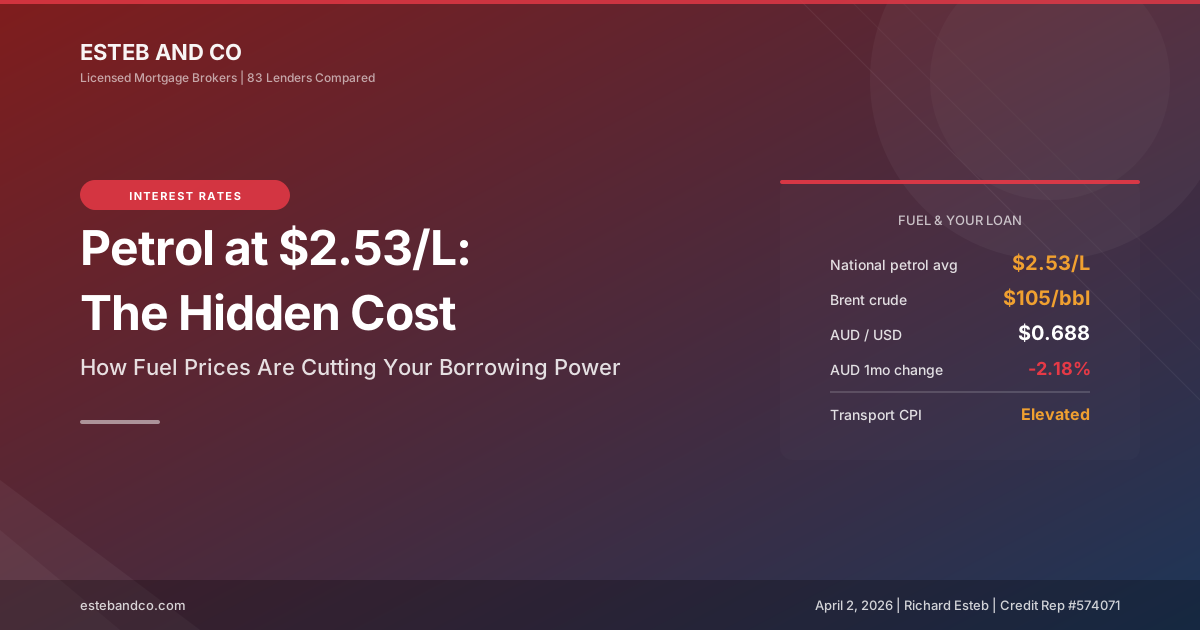
If you’ve filled up lately, you already know. National average unleaded hit $2.53 per litre in late March 2026 — and it got worse before it got better.
City-by-city, here’s what Australians were paying before the April 1 excise cut:
| City | Average Unleaded (late March) |
|---|---|
| Sydney | $2.44 – $2.51 |
| Melbourne | $2.53 |
| Brisbane | $2.49 |
| Perth | $2.57 |
| Darwin | $2.57 |
The cause is not domestic. Brent crude surged above $105 per barrel — and briefly hit $109 on April 2 — driven by the Iran conflict and Strait of Hormuz shipping disruptions. The IEA has called this the largest supply disruption in the history of the global oil market.
Making it worse: the Australian dollar is sitting at $0.688 USD. Oil is priced in US dollars, so a weaker Aussie dollar means we pay even more at the pump.
Why Your Finance Broker Cares About Oil Prices
You might think petrol prices and home loans are unrelated. They’re not. Fuel prices affect your mortgage in three direct ways:
- Your living expenses go up — lenders assess your ability to repay based on what it costs you to live. Higher fuel costs mean higher expenses, which means less room for mortgage repayments.
- Inflation stays hotter for longer — transport costs feed into everything: food delivery, tradies, logistics, childcare transport. This keeps CPI elevated, which keeps the RBA hawkish.
- The RBA is less likely to cut rates — the February CPI came in at 3.7% annual, with transport a major contributor. Until that falls back into the 2–3% band, rate cuts are off the table.
How Fuel Costs Reduce Your Borrowing Power
When you apply for a home loan, lenders don’t just look at your income. They compare your income against your living expenses using either your actual declared expenses or the HEM (Household Expenditure Measure) benchmark — whichever is higher.
HEM benchmarks are updated by the Melbourne Institute using ABS data, and they include transport costs. When fuel prices surge, these benchmarks rise at the next quarterly update.
Here’s the practical impact for a couple with two children:
| Scenario | Monthly Transport Cost | Borrowing Power Impact |
|---|---|---|
| Pre-oil shock (mid 2025) | ~$320/month | Baseline |
| Current ($2.53/L) | ~$440/month | −$22,000 |
| If fuel hits $3.00/L | ~$510/month | −$35,000 |
Based on a household driving 30,000km/year across two vehicles at 10L/100km, assessed at current variable rates with a 3% serviceability buffer.
That’s $22,000 less you can borrow — not because your income changed, but because the cost of driving to work went up.
The Fuel → Inflation → RBA Connection
Here’s the chain reaction that connects the Strait of Hormuz to your mortgage repayment:
Iran conflict disrupts oil supply
↓ Brent crude above $105/barrel
↓ Weak AUD ($0.688) amplifies the cost
↓ Petrol hits $2.53/L nationally
↓ Transport component of CPI surges
↓ ABS CPI stays at 3.7% (target is 2–3%)
↓ RBA keeps rates at 4.10% or hikes again in May
↓ Your variable rate stays at 5.50–6.50%
The RBA has been explicit. Governor Bullock cited the Middle East conflict and fuel prices as a key reason for the March hike. The March statement flagged “material risk that inflation will remain above target for longer than previously anticipated.”
The next RBA decision is May 5, 2026. If oil stays above $100 and the March quarter CPI (due April 29) comes in hot, another hike is on the table.
Will the Fuel Excise Cut Actually Help?
On April 1, the government halved the fuel excise from 52.6c/L to 26.3c/L. That should save you around 20–25c per litre at the pump (not all retailers pass it through immediately).
For a household spending $440/month on fuel, that’s roughly $50–60/month in savings. Meaningful at the pump, but there are two catches:
- It expires June 30. Lenders assess your ongoing expenses, not temporary government subsidies. No bank is going to increase your borrowing power because of a 3-month excise holiday.
- It won’t fix inflation. The RBA looks through temporary government measures when assessing underlying inflation. The excise cut mechanically reduces headline CPI but doesn’t change the RBA’s rate path.
Worried about how rising costs affect your borrowing power?
We compare 50 lenders in 60 seconds. No cost to start, no credit check at this stage.
Check My Borrowing PowerWhat to Do Right Now
1. Get your application in before HEM benchmarks update
HEM benchmarks are updated quarterly. If you’re planning to buy, getting your application assessed now means it’s evaluated against current living expense benchmarks — before any fuel-driven increases hit.
2. Declare actual expenses (if they’re lower than HEM)
If you work from home, drive an EV, or have low transport costs, make sure your broker knows. Lenders use the higher of HEM or your declared expenses. If your real costs are below HEM, declaring them accurately can preserve your borrowing power.
3. Consider non-bank lenders with lower buffers
APRA-regulated banks must assess you at your rate + 3.00%. Non-bank lenders use a 2.00–2.75% buffer. On a $600,000 loan, that difference can mean $50,000–$80,000 more borrowing capacity — enough to offset the fuel cost squeeze entirely.
4. Lock in a pre-approval before May 5
The next RBA decision is May 5. If rates go up again, your borrowing power shrinks further. A pre-approval locks in your capacity at today’s assessment rate for 90 days.
Frequently Asked Questions
How do fuel prices affect home loan applications?
Lenders use HEM (Household Expenditure Measure) benchmarks that include transport costs. When fuel prices rise, these benchmarks increase, meaning lenders assume you spend more on living costs — which reduces the amount they’ll lend you.
Will the fuel excise cut help my borrowing power?
Not directly. The 26.3c/L excise cut from April 1 provides temporary relief at the pump, but lenders look at underlying costs, not temporary government subsidies. It expires June 30, so lenders won’t factor it into long-term assessments.
Why is petrol so expensive in Australia right now?
Brent crude oil surged above $105/barrel due to the Iran conflict disrupting shipping through the Strait of Hormuz. The weak Australian dollar ($0.688 USD) makes it worse since oil is priced in US dollars.
Will fuel prices come down in 2026?
It depends entirely on the Iran situation. If the conflict de-escalates and shipping lanes reopen, prices could fall quickly. If it drags on, the IEA warns of sustained high prices through 2026. The fuel excise cut provides temporary relief until June 30.
Disclaimer: This article provides general information only and does not constitute financial advice. Your personal circumstances may differ. Esteb & Co Pty Ltd (ACN 690 323 687). Credit Representative #574070 is authorised under Australian Credit Licence #389328 held by Connective Credit Services Pty Ltd. Credit Representative Richard Esteb #574071.
See where you stand
Compare your options across our panel of 50 lenders in about 2 minutes. Free, and it won’t affect your credit score.
Start complimentary assessment →No obligation · Richard Esteb, Credit Rep #574071
Richard Esteb
Ricky founded Esteb & Co to give everyday Australians access to the same loan comparison technology used by the big banks. He compares products from a panel of 50 lenders to find the right fit for each client’s situation.