Trump Tariffs, a Weak Dollar, and Your Mortgage: What Australian Borrowers Need to Know

In this article
The Tariff Situation in 60 Seconds
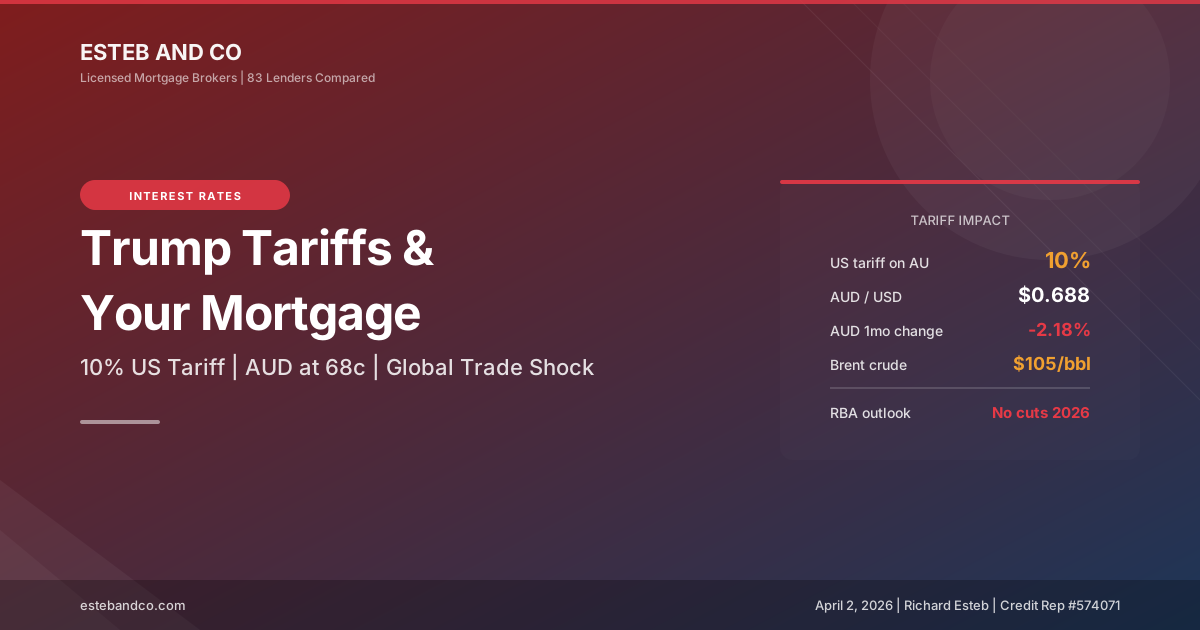
Here’s where Australia stands with US trade policy as of April 2026:
- 10% baseline tariff on most Australian exports to the US
- 50% tariff on steel and aluminium — hitting our mining sector hard
- Key affected exports: beef, wine, machinery, pharmaceuticals, aluminium, critical minerals
The original “reciprocal tariffs” were struck down by the US Supreme Court in February 2026 under IEEPA challenges. Trump replaced them with a flat 10% global tariff that applies to virtually all trading partners.
For Australia, this means reduced export revenue, business uncertainty, and pressure on the dollar. None of which helps borrowers.
The Weak Dollar Problem
The Australian dollar is trading at $0.688 USD — down 2.18% over the past month. A weaker dollar is not just a number on a screen. It has real consequences for your cost of living and your mortgage:
| What Gets More Expensive | Why It Matters for Mortgages |
|---|---|
| Fuel (oil priced in USD) | Higher transport costs → higher HEM benchmarks → less borrowing power |
| Imported goods (electronics, vehicles, clothing) | Higher CPI → RBA keeps rates elevated |
| Overseas lender funding | Some Australian lenders raise capital in USD markets. Weaker AUD = higher funding costs = higher rates passed to you |
| Building materials | Construction loan costs rise → project budgets blow out |
The compounding effect is what matters. A weak dollar doesn’t just make one thing more expensive — it makes everything more expensive simultaneously, which feeds into the inflation numbers the RBA watches obsessively.
How Global Trade Hits Your Mortgage
The connection between a trade war in Washington and your home loan in Brisbane runs through three channels:
Channel 1: Inflation stays sticky
ABS data shows annual CPI at 3.7% (February 2026), with trimmed mean inflation at 3.3%. Both are well above the RBA’s 2–3% target band. Tariffs add import cost pressure on top of the existing oil shock, making it harder for inflation to fall back to target.
Until CPI is sustainably below 3%, the RBA will not cut rates. That means your variable rate stays at 5.50–6.50% for the foreseeable future.
Channel 2: Business confidence drops
Australian businesses that export to the US — or compete with US-tariffed imports — face uncertainty. Uncertainty means less hiring, less investment, and a weaker economy. If unemployment rises beyond the current 4.3%, some borrowers will face genuine hardship.
Channel 3: The dollar drags down rate relief
Even if the RBA wanted to cut rates to stimulate the economy, cutting rates with a dollar at $0.688 would push it even lower — making imports more expensive and inflation worse. The weak dollar effectively traps the RBA at current settings.
The Stagflation Scenario Nobody Wants
Economists are increasingly using the word stagflation — an economy where growth stalls but prices keep rising. That’s the worst-case scenario for mortgage holders because:
- Wages don’t keep up: ABS wage growth is 3.4% but CPI is 3.7%. Real wages are going backwards.
- Rates stay high: The RBA can’t cut because inflation is above target.
- Cost of living rises: Fuel, groceries, utilities — all up.
- Jobs get less secure: Unemployment ticked up to 4.3% in February.
Governor Bullock has acknowledged the tension directly: “The Board is aware that the economy is slowing, but our primary mandate is price stability.” Translation: even if unemployment rises further, don’t expect rate cuts while inflation is above 3%.
Two Bright Spots for Borrowers
It’s not all bad news. Two developments are working in borrowers’ favour:
1. EU-Australia Free Trade Agreement (signed March 24)
The new EU-Australia trade deal removes most tariffs between the two blocs. This opens up alternative export markets and gives Australia’s economy a counterweight to US trade restrictions. It should support the dollar and business confidence over the medium term.
2. Lender competition is fierce
Despite the RBA holding rates high, non-bank lenders are competing aggressively for market share. The gap between the highest and lowest variable rates across our 82-lender panel is over 1.50%. On a $600,000 loan, that’s a difference of $580/month.
The banks want to keep you at 6.00%+. The non-banks want your business at 5.54%. The difference is real.
Are you overpaying on your mortgage?
Compare rates from 50 lenders in 60 seconds. No cost to start, no credit check at this stage.
Compare My OptionsWhat to Do About It
1. Don’t wait for rate cuts
Markets are pricing in roughly zero chance of a rate cut before late 2026 at the earliest. If your plan depends on rates falling, you need a Plan B. Act on today’s rates, not hypothetical future ones.
2. Refinance now if you’re on a loyalty rate
The average existing borrower is paying 0.50–1.50% more than new customers at the same bank. On a $600,000 loan, switching from 6.50% to 5.54% saves $370/month — that’s $4,440/year. In a cost-of-living crisis, that money matters.
3. Consider fixing part of your loan
Current 2-year fixed rates sit around 5.79–6.09%. If the RBA hikes again at the May 5 meeting, variable rates will move higher. Fixing part of your loan provides certainty on that portion, while keeping the rest variable in case rates eventually fall.
4. If you’re buying, move before May 5
Every RBA hike reduces your borrowing power. Get pre-approved now at current assessment rates. A pre-approval locks in your capacity for 90 days, protecting you from the next potential move.
Frequently Asked Questions
How do US tariffs affect Australian home loans?
Tariffs weaken the Australian dollar and push up the cost of imports. A weaker dollar means higher fuel and goods prices, which feeds into inflation. Higher inflation makes it harder for the RBA to cut rates, keeping mortgage rates elevated for longer.
Will the RBA cut rates if the economy slows from tariffs?
This is the dilemma. Tariffs slow economic growth but also push up prices (stagflation). The RBA has said it will prioritise fighting inflation, which means rate cuts are unlikely even if the economy weakens, as long as CPI remains above the 2–3% target.
Does the weak Australian dollar affect my mortgage?
Indirectly, yes. A weaker AUD makes imports more expensive, especially fuel (priced in USD). This increases your cost of living and keeps inflation higher, which means the RBA is less likely to cut rates. It also means lender funding costs from overseas markets increase.
Should I fix my rate because of global uncertainty?
Fixing provides certainty against further hikes. Current 2-year fixed rates around 5.79–6.09% protect you if the RBA hikes again in May. But if you think rates have peaked, variable gives you the benefit of future cuts. A split loan (part fixed, part variable) hedges both scenarios.
Disclaimer: This article provides general information only and does not constitute financial advice. Your personal circumstances may differ. Esteb & Co Pty Ltd (ACN 690 323 687). Credit Representative #574070 is authorised under Australian Credit Licence #389328 held by Connective Credit Services Pty Ltd. Credit Representative Richard Esteb #574071.
See where you stand
Compare your options across our panel of 50 lenders in about 2 minutes. Free, and it won’t affect your credit score.
Start complimentary assessment →No obligation · Richard Esteb, Credit Rep #574071
Richard Esteb
Ricky founded Esteb & Co to give everyday Australians access to the same loan comparison technology used by the big banks. He compares products from a panel of 50 lenders to find the right fit for each client’s situation.