RBA Hikes Cash Rate to 4.10%: What Every Borrower Needs to Do Now

In this article
What Happened on March 17
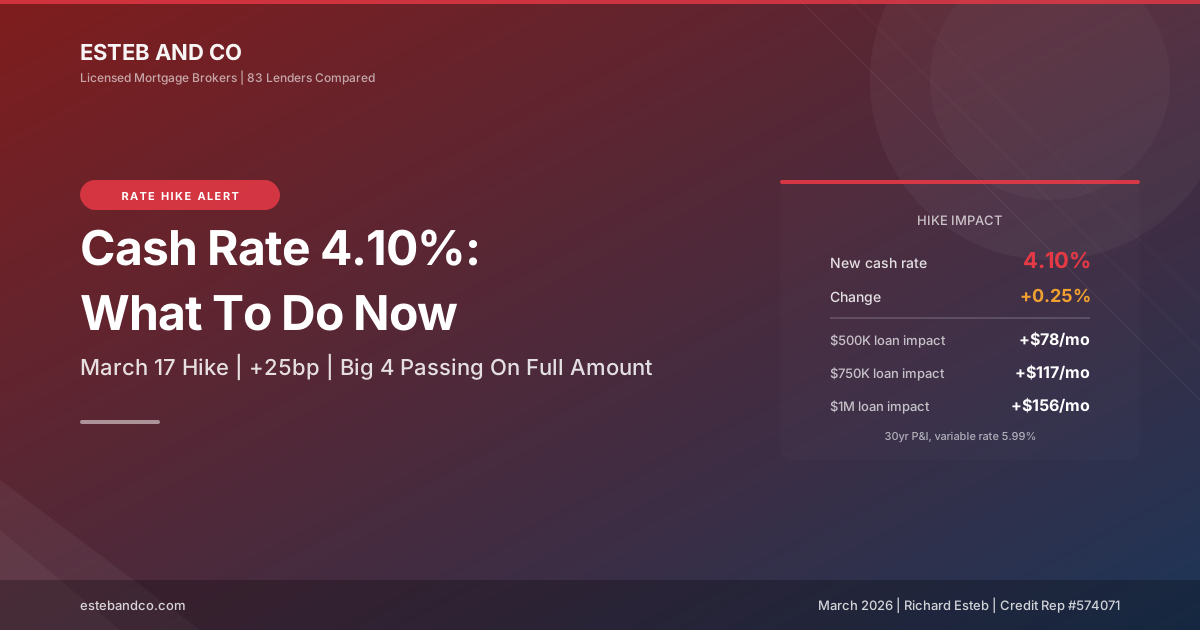
The Reserve Bank of Australia lifted the cash rate by 25 basis points to 4.10% on March 17, 2026. This is the second consecutive hike after February's increase from 3.60% to 3.85%, marking the most aggressive tightening cycle since 2023.
The decision was split 5 to 4 — the closest vote in years. Four board members wanted to hold. Five decided the inflation data demanded action. RBA Governor Michele Bullock pointed to two factors:
- Inflation reaccelerated in the second half of 2025, with capacity pressures building faster than expected
- The Middle East conflict has driven fuel prices sharply higher, adding a new inflationary force that could persist
For borrowers, this means your repayments are going up again. But it also means lender competition is intensifying — and that creates opportunities.
How Every Major Bank Responded
All four major banks have confirmed they are passing on the full 0.25% increase:
- NAB — effective March 27
- CBA — effective March 27
- ANZ — effective March 27
- Westpac — effective March 31
Smaller banks and non-bank lenders typically take 14 to 16 days to announce their response. Some may not pass on the full increase, particularly non-banks competing for market share.
Post-Hike Rate Comparison: March 2026
Here is what the major lenders are offering after the hike. These are the lowest advertised variable rates for new borrowers.
| Lender | Owner Occupied | Investment | Type |
|---|---|---|---|
| La Trobe Financial | 5.54% | 5.84% | Non-bank |
| Macquarie Bank | 5.59% | 5.89% | Non-bank |
| Westpac | 5.74% | 5.79% | Bank |
| ANZ | 5.76% | 5.95% | Bank |
| Bankwest | 5.84% | 6.14% | Bank |
| ING | 5.89% | 6.19% | Non-bank |
| Suncorp | 5.89% | 6.19% | Bank |
| CBA | 5.99% | 6.09% | Bank |
| NAB | 5.99% | 6.29% | Bank |
| Liberty | 6.24% | 6.54% | Non-bank |
| Pepper Money | 6.39% | 6.69% | Non-bank |
Rates effective March 27, 2026. Your actual rate depends on LVR, loan amount, and credit profile. Compare your personalised options here.
What This Costs You Per Month
On the average Australian home loan of $736,000, each 0.25% increase adds roughly $120 per month. The cumulative impact of the back-to-back hikes from 3.60% to 4.10% is significant:
| Loan Size | Monthly Increase (0.25%) | Annual Extra Cost | Total Since 3.60% |
|---|---|---|---|
| $400,000 | +$65 | +$780 | +$1,560 |
| $600,000 | +$97 | +$1,164 | +$2,328 |
| $750,000 | +$122 | +$1,464 | +$2,928 |
| $1,000,000 | +$163 | +$1,956 | +$3,912 |
Why Non-Bank Lenders Matter More Than Ever
Look at the rate table above. The lowest rate is 5.54% from La Trobe Financial — a non-bank lender — not from any of the Big 4. Macquarie at 5.59% also undercuts every major bank.
But rates are only half the story. Non-bank lenders also use a lower serviceability buffer:
- Major banks (APRA-regulated): Must assess you at your rate + 3.00% buffer = ~8.76% assessment rate
- Non-banks: Use a 2.00–2.75% buffer = ~7.54–8.29% assessment rate
That lower buffer means you could borrow $50,000 to $100,000 more through a non-bank than a major bank, even with the same income and expenses.
This is not about taking on more risk. These are the same quality loans, assessed against the same credit criteria. The difference is regulatory: APRA applies a conservative buffer to banks that non-banks are not required to follow.
Want to see what non-bank rates you qualify for?
We compare 50 lenders in 60 seconds. No cost to start, no credit check at this stage.
Compare My Options3 Things to Do This Week
1. Check your current rate
Log into your banking app and check what you are actually paying. If your variable rate is above 6.50%, you are almost certainly overpaying. Many borrowers on loyalty rates are paying 0.50% to 1.50% more than new customers at the same bank.
2. Compare across the whole market
Do not just call your bank and ask for a discount. Compare across banks and non-banks. A broker can access rates from 50 lenders in minutes. Even a 0.50% reduction on a $600,000 loan saves you $3,000 per year.
3. Lock in a pre-approval before the next move
If you are buying, get pre-approved now. Pre-approvals are assessed at today’s assessment rate. If the RBA hikes again later this year, your borrowing power could shrink. A pre-approval locks in your capacity at current levels for 90 days.
Frequently Asked Questions
Will there be another rate hike in 2026?
It depends on the March quarter CPI data due in late April. If trimmed mean inflation stays above 3.3%, another hike in May or June is possible. Markets are pricing in roughly a 40% chance of one more increase this year.
Should I fix my rate?
Fixing provides certainty but current fixed rates (5.79%–6.09%) are not dramatically lower than variable rates. If you think rates will keep rising, fixing protects you. If you think this is close to the peak, variable gives you the benefit of future cuts. Many borrowers split their loan — part fixed, part variable — as a hedge.
Will my bank automatically increase my rate?
Yes. Variable rate customers will see their rate increase automatically on the effective date (March 27 for most banks, March 31 for Westpac). You do not need to do anything — it happens automatically. Your next repayment will reflect the higher rate.
Can I negotiate a lower rate with my bank?
Yes, but you need leverage. Call your bank’s retention team and tell them you have a better offer elsewhere. Having a genuine comparison from a broker strengthens your position. Banks regularly discount by 0.20%–0.50% to retain customers who threaten to leave.
How do non-bank lenders compare on safety?
Non-bank lenders like Macquarie, La Trobe, and Pepper are regulated by ASIC and must comply with responsible lending laws. Your loan is secured against your property regardless of the lender. The main difference is they are not covered by the government deposit guarantee — but that applies to savings accounts, not home loans.
Disclaimer: This article provides general information only and does not constitute financial advice. Your personal circumstances may differ. Esteb & Co Pty Ltd (ACN 690 323 687). Credit Representative #574070 is authorised under Australian Credit Licence #389328 held by Connective Credit Services Pty Ltd. Credit Representative Richard Esteb #574071.
See where you stand
Compare your options across our panel of 50 lenders in about 2 minutes. Free, and it won’t affect your credit score.
Start complimentary assessment →No obligation · Richard Esteb, Credit Rep #574071
Richard Esteb
Ricky founded Esteb & Co to give everyday Australians access to the same loan comparison technology used by the big banks. He compares products from a panel of 50 lenders to find the right fit for each client’s situation.