
Note: This is a template article for co-branding with a local accountant. Replace [Accountant Name], [Firm Name], and [Accountant Quote] placeholders before publishing. Schedule for May/June 2026 ahead of EOFY.
Why Your Tax Return Matters More Than You Think
Your most recent tax return is the single most important document in a loan application for self-employed borrowers. Lenders use it to verify your income, calculate your borrowing power, and assess risk. What you claim and how you structure your return directly affects how much you can borrow.
We asked [Accountant Name] from [Firm Name] to co-author this guide because we see the same problem every tax season: clients who aggressively minimise their taxable income for tax purposes, then come to us wanting a $600,000 home loan. The numbers do not work.
The Tax Minimisation Trap
[Accountant Name]: "As accountants, our job is to legally minimise your tax. But if you're planning to apply for a loan in the next 12 months, we need to have that conversation first. There's a balance between paying less tax and showing enough income to qualify for the loan you want."
Ricky: "I see this constantly. A self-employed client earns $180,000 in revenue but declares $65,000 in taxable income after deductions. Legitimate deductions — but now they can only borrow $350,000 instead of $650,000. If they'd declared $120,000, the loan would be approved."
What to do if you are planning to borrow
- Talk to your accountant AND your broker BEFORE lodging your return
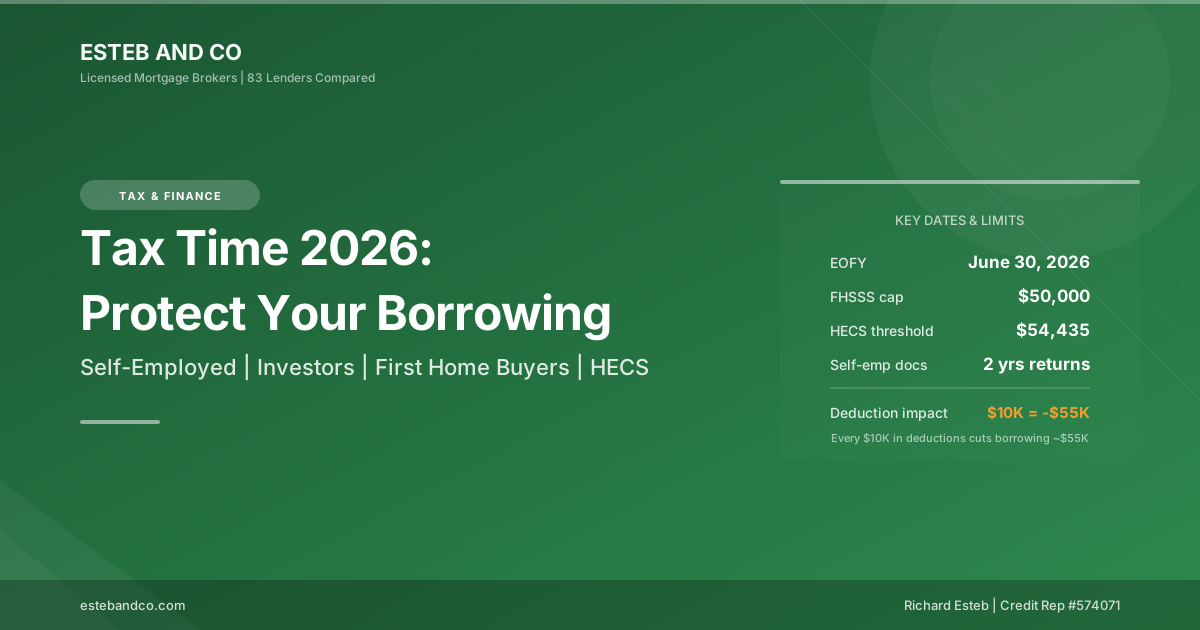
- Understand the trade-off: every $10,000 in extra deductions reduces borrowing power by roughly $50,000-$60,000
- Consider deferring discretionary deductions by one year if you are applying for a loan this financial year
- For self-employed: 2 years of tax returns are typically required. Plan ahead — this year's return and next year's both matter
Investment Property Owners: What You Can and Cannot Claim
[Accountant Name]:
- Deductible: Loan interest (investment only), property management fees, repairs and maintenance, depreciation, council rates, insurance, land tax
- NOT deductible: Principal repayments, renovations that improve (not repair), owner-occupied loan interest
- Commonly missed: Depreciation schedules on newer properties, travel to inspect the property (if > 2 hours from home), borrowing costs spread over 5 years
Ricky: "If you're negatively gearing an investment property, keep in mind that lenders only count 80% of rental income in your serviceability assessment. So a property that costs you $500/week in repayments but earns $400/week in rent actually hurts your borrowing power for additional loans."
HECS/HELP Debt and Borrowing Power
HECS repayments are factored into your serviceability assessment by every lender. The current repayment thresholds and rates for 2025-26 are:
| Income Range | Repayment Rate | Monthly Impact |
|---|---|---|
| $54,435 - $62,850 | 1.0% | $45 - $52 |
| $62,851 - $66,620 | 2.0% | $105 - $111 |
| $66,621 - $70,618 | 2.5% | $139 - $147 |
| $70,619 - $74,855 | 3.0% | $176 - $187 |
| $100,000+ | 5.0-10.0% | $417+ |
Tip: If your HECS balance is small (under $10,000) and you have savings, consider paying it off before applying for a loan. Removing the HECS repayment from your serviceability calculation can increase your borrowing power by $40,000-$60,000.
First Home Buyer Super Saver Scheme (FHSSS)
If you have been making voluntary super contributions to save for a deposit, you can withdraw up to $50,000 under the FHSSS. Critical timing: You must apply for a FHSSS determination from the ATO before signing a contract to purchase. If you sign first and apply second, you are ineligible.
Action Steps Before June 30
- If planning to borrow: Call your accountant and your broker before lodging your return
- If self-employed: Ensure your BAS is up to date — lenders check for consistency between BAS and tax returns
- If you have investment property: Get a depreciation schedule if you do not have one — it is a guaranteed deduction
- If you have HECS: Calculate whether paying it off improves your borrowing position more than keeping the cash
- If you are a first home buyer: Apply for FHSSS determination before you start seriously looking
Not sure how your tax position affects your borrowing power?
Free comparison from 105 lenders. 60 seconds. No credit check.
Check My Borrowing PowerFAQ
Does my tax return affect my home loan application?
Yes. Lenders use your most recent 1-2 tax returns to verify income. For PAYG employees, payslips are usually sufficient. For self-employed borrowers, complete tax returns (including all schedules) are required. The amount of taxable income directly determines how much you can borrow.
Can I claim mortgage interest on my tax return?
Only if the property is an investment property that is rented or genuinely available for rent. Owner-occupied home loan interest is NOT tax deductible in Australia.
Should I minimise my taxable income before applying for a loan?
No — this is the biggest mistake self-employed borrowers make. Lenders assess borrowing power based on taxable income. Talk to both your accountant and broker before lodging if you plan to apply for a loan within 12 months.
How does HECS affect my borrowing power?
HECS repayments reduce your disposable income in the lender's serviceability calculation. Depending on your income, this can reduce borrowing power by $40,000-$80,000.