Investor Lending Record $42.9B: Which Lenders Still Write 95% LVR in April 2026

In this article
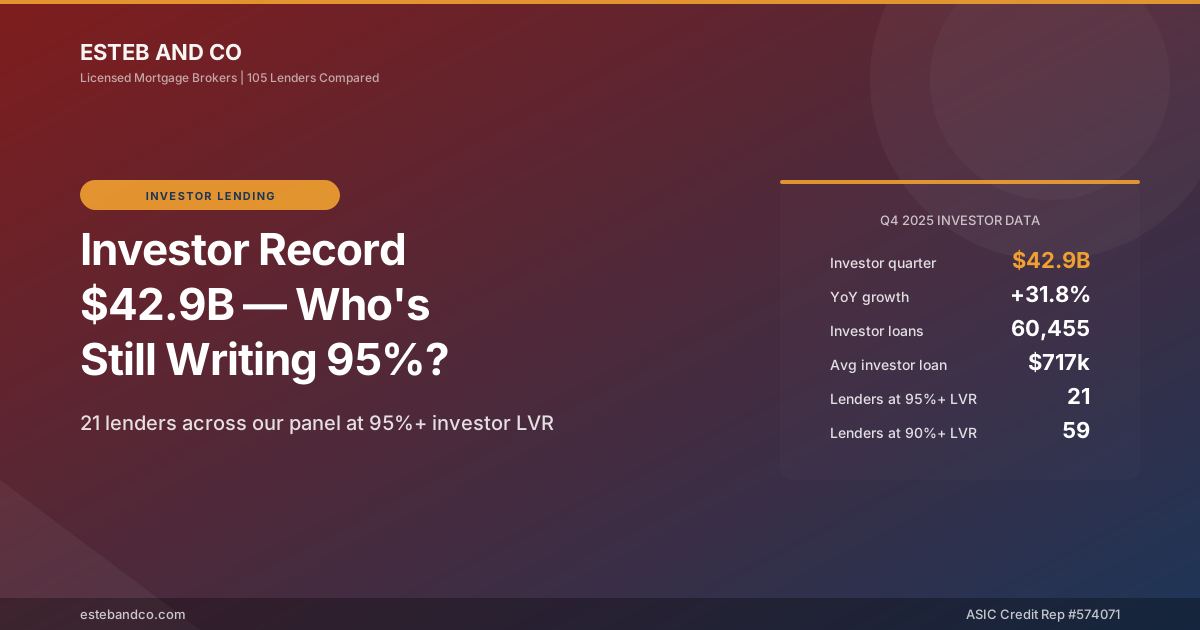
The ABS Lending Indicators release for December Quarter 2025 (published 23 February 2026) landed one of the cleanest signals we've seen in years on Australian investor lending: a record $42.9 billion quarter, up 31.8% year-on-year, across 60,455 loans at an average size of $717,000.
That's not a gentle uptick. That's investor demand back at cycle peaks — with a 4.10% cash rate, a market average variable rate above 5.74%, and an APRA 3% serviceability buffer still in place. The appetite is there. The question for most investor borrowers in April 2026 is simpler: which lender will actually write the file?
This post walks through every lender on Esteb and Co's 50-lender panel that currently supports investor home loans at 90% LVR or higher. The data comes from the lender_policies table we maintain from monthly Connective policy-matrix imports — the same data our matching engine runs against for every client file.
The record: what $42.9B means
Two forces underneath the number. First, the rental-yield gap: Q1 2026 metro capital-city gross yields sit around 3.5–4.2%, which against mortgage rates of 6.0–6.5% looks negative on paper — but combined with depreciation, negative gearing, and capital-growth expectations, the after-tax picture still pencils for higher-income investors. Second, the "too many buyers chasing too few properties" effect — FHB demand alone drove a 6.8% quarterly rise in FHB loans, and investors are competing in the same listings.
The upshot: demand is there. Supply of lenders willing to write high-LVR investor files, on the other hand, has been getting tighter since 2023.
The LVR story: why 95% matters
LVR on an investor file does two things. It determines whether the loan needs Lenders Mortgage Insurance (below 80% LVR, no LMI; above 80%, LMI applies). And it sets the pricing tier — every additional 5% of LVR typically costs 10–30 basis points more on the interest rate.
For an investor with strong servicing but thin cash deposit, writing at 95% rather than 80% is the difference between buying now and buying in 18 months. An $800,000 investor property needs a $160,000 deposit at 80%, a $120,000 deposit at 85%, an $80,000 deposit at 90%, and $40,000 deposit at 95%. Plus LMI of roughly $10–35,000 depending on LVR and loan size.
So the question of who still writes 95% investor is really the question of who still lets investors use equity-thin positions. Here's the picture across our panel.
| Investor LVR band | Lenders on panel |
|---|---|
| 95% or higher | 21 |
| 90–94% | 38 |
| 85–89% | 1 |
| 80–84% | 3 |
| Below 80% | 1 |
59 of the 64 lenders where we have current policy data are at 90%+ investor LVR — so the tier is not as thin as trade press often suggests. But the ones at 95%+ cluster into two distinct camps, and knowing which camp your file fits determines everything.
The 21 lenders at 95%+ investor LVR
Sorted by LVR, then by DTI cap, then by turnaround. All figures are current as at 20 April 2026.
| Lender | Type | Inv LVR | DTI cap | Turnaround |
|---|---|---|---|---|
| Credit Union SA | Credit Union | 97% | 6.5x | 9 days |
| Liberty Financial | Non-Bank | 95% | 7.5x | 8 days |
| Bankwest | Major Bank | 95% | 7.0x | 7 days |
| Bank of Melbourne | Major Bank | 95% | 7.0x | 9 days |
| Commonwealth Bank | Big 4 Bank | 95% | 7.0x | 9 days |
| ANZ | Big 4 Bank | 95% | 7.0x | 10 days |
| Resimac | Non-Bank | 95% | 7.0x | 13 days |
| Bank of Queensland | Regional | 95% | 7.0x | 14 days |
| Granite Home Loans | Non-Bank | 95% | 7.0x | 14 days |
| Firefighters Mutual Bank | Mutual | 95% | 6.5x | 9 days |
| MyState | Mutual | 95% | 6.5x | 9 days |
| Health Professionals Bank | Mutual | 95% | 6.5x | 10 days |
| GMCU | Credit Union | 95% | 6.5x | 11 days |
| QBANK | Mutual | 95% | 6.5x | 11 days |
| Hejaz Financial Services | Specialist | 95% | 6.5x | 14 days |
| Newcastle Permanent | Mutual | 95% | 6.5x | 14 days |
| Queensland Country Bank | Regional | 95% | 6.5x | 14 days |
| Teachers Mutual Bank | Mutual | 95% | 6.5x | 15 days |
| UniBank | Mutual | 95% | 6.5x | 17 days |
Three observations:
Credit Union SA is the outlier. 97% investor LVR is the highest on panel by 200bps. It's a single-state credit union by origin (now with broader availability) but its investor policy is the sharpest for equity-thin files.
Liberty Financial is the only lender combining 95% LVR with 7.5x DTI. Every other lender at 95% caps DTI at 7.0x or 6.5x. If your investor file is income-heavy but debt-thin, Liberty's combination is unique.
Big 4 are in, but they're not market-leading. CBA and ANZ both support 95% investor LVR at 7.0x DTI — reasonable policy. Westpac and NAB are notable absences from the 95% tier (they cap at 90% investor). Bankwest (CBA-owned) and Bank of Melbourne (Westpac-owned) stay in via their subsidiary positions.
DTI caps: where 95% gets tight
Debt-to-Income ratio is where high-LVR investor files most commonly fall over. For a typical Sydney investor file with a $250k household income and $1.2m of existing debt, the DTI is 4.8x — fine everywhere. But once you add a new $800k investor loan, the DTI jumps to 8.0x — which only three lenders on our panel accept, and none of them at 95% LVR.
Here's the DTI distribution at 95%+ investor LVR:
| DTI cap | Lenders | Where they sit |
|---|---|---|
| 7.5x | 1 | Liberty Financial |
| 7.0x | 8 | CBA, ANZ, Bankwest, Bank of Melbourne, BoQ, Granite, Resimac |
| 6.5x | 10 | Mutual bank group, CUSA (97%), MyState, Newcastle Permanent, QCB, Hejaz |
The 6.5x cap is the binding constraint for most mutual-bank investor files. If your household DTI is sitting above 6.5x, the entire customer-owned mutual sector is closed — which means losing access to the cheapest variable rates on panel and being forced into Big 4 or non-bank pricing.
High-DTI investor specialists (where 95% isn't the constraint)
If the binding constraint is DTI rather than LVR, the specialist non-banks become relevant. At 90% investor LVR, the DTI space opens up materially:
| Lender | Inv LVR | DTI cap | Turnaround |
|---|---|---|---|
| Pepper Money | 90% | 8.0x | 12 days |
| Pepper Money Multi-Product | 90% | 8.0x | 5 days |
| RedZed | 90% | 8.0x | 12 days |
These three are the only lenders on our panel combining 90%+ investor LVR with an 8.0x DTI cap. Pricing reflects the risk appetite — rates typically 100–250bps above the mutual-bank tier — but for investors whose file needs both high LVR and high DTI, this is the only route.
Turnaround matters: auction-ready investor files
Investor purchases often happen at auction, where settlement timelines are fixed and unconditional-approval speed determines whether you can bid. Of the 21 lenders at 95%+ investor LVR, the fastest turnaround options are:
- Bankwest — 7 days
- Liberty Financial — 8 days
- Bank of Melbourne — 9 days
- Commonwealth Bank — 9 days
- Credit Union SA — 9 days
- Firefighters Mutual Bank — 9 days
- MyState — 9 days
For auction buyers, the 2-week turnaround at UniBank, Newcastle Permanent and QCB is the constraint. The 5-day turnaround at Pepper Money Multi-Product is the fastest on panel for 90%+ LVR investor files — worth knowing if speed matters more than price.
What it means if you're writing an investor file now
If you're a first-time investor with clean credit and strong income (DTI < 6.5x): the cheapest options are mutual banks at 95% LVR. Queensland Country Bank, MyState, or the Mutual Bank Ltd divisions (Firefighters, Health Professionals, Teachers, UniBank, QBANK). You'll pay 5.64–5.84% variable vs Big 4 at 5.99–6.19%.
If you're a multi-property investor with DTI 6.5–7.0x: the Big 4 stay in — CBA and ANZ both write at 7.0x DTI at 95% LVR. Bankwest and Bank of Melbourne are cheaper alternatives at the same DTI cap.
If you're equity-strong but DTI-tight (DTI 7.0–8.0x): Liberty Financial is your 95% LVR option. If you can step down to 90% LVR, Pepper Money and RedZed open up at 8.0x DTI.
If you're buying at auction: don't bid until you have unconditional approval from a lender whose turnaround fits your settlement timeline. Bankwest at 7 days, Liberty at 8 days, or Pepper Multi-Product at 5 days are the speed options.
Frequently asked questions
What was the average investor loan size in Q4 2025?
$717,000 nationally. NSW investor loans averaged $873,000 (the only state above national average). Source: ABS Lending Indicators, December Quarter 2025.
Can I get 95% LVR on a second investment property?
Yes, but the lender pool narrows. Most 95% investor LVR lenders apply additional restrictions on files with two or more existing investment properties — including tighter DTI caps (usually 0.5x lower) and higher rental-income shading (typically 75% rather than 80%). The 21 lenders in this post are the starting pool; the actual fit for a 2nd-or-later investment file depends on your total existing-property exposure.
Why is Liberty the only 7.5x DTI lender at 95% LVR?
Liberty's product architecture differs from bank competitors — they price each file individually rather than using fixed product tiers. The 7.5x DTI at 95% LVR is a specific product configuration that only one other lender on the wider market (outside our panel) matches. See our full Liberty Financial profile for the 5-step qualifier tree.
How do rental income shading rules affect my borrowing capacity?
Lenders typically accept 75–80% of rental income toward serviceability (the shade covers vacancy, repairs, rates). A $600/week rental property thus contributes roughly $450–480/week to borrowing capacity rather than the full $600. That shade is applied BEFORE the DTI and DSR calcs — so on a tight investor file, rental shading can flip a "will write" lender into a decline.
See where you stand
Compare your options across our panel of 50 lenders in about 2 minutes. Free, and it won’t affect your credit score.
Start complimentary assessment →No obligation · Richard Esteb, Credit Rep #574071
Richard Esteb
Ricky founded Esteb & Co to give everyday Australians access to the same loan comparison technology used by the big banks. He compares products from a panel of 50 lenders to find the right fit for each client’s situation.