Cash Rate 4.10%: Which Lenders Passed the Hike Through — And Which Held (April 2026)

In this article
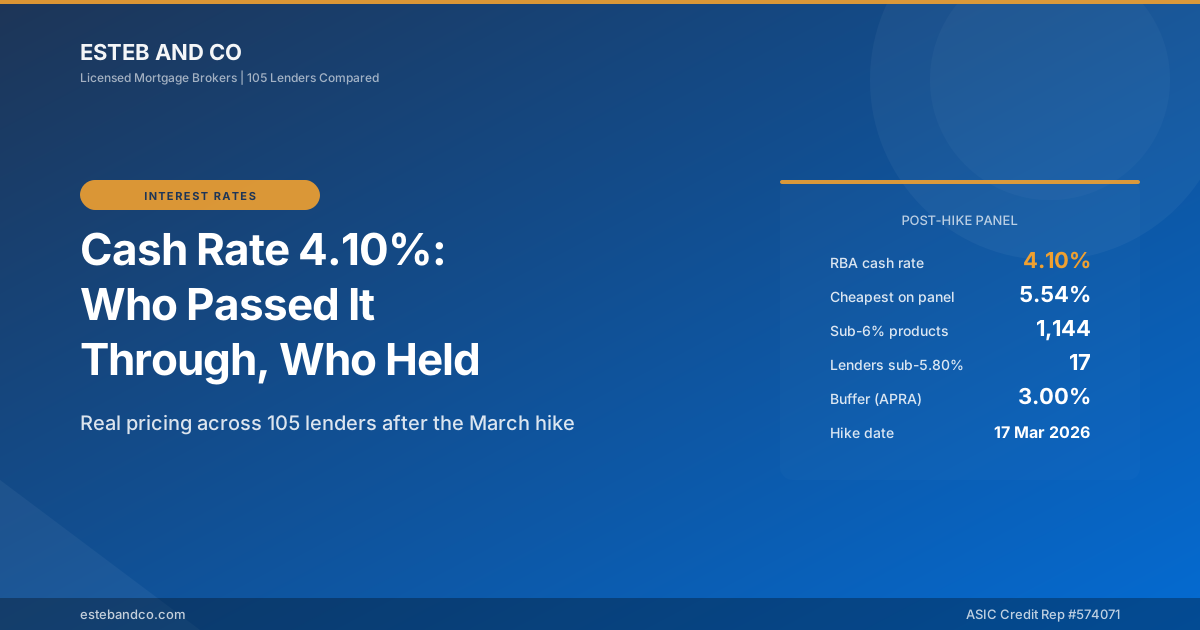
On 17 March 2026 the Reserve Bank of Australia lifted the cash rate target by 25 basis points to 4.10%, the second consecutive hike after February's move from 3.60% to 3.85%. The policy statement cited sticky services inflation and a tighter-than-expected labour market.
The natural question for borrowers: did the lender pass it through? Not all of them did. Not all at once. And the gap between the cheapest and the most expensive variable rate on our panel is now wider than at any point in 2025.
This post walks through what actually happened across the 50 lenders on our panel. All figures reflect product-matrix data current as at 20 April 2026 — so roughly four weeks after the hike, which is the typical window for the full reprice cycle to land.
The 17 March 2026 hike in 60 seconds
Two relevant numbers to anchor against:
If every lender had passed through both hikes in full, the ABS-level average variable would now sit around 5.99%. The actual picture on our panel is messier.
The pass-through question
We track ~12,500 individual variable-rate home loan products across the 50-lender panel (different LVR bands, purposes, offset / no-offset variants, package / basic variants). Of those, 1,144 products currently price below 6.00%. The distribution:
| Variable rate band | Products on panel | What it signals |
|---|---|---|
| Under 5.50% | 0 | Nobody held that hard |
| 5.50–5.79% | 155 | Customer-owned mutuals + a few sharp banks |
| 5.80–5.99% | 989 | Mid-tier + some Big 4 loss-leader products |
| 6.00–6.49% | 1,914 | Standard prime — most Big 4 and major banks here |
| 6.50–6.99% | 1,519 | Near-prime / higher LVR / package discount tier |
| 7.00–7.99% | 2,390 | Alt-doc, low-doc, investor higher-LVR |
| 8.00–8.99% | 1,795 | Specialist / credit-impaired / SMSF |
| 9.00%+ | 1,463 | Last-resort, private credit, non-conforming |
The interesting read is the top two bands. Pre-hike, the ABS market-average variable was 5.49%. A full 50bps pass-through (both hikes) would have pushed that to 5.99% — meaning nothing should be priced below ~5.74% for the strongest files. Yet we have 155 products at 5.50–5.79% and nearly 1,000 more at 5.80–5.99%. That's a lot of lenders who didn't pass through the full 50bps.
Who's cheapest on the panel right now
These are the 17 lenders with at least one variable-rate product priced below 5.80% as at 20 April 2026. Cheapest variable shown; most of these lenders have more expensive variants higher up the shelf.
| Lender | Type | Cheapest variable | Assessment rate | DTI cap |
|---|---|---|---|---|
| Queensland Country Bank | Mutual | 5.54% | 8.44% | 6.5x |
| UniBank | Mutual | 5.64% | 8.49% | 6.5x |
| Teachers Mutual Bank | Mutual | 5.64% | 8.49% | 6.5x |
| Firefighters Mutual Bank | Mutual | 5.64% | 8.49% | 6.5x |
| Health Professionals Bank | Mutual | 5.64% | 8.49% | 6.5x |
| Bank of China | Regional | 5.68% | 8.43% | 6.5x |
| Bank of Sydney | Regional | 5.69% | 8.39% | 6.5x |
| GMCU | Credit Union | 5.69% | 8.64% | 6.5x |
| HSBC | Regional | 5.69% | 8.69% | 7.0x |
| QBANK | Mutual | 5.74% | 8.49% | 6.5x |
| People's Choice Credit Union | Mutual | 5.74% | 8.49% | 6.5x |
| Newcastle Permanent | Mutual | 5.74% | 8.69% | 6.5x |
| BCU | Mutual | 5.74% | 8.49% | 6.5x |
| Heritage Bank | Mutual | 5.74% | 8.49% | 7.0x |
| Hume Bank | Mutual | 5.74% | 8.49% | 6.5x |
| ANZ | Big 4 Bank | 5.78% | 8.76% | 7.0x |
| Credit Union SA | Credit Union | 5.79% | 8.79% | 6.5x |
| Great Southern Bank | Mutual | 5.79% | 8.89% | 6.5x |
Thirteen of these 18 lenders are customer-owned mutuals or credit unions. Only one Big 4 bank (ANZ at 5.78%) sits in the sub-5.80% tier — and only on a specific loan-size and LVR configuration. The rest of the Big 4 start at 5.83% (Suncorp, Bank of QLD, ME all at 5.83%) or higher.
Why customer-owned mutuals held rates
Three structural reasons:
1. No shareholder dividend. Mutual banks and credit unions return surplus to members through pricing or lower fees rather than dividend yield. When funding costs rise, the options are: raise pricing, cut fees to the bone, or accept lower member surplus. Big 4 have a fourth: cut dividends — which is the politically least acceptable option. Mutuals don't have that pressure.
2. Smaller back book. A mutual with a $5–20B mortgage book can pass through a rate hike tactically (ie. only on new business) without broadcasting it to 500,000 existing variable-rate customers. Big 4 banks with $400–600B books can't hide the reprice — every customer gets the notification.
3. Mutual Bank Ltd cost synergies. Note that UniBank, Teachers Mutual, Firefighters Mutual and Health Professionals Bank all sit at exactly 5.64% with identical 8.49% assessment rates and 6.5x DTI caps. That's because they're all divisions of Mutual Bank Ltd — shared ADI, shared rate card, shared credit engine. One pricing decision covers four brands.
Assessment rates and the APRA 3% buffer
Headline variable rate isn't the whole picture. APRA requires every home-loan lender to assess serviceability at the product rate plus a buffer of at least 3 percentage points (APG 223, tightened in November 2021 from 2.5%). So a borrower taking a 5.54% variable is actually being tested at 8.54% (or the lender's minimum assessment rate, whichever is higher).
The cheapest 17 lenders have assessment rates from 8.39% (Bank of Sydney) to 8.89% (Great Southern Bank). The narrowness of that range — 50bps across 18 lenders — is the real pass-through story. Lenders can choose to hold headline rates but tighten assessment, which produces the same borrowing-capacity effect without the PR cost of a rate hike. A 10bps move in assessment rate cuts roughly $10,000–$15,000 off borrowing capacity on a typical $600k purchase.
The Big 4 assessment rates on cheapest products are higher still:
- CBA: 8.99%
- Westpac: 8.94%
- ANZ: 8.76%
- NAB: 8.94%
A customer moving from Big 4 to a mutual isn't just saving on headline rate — they're often picking up 30–50bps on assessment as well. That combination can add $40,000+ to borrowing capacity on a middle-income file.
What borrowers should do in April 2026
If you're variable-rate and haven't reviewed since February: your current lender almost certainly passed through the 25bps in March and may have added another 5–15bps on top via package reprice. A refinance comparison is worth running. Our 50-lender comparison and the portal matching engine both surface where you sit vs market.
If you're pre-approval shopping: the cheapest panel rates are in the mutual bank space. But pre-approval with a mutual often takes 9–15 days vs 5–7 at a Big 4 — build that into any auction or settlement timeline. Queensland Country Bank's 5.54% is legitimately the cheapest variable nationally, but the 14-day conditional approval is the tradeoff.
If you're considering fixing: 2-year fixed rates on our panel currently range 5.79–6.19% for prime files. That's within 25bps of the cheapest variable — a historically tight fixed/variable spread. Fixing locks out further hikes but also locks out any cut. The RBA's May 2026 meeting statement will be the next signal.
Frequently asked questions
Did all lenders pass through the March 2026 RBA hike?
No. Full pass-through of the 25bps hike would have moved the market average variable from 5.49% (ABS Dec Q 2025) to approximately 5.74%. Our panel has 1,144 variable-rate products priced below 6.00% and the cheapest variable sits at 5.54% — so a meaningful portion of the market held or absorbed part of the increase.
Why are customer-owned mutual banks cheaper than Big 4?
Three reasons: no shareholder dividend to fund, smaller back books to reprice, and shared ADI structures (Mutual Bank Ltd) that spread pricing across multiple brands. The tradeoff is usually slower turnaround times and tighter DTI caps.
What's the cheapest variable rate in April 2026?
Queensland Country Bank at 5.54% variable, available nationally. See our Queensland Country Bank profile for eligibility and turnaround detail.
How much can the assessment rate change my borrowing capacity?
A 10bps move in assessment rate typically shifts borrowing capacity by $10,000–$15,000 on a middle-income file (single income $120k, no dependants, 20% deposit). Moving from a Big 4 at 8.99% to a mutual at 8.49% can unlock $40,000+ in borrowing capacity on the same application.
See where you stand
Compare your options across our panel of 50 lenders in about 2 minutes. Free, and it won’t affect your credit score.
Start complimentary assessment →No obligation · Richard Esteb, Credit Rep #574071
Richard Esteb
Ricky founded Esteb & Co to give everyday Australians access to the same loan comparison technology used by the big banks. He compares products from a panel of 50 lenders to find the right fit for each client’s situation.