LMI Costs in Australia 2026: How Much You’ll Pay and 5 Ways to Avoid It

In this article
What Is Lenders Mortgage Insurance?
Lenders Mortgage Insurance — LMI — is a one-off insurance premium you pay when your deposit is less than 20% of the property’s value. It’s one of the most misunderstood costs in the home-buying process, and I spend a lot of time explaining it to first home buyers in particular.
The first thing to understand: LMI protects the lender, not you. If you can’t repay your loan and the property sells for less than the outstanding balance, the LMI insurer covers the lender’s loss. You’re paying the premium, but the lender is the beneficiary. It’s a condition of borrowing more than 80% of the property’s value — what the industry calls a Loan-to-Value Ratio (LVR) above 80%.
In Australia, LMI is provided by two main insurers: Genworth (now Helia) and QBE. Some major banks also self-insure through their own mortgage insurance subsidiaries. Your lender chooses the insurer — you don’t get to pick.
Most borrowers capitalise the LMI onto their loan, which means you don’t pay it out of pocket at settlement. Instead, it gets added to your loan balance and you pay interest on it for the life of the mortgage. That’s important to understand because a $16,800 LMI premium capitalised at 6% over 30 years actually costs you closer to $36,300 once you factor in the compounding interest.
With the national median home value now sitting at $912,465 (ABS, January 2026) and first home buyer loans surging — 31,783 loans last quarter alone, up 6.8% — LMI is a cost that a significant number of buyers need to plan for. Let’s look at exactly how much it costs.
How Much Does LMI Cost in 2026?
LMI is not a flat fee. It scales with two things: how much you’re borrowing, and how small your deposit is relative to the property value. The higher your LVR, the more risk for the insurer, and the higher the premium.
I pulled current LMI estimates using the national median dwelling value of $912,465. These figures are based on owner-occupier, principal and interest loans with standard employment.
LMI by deposit size (national median $912,465)
| LVR | Deposit % | Deposit Amount | Loan Amount | Approx. LMI |
|---|---|---|---|---|
| 95% | 5% | $45,623 | $866,842 | ~$35,200 |
| 90% | 10% | $91,247 | $821,218 | ~$16,800 |
| 85% | 15% | $136,870 | $775,595 | ~$8,400 |
| 80% | 20% | $182,493 | $729,972 | $0 |
Estimates based on standard owner-occupier, P&I, PAYG employment. Actual premiums vary by lender and insurer.
The jump between 90% and 95% LVR is where it really hurts. Going from a 10% deposit to a 5% deposit more than doubles the LMI — from roughly $16,800 to $35,200. That extra 5% of deposit you didn’t save costs you $18,400 in LMI alone.
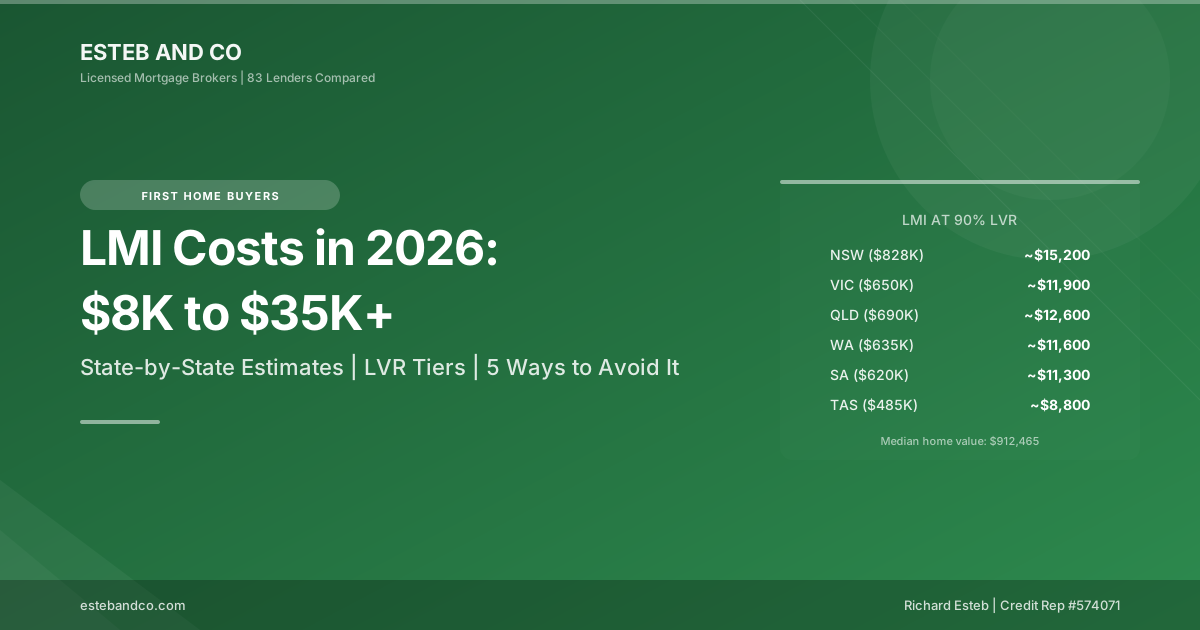
But the national median doesn’t tell the full story. Property prices vary enormously by state, and so does LMI. Here’s what it looks like at 90% LVR (10% deposit) across each state, using average property values from the latest ABS lending data:
LMI by state at 90% LVR (10% deposit)
| State | Avg Property Value | 10% Deposit | Loan Amount | Approx. LMI |
|---|---|---|---|---|
| NSW | $828,000 | $82,800 | $745,200 | ~$15,200 |
| QLD | $690,000 | $69,000 | $621,000 | ~$12,600 |
| VIC | $650,000 | $65,000 | $585,000 | ~$11,900 |
| WA | $635,000 | $63,500 | $571,500 | ~$11,600 |
| ACT | $630,000 | $63,000 | $567,000 | ~$11,500 |
| SA | $620,000 | $62,000 | $558,000 | ~$11,300 |
| TAS | $485,000 | $48,500 | $436,500 | ~$8,800 |
| NT | $480,000 | $48,000 | $432,000 | ~$8,700 |
Estimates based on standard owner-occupier, P&I. Source property values: ABS Lending Indicators, December Quarter 2025.
NSW buyers face the steepest LMI — roughly $15,200 at 90% LVR. That’s nearly double what a Tasmanian or NT buyer would pay on the same deposit percentage. The reason is straightforward: higher property prices mean higher loan amounts, and LMI scales with the loan.
LMI Cost Factors: What Drives the Price
LMI isn’t calculated on a single formula. Several factors determine what you’ll actually pay, and understanding them can help you make decisions that reduce (or eliminate) the cost.
1. Loan-to-Value Ratio (LVR)
This is the biggest driver. LMI premiums increase at each LVR tier, with the largest jumps happening above 90%. Most LMI providers use bands: 80.01–85%, 85.01–90%, 90.01–95%, and 95.01–97%. Each band carries a significantly higher premium rate than the one below it.
2. Loan size
LMI is calculated as a percentage of the loan amount, but it’s not a flat percentage. Larger loans attract proportionally higher premiums. A $400,000 loan at 90% LVR might incur LMI of around 1.8% of the loan ($7,200), while an $800,000 loan at the same LVR could be charged around 2.0% ($16,000). The rate itself increases with the loan size.
3. Lender and insurer
Different lenders use different LMI providers, and premiums vary. Some lenders self-insure and pass on lower costs. Others negotiate bulk discounts with Genworth or QBE. We compare across our panel of 50 lenders, and the LMI difference on the same loan can be $2,000–$4,000 depending on which lender you use.
4. Employment type
Self-employed borrowers, casual workers, and contract employees often face LMI loading — an additional surcharge of 10–20% on the standard premium. Some LMI providers won’t insure casual or self-employed borrowers above 90% LVR at all.
5. First home buyer status
Some LMI providers offer discounted premiums for first home buyers, particularly at lower LVR tiers (80–90%). The discount is modest — typically 5–15% off the standard premium — but every bit helps. Not all lenders pass this through, so it’s worth asking.
5 Ways to Avoid Paying LMI
LMI is not inevitable. Here are five proven strategies we use with clients every week to eliminate or bypass it entirely.
1. Save a 20% deposit
The most straightforward path. At the national median of $912,465, that’s $182,493. If you’re saving $3,000 per month, that takes roughly 5 years. For many buyers, this is too long to wait — but if you’re within 12–18 months of reaching 20%, it can be worth the final push.
The benefit isn’t just avoiding LMI. At 80% LVR, you also unlock better interest rates. Most lenders have tiered pricing, and the rate drop at 80% LVR is typically 0.10–0.30%. On a $730,000 loan, that 0.20% rate improvement saves approximately $96 per month on top of the LMI you’ve avoided.
2. First Home Guarantee (5% deposit, no LMI)
Since October 2025, the expanded First Home Guarantee lets all first home buyers purchase with just a 5% deposit and zero LMI. The government guarantees the remaining 15% of the deposit to the lender. Income caps have been removed and places are unlimited.
This is the single biggest change to the first home buyer landscape in years. On the national median property, it saves you roughly $35,200 in LMI compared to buying at 95% LVR without the scheme. The Help to Buy shared equity scheme is another option, letting eligible buyers in with just 2% deposit — though the government takes an equity stake in your property.
3. Family guarantee (guarantor loan)
If a parent or close family member owns property, they can use their equity to guarantee part of your loan. This eliminates the need for LMI because the lender has additional security. Most banks limit the guarantee to 20% of the property value.
The guarantor doesn’t make repayments. They’re providing security only, and once your LVR drops below 80% (through repayments or property growth), the guarantee can be released. CBA, Westpac, ANZ, NAB, and most major banks offer guarantor loans. It’s one of the most common structures I use for first home buyers.
4. Professional packages (doctors, lawyers, accountants)
Several lenders offer LMI waivers for specific professions, typically at up to 85% or even 90% LVR. Medical professionals are the most common beneficiaries — many lenders will lend doctors, dentists, and veterinarians up to 90% LVR with no LMI.
Lawyers, accountants, engineers, and some other professionals also qualify with selected lenders. The eligibility criteria vary, but if you’re in a qualifying profession, this can save you $8,000–$17,000. We track which lenders offer these waivers across our panel.
5. Use a broker to find LMI-waived products
Beyond professional packages, some lenders periodically offer LMI promotions — waived or reduced LMI for borrowers who meet specific criteria (loan size thresholds, LVR caps, owner-occupier only). These aren’t widely advertised and change frequently. A broker who monitors the full lender panel can identify these opportunities. We compare 50 lenders and flag LMI-waived options whenever they’re available for a client’s profile.
When Paying LMI Is Actually Worth It
Here’s something that might surprise you: in most Australian property markets right now, paying LMI and buying sooner is financially better than waiting to save 20%.
Let me walk through a real scenario using current numbers.
The numbers: buy now with LMI vs. wait 2 years
Say you’re looking at a $700,000 property today. You have a 10% deposit ($70,000). If you buy now, you’ll pay approximately $12,800 in LMI.
The alternative: keep saving for another 2 years to reach 20% ($140,000). You need to save an extra $70,000 — that’s $2,917 per month on top of rent.
But while you’re saving, the property market doesn’t stand still. If prices grow at a conservative 5% per year, that $700,000 property becomes $771,750 in two years. Your new 20% deposit target is now $154,350 — not the $140,000 you originally planned. And you’re buying a more expensive property.
You avoided $12,800 in LMI but paid $71,750 more for the same home. The maths overwhelmingly favours buying earlier.
Even accounting for the interest you pay on the capitalised LMI over the loan term (roughly $27,700 total on $12,800 at 6% over 30 years), you’re still $44,050 better off buying sooner. Plus you’ve had two years of living in your own home, building equity, and not paying someone else’s mortgage through rent.
The only scenario where waiting beats paying LMI is if property prices are flat or falling in your target area. In markets with strong price growth — which describes most of Australia in 2026 — the cost of waiting far exceeds the cost of LMI.
Can You Get LMI Refunded?
This is one of the most common questions I get, and the answer is: sometimes, partially, and only within a narrow window.
Both Genworth (Helia) and QBE have refund policies that allow a partial refund if you refinance, sell, or pay out the loan within 1–2 years of the LMI policy start date. The refund is calculated on a sliding scale — the longer you’ve had the policy, the smaller the refund.
In practice, a typical refund schedule looks like this:
- Within 12 months: Up to 40–50% refund of the original premium
- 12–24 months: 10–25% refund
- After 24 months: No refund available
To claim a refund, you need to contact the LMI provider directly (not your lender). You’ll need your original loan details, the LMI certificate number, and proof that the loan has been discharged. The process takes 4–6 weeks.
One important caveat: not all LMI policies include a refund provision. Some lenders negotiate terms with insurers that exclude refunds. Check your loan documents or ask your broker before assuming you can recover any LMI.
If you’re thinking about refinancing within the first year or two of your loan, factor in the potential LMI refund. I’ve had clients recover $3,000–$6,000 on early refinances, which significantly offsets the cost of switching lenders.
Frequently Asked Questions
What is Lenders Mortgage Insurance (LMI)?
LMI is a one-off insurance premium that protects the lender (not you) if you default on your home loan. It’s required when your deposit is less than 20% of the property value — meaning your LVR is above 80%. The cost depends on your loan amount, LVR, lender, and employment type. Most borrowers add it to their loan balance rather than paying it upfront.
How much does LMI cost on a $700,000 home loan?
At 90% LVR (10% deposit), LMI on a $700,000 property is approximately $12,800. At 95% LVR (5% deposit), it rises to approximately $27,000. At 85% LVR (15% deposit), it drops to roughly $6,500. These are estimates — actual costs vary by lender, LMI provider, and borrower profile.
Can I avoid paying LMI?
Yes. The five main ways are: saving a 20% deposit, using the First Home Guarantee (5% deposit with no LMI), getting a family guarantee where a parent uses their property as security, qualifying for a professional package (doctors, lawyers, accountants), or using a broker to find lenders offering LMI-waived products for your profile.
Is LMI added to the loan or paid upfront?
Most borrowers capitalise (add) LMI onto their loan amount, meaning you pay interest on it over the life of the loan. For example, $16,800 in LMI capitalised at 6% over 30 years costs approximately $36,300 in total. You can also pay it upfront as a lump sum at settlement, which avoids the interest cost but requires more cash on hand. Your lender will let you choose.
Can I get an LMI refund if I refinance?
Some LMI providers offer partial refunds if you refinance or sell within 1–2 years of the policy start date. The refund reduces over time and typically disappears after 24 months. You need to contact the LMI provider (Genworth/Helia or QBE) directly to claim. Not all policies include a refund provision, so check your loan documents.
See where you stand
Compare your options across our panel of 50 lenders in about 2 minutes. Free, and it won’t affect your credit score.
Start complimentary assessment →No obligation · Richard Esteb, Credit Rep #574071
Richard Esteb
Ricky founded Esteb & Co to give everyday Australians access to the same loan comparison technology used by the big banks. He compares products from a panel of 50 lenders to find the right fit for each client’s situation.