Self-Employed Home Loans: Only 2 Lenders Will Accept 1 Year of Returns in 2026

In this article
Here is a reality check most new business owners don't see coming. You leave your salary job, start a consultancy, have a stellar first year, lodge a tax return showing strong profit — and then you try to buy a house. Every bank you speak to says no. Not because your income isn't good enough. Because you have only been doing it for 12 months.
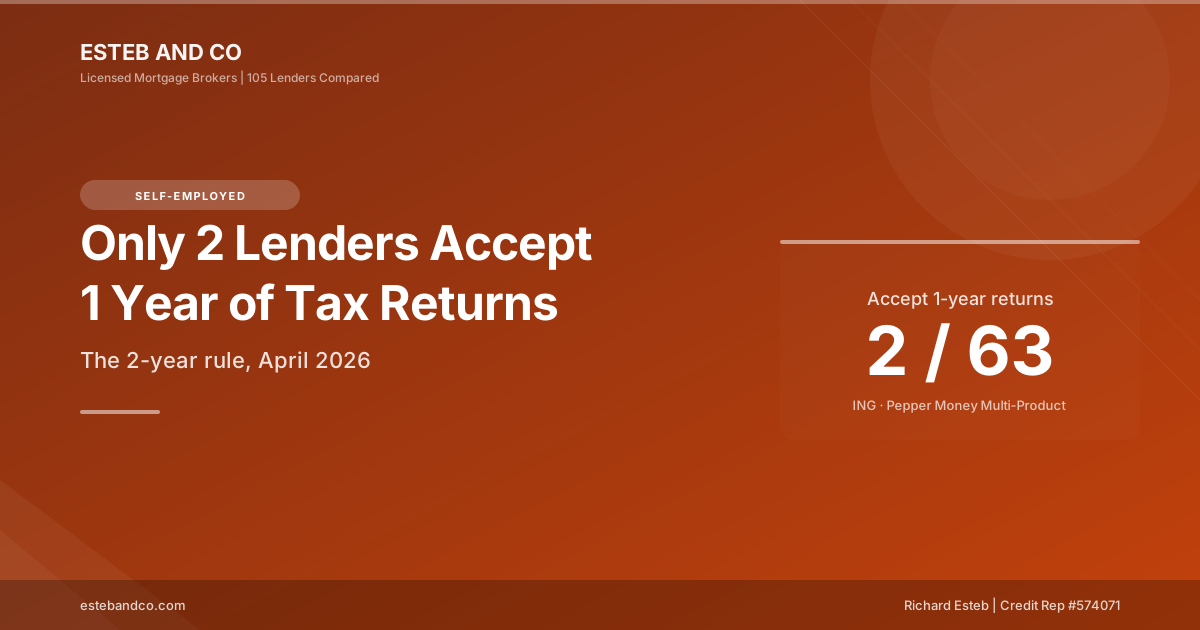
We pulled the employment policy data for every lender on our panel this week. Of the 63 lenders that write self-employed home loans, 61 require a minimum of 24 months of trading and two full years of lodged tax returns. Two lenders will consider one year. That's it.
This article is about that gap. The two exceptions, how their policies differ, what it takes to actually qualify with a single year, and what to do if you sit in the 12-23 month window that excludes you from every mainstream lender.
The 2-Year Rule in Numbers
Here is the distribution of minimum trading history across our active lender panel for home loans:
That's what it looks like when an industry quietly standardises around a rule nobody votes on. There was no regulation requiring the 2-year minimum. It emerged organically from credit risk appetite at the majors in the early 2000s and propagated across the industry because banks copy each other.
ING and Pepper Money Multi-Product: the Exceptions
The two lenders that break the rule are quite different from each other.
| ING | Pepper Money Multi-Product | |
|---|---|---|
| Lender type | Non-bank (Dutch-owned digital) | Non-bank (near-prime specialist) |
| Min trading history | 12 months | 12 months |
| Tax returns required | 1 most recent | Alt-doc accepted in lieu of tax return |
| Max OO LVR | 95% (with LMI) | 95% (with LMI) |
| Credit appetite | Prime only | Prime, near-prime, specialist |
| Rate band (variable) | ~5.89-6.40% | ~6.50-8.00% |
| Best-fit borrower | Clean file, strong single-year tax return | Alt-doc, bank statement income, or light credit events |
| April 2026 policy data. Rates indicative; actual pricing depends on LVR, product and borrower profile. | ||
ING is the much cheaper and more mainstream option. Their 1-year policy is not advertised widely but sits inside their broker channel. The important caveat is that ING's 1-year rule assumes you have a full ATO-lodged tax return for the most recent financial year, not just an interim BAS or profit-and-loss. Tight timelines matter: if your FY25 return isn't lodged, ING can't use it. Most accountants lodge between July and April — so if you are trying to finance a purchase in May or June, you may find yourself lodging early specifically to qualify.
Pepper Money's Multi-Product range sits in a different space. Pepper is the market-leading near-prime lender, which means they underwrite borrowers who have either credit file issues, irregular income, or insufficient documentation. Their alt-doc self-employed product takes bank statements and a BAS or accountant declaration instead of a tax return — helpful for the newly self-employed whose first return hasn't been lodged yet. The rate premium (0.60-1.50% above prime) reflects that risk layering.
Between the two, ING is the first stop for any newly self-employed borrower with clean credit and a strong tax return. Pepper is the fallback for those who can't meet ING's criteria.
Why 2 Years Exists at All
Lenders want to see that your business income is repeatable, not just a lucky year. The 2-year minimum gives them two data points: if year 2 is broadly consistent with year 1, the lender assumes that level of income will continue. If year 2 is significantly different, they apply the "lower of the two" test to be conservative.
There is also a servicing rationale. APRA's standard is that lenders must assess serviceability using a stable, repeatable income measure. A single year can be biased by one-off contracts, front-loaded billing, or an unusually soft or strong year in the industry. Two years smooths that out. When the ACCC or ASIC eventually audits an approved loan, "we used 2 years average" defends more easily than "we used their first full year".
It's a genuine risk-management rule, not arbitrary red tape. The flip side is that it disproportionately excludes newer business owners who actually have strong cashflow, from borrowing at the prime rates available to PAYG equivalents.
How Self-Employed Income Is Calculated
This part trips up nearly every new self-employed borrower because it is completely different from how PAYG income is assessed.
For PAYG borrowers, lenders take gross salary from your most recent 2 payslips, annualise it, and use that figure. Bonuses and overtime might be averaged over 1-2 years.
For self-employed borrowers, lenders start from your net profit before tax in the tax return, then adjust. A typical formula looks like this:
Net profit before tax + depreciation add-back + one-off business interest add-back − superannuation paid − non-recurring income items = Assessable self-employed income
The key traps:
- Retained profits in a company structure are often ignored. If your business earns $200K but you only pay yourself $80K in wages and leave $120K in the company, most lenders will assess you on $80K unless they can pierce through to company financials.
- Two-year averaging means a strong recent year is partly discounted. If year 1 was $80K and year 2 is $140K, most lenders use $80K or at best average to $110K — not $140K.
- "Stable income" rules cap year-on-year increases. If year 2 exceeds year 1 by more than 20%, several lenders use year 1 as the floor. Fast-growing businesses paradoxically borrow less.
Net effect: self-employed borrowers typically qualify for 15-25% less than PAYG equivalents with the same take-home pay. The workaround is either structural (drawing more wages from your company) or lender choice (Pepper, Liberty and Bankwest have more generous add-back policies than the Big 4).
Low-Doc: The Alt-Doc Workaround
Low-doc (now usually called "alt-doc") products exist specifically for self-employed borrowers who can't or won't provide 2 years of tax returns. Instead of tax returns, they accept one or more of:
- 6-12 months of business bank statements showing consistent deposits
- BAS history for the equivalent period
- A declaration from your accountant certifying your income
Low-doc lenders on our panel include Pepper Money, Liberty Financial, Resimac, La Trobe Financial, Better Choice and Bluestone. LVRs are typically capped at 80% (versus 95% for full-doc), and rates are 0.30-1.00% above prime depending on borrower profile and documentation strength.
Low-doc is not a shortcut to avoid documentation — it is a trade of one set of evidence for another. The lender still wants to see a verifiable income stream; they just accept different proof. A borrower whose BAS history or bank statements don't support the declared income will still be declined.
What You Can Do at 12 Months
Your realistic options between 12 and 24 months of self-employment look like this:
| Option | Who it works for | Expected rate | Catch |
|---|---|---|---|
| ING Full-doc at 1 year | Strong FY25 return lodged, clean credit | 5.89-6.40% | Must have tax return already lodged |
| Pepper Multi-Product | Alt-doc or near-prime profile | 6.50-8.00% | Rate premium, LVR caps tighter |
| Low-doc (Liberty / Resimac / La Trobe) | BAS + accountant declaration | 6.80-7.60% | Max 80% LVR |
| Guarantor loan from family | Parents have equity | 5.69-6.30% (prime rates) | Parents take on liability |
| Wait until year 2 tax return | Anyone with 12-20 months | Whatever the market looks like then |
The guarantor route is the most overlooked option in this list. If a parent or family member has significant equity in their own home, they can guarantee the deposit shortfall, which lets you access prime lending from any Big 4 or mainstream lender. It carries real risk for the guarantor and needs independent legal advice, but for many young self-employed borrowers with supportive parents it is the cheapest path to home ownership.
Getting Ready for Year 2
If you are at 12-18 months and prepared to wait for your second tax return, here is how to use that window.
1. Structure your income now for servicing later
If you're running a company, consider paying yourself a market wage rather than minimal drawings. Drawings don't count as income at most lenders. Wages do. Paying yourself $100K from a company that earns $160K costs you extra PAYG tax but unlocks serviceability that retained profit doesn't.
2. Keep business and personal finances separate
Lenders reviewing business bank statements (for alt-doc) want to see deposits that look like revenue, not a mixed pile of transfers and reimbursements. A clean business account with regular client payments dramatically simplifies the assessment.
3. Lodge early
Your tax return is only useful for a home loan after it is lodged with the ATO. Waiting until April to lodge your FY25 return costs you 9 months of purchase opportunity. Work with your accountant to have returns lodged by August each year if you plan to borrow.
4. Clean your credit file
Credit scoring now includes "repayment history information" (RHI) — late utility or credit card payments show up on your Equifax file for 2 years. Above 80% LVR, any missed payment in the last 24 months is effectively a decline at most lenders. Pull your file, dispute errors, and set every bill on autopay.
5. Save your deposit in your own name
Mainstream lenders require 5% genuine savings — money saved in your personal name for 3+ months. Retained profit inside a company is not genuine savings. Move planned deposit funds into your personal accounts well before you apply.
Frequently Asked Questions
Can I get a home loan if I have only been self-employed for 1 year?
Yes, but your options are ING (full-doc with 1 year's lodged return) or Pepper Money Multi-Product (alt-doc). The other 61 lenders on our panel require 2 years minimum.
Which Australian lenders accept 1 year of tax returns for self-employed home loans?
As of April 2026, two lenders: ING and Pepper Money Multi-Product. Both cap at 95% LVR with LMI. ING is cheaper (5.89-6.40% variable). Pepper takes alt-doc income where ING requires a full tax return.
What counts as self-employed for home loan purposes?
Owning 25% or more of an operating business, or deriving your primary income from a business you control. Includes sole traders, partners, directors of private companies, and trading-trust beneficiaries. Even a 25% shareholding triggers self-employed assessment rules.
What documents do self-employed borrowers need?
For 2-year lenders: 2 years personal and company tax returns, 2 years ATO Notices of Assessment, 2 years company financial statements, and typically 6 months of business bank statements. For low-doc: bank statements + BAS + accountant declaration in place of tax returns (capped at 80% LVR).
How is self-employed income calculated?
Net profit before tax, plus depreciation and loan interest add-backs, minus super and non-recurring items. Most lenders use the lower of 2 years or average if increasing, and apply a "stable income" cap if year 2 exceeds year 1 by more than 20%. This typically produces 15-25% lower borrowing capacity than a PAYG equivalent with the same take-home.
Is low-doc the same as a sub-prime loan?
No. Low-doc is about documentation type (bank statements and BAS instead of tax returns), not credit quality. Most low-doc borrowers have clean credit files — they just don't have 2 years of returns lodged. Alt-doc and near-prime are related but distinct: near-prime refers to credit impairment, while alt-doc refers to documentation.
See where you stand
Compare your options across our panel of 50 lenders in about 2 minutes. Free, and it won’t affect your credit score.
Start complimentary assessment →No obligation · Richard Esteb, Credit Rep #574071
Richard Esteb
Ricky founded Esteb & Co to give everyday Australians access to the same loan comparison technology used by the big banks. He compares products from a panel of 50 lenders to find the right fit for each client’s situation.