How to Refinance Your Home Loan in 2026

Why Refinancing Matters More in April 2026
I've processed thousands of refinances over the years, and I can tell you right now: the gap between what the average borrower is paying and what they could be paying has never been wider.
Let me explain why April 2026 is a particularly important moment to be looking at your home loan.
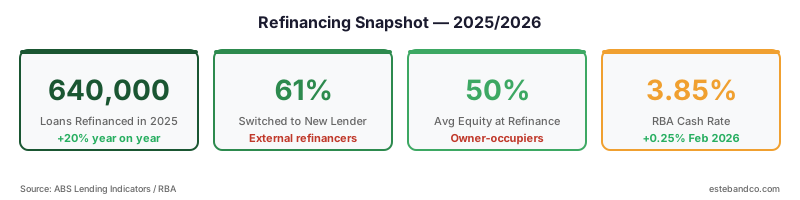
The RBA hit us with two consecutive rate hikes to start the year. Cash rate went from 3.60% to 3.85% in February, then to 4.10% on March 18. Most lenders passed both increases on in full within days. Some added a margin on top. If you're on a standard variable rate with one of the big four, your rate likely sits somewhere between 6.34% and 6.59% right now.
Meanwhile, the best variable rates on our panel start from 5.54%. That's a gap of 0.80% to 1.05% just sitting there, costing you money every single day you don't act on it.
The latest ABS Lending Indicators paint a clear picture. In the September quarter of 2025 alone, external refinancing hit a record $65.8 billion - that works out to roughly $500,000 per minute of every business day. Owner-occupiers accounted for 67,051 loans worth $41.3 billion. Investor refinancing was even more aggressive - 37,303 loans worth $24.5 billion, up 8.4% in volume and 9.7% in value compared to the previous quarter.
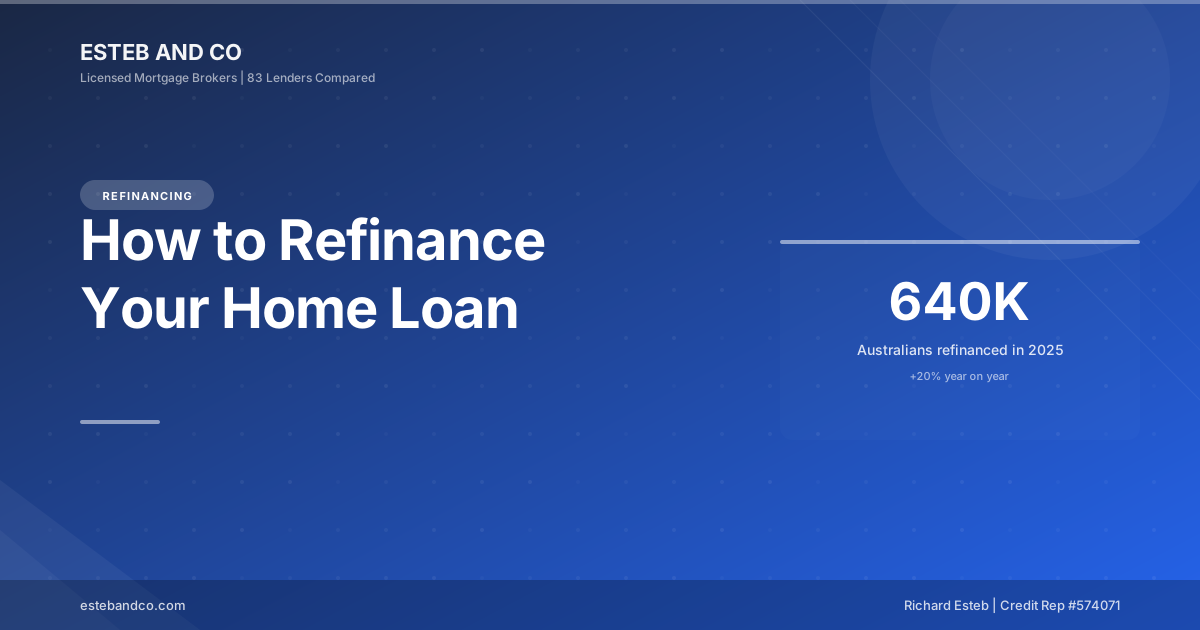
Through all of 2025, 640,000 mortgages were externally refinanced - up 20% on the previous year. And 61% of those borrowers didn't just negotiate a discount with their existing bank. They switched to a completely different lender.
That tells me something I already see in my business every day: Australians have woken up to the fact that bank loyalty is a tax on the complacent.
Then there's the stress data. Roy Morgan's March 2026 report shows 26.6% of mortgage holders - that's 1,319,000 households - are now classified as at risk of mortgage stress. After two hikes in two months, that number is only going to climb. Refinancing to a sharper rate is the single fastest thing most of those households can do to relieve the pressure.
How Much Can You Actually Save?
I don't believe in vague promises about "potential savings." Let me show you the actual maths using real numbers from this week.
The headline calculation
Take a $600,000 loan with 25 years remaining - close to the national average (the ABS puts the average mortgage at $736,000 as of December 2025, but many refinancers have paid down some principal).
| Scenario | Rate | Monthly Repayment | Annual Cost |
|---|---|---|---|
| Big bank standard variable (SVR) | 6.59% | $4,120 | $49,440 |
| Big bank discounted (if you ask nicely) | 6.10% | $3,895 | $46,740 |
| Competitive bank / credit union | 5.78% | $3,760 | $45,120 |
| Best available rate | 5.54% | $3,639 | $43,668 |
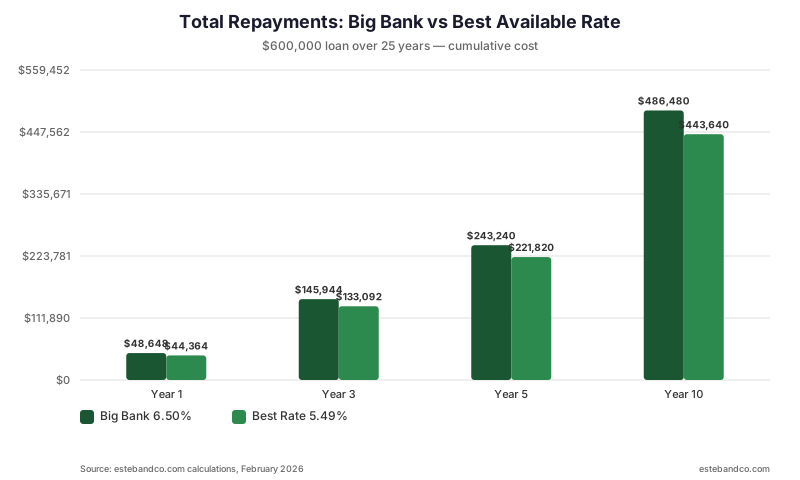
The difference between that big bank SVR at 6.59% and the best available at 5.54%:
- $481 per month saved
- $5,772 per year saved
- ~$144,000 in total interest saved over the remaining 25 years
Read that last number again. A hundred and forty-four thousand dollars. That's not a theoretical maximum from some comparison site. That's the real difference between paying your current bank's standard rate and switching to the best rate available on our panel right now.
The average owner-occupier refinancer has approximately 50% equity in their property (ABS data). If that's you, you're in the strongest possible negotiating position - lenders compete aggressively for low-LVR borrowers because you represent low risk.
But what if your gap is smaller?
Even a 0.50% rate reduction on a $600,000 loan saves you roughly $190 per month - $2,280 per year. Given that refinancing typically costs $0-$700 in total fees, you're ahead within the first few months.
On the current national average mortgage of $736,000, a 1.05% rate drop (SVR to best available) saves $590 per month. That's $7,080 a year. Some of the clients I work with are saving more than that because they've been on rates above 7%.
The Rate Cycle Context
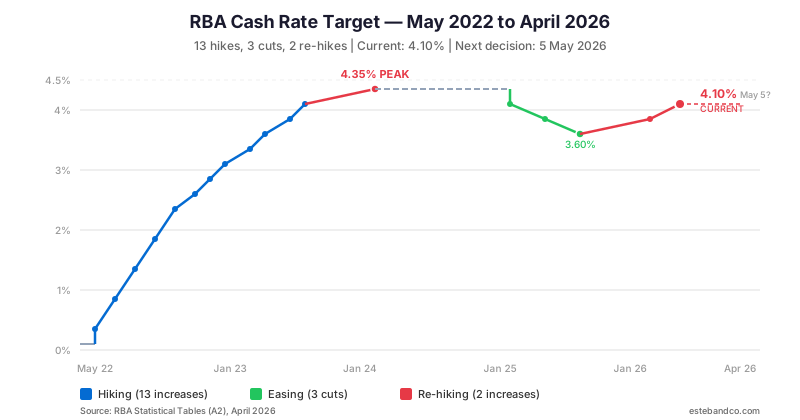
To understand why the current refinancing window matters, you need the full picture of where rates have been.
The cash rate was at 0.10% in April 2022 - the emergency pandemic low. The RBA then hiked aggressively through 2022 and 2023, peaking at 4.35% in November 2023. They held there for months before eventually easing, bringing the rate down to 3.60% by August 2025.
Most borrowers thought rates were on a clear downward path. Then came the surprise. Inflation proved stickier than the RBA expected, and we got two consecutive hikes in early 2026:
- February 2026: Cash rate raised to 3.85%
- March 18, 2026: Cash rate raised to 4.10%
The next RBA decision is May 5, 2026. Markets are split on whether we'll see a third hike or a pause. Either way, the rates you're paying today reflect a 4.10% cash rate - and the spread between your bank's SVR and competitive lenders exists regardless of what happens in May.
What this means for timing your refinance
I get asked constantly: "Should I wait for rates to come down before refinancing?"
Here's my honest answer: no.
You don't refinance because of where the cash rate is going. You refinance because of the gap between what you're paying and what you could be paying. That gap exists right now. Every month you wait, you're paying the difference. If the cash rate goes up again, both your current rate and the best available rate will go up - but the gap between them stays. If rates eventually come down, you'll benefit from the lower rate and the better rate you locked in by switching.
The only scenario where waiting makes sense is if you believe your current bank will voluntarily lower your rate more than the competition. In 11+ years of broking, I've never seen that happen without the customer threatening to leave first.
When Refinancing Makes Sense (and When It Doesn't)
I turn away clients when the numbers don't stack up. Not every refinance is a good refinance, and I'd rather tell you that upfront than waste your time.
Refinancing makes sense when:
- Your rate is more than 0.50% above the best available. At that gap, the savings almost always outweigh costs within a few months. On today's numbers, if you're above 6.04%, there's a saving waiting for you.
- Your fixed rate period is ending. Banks typically roll you onto a high standard variable rate when your fixed term expires. This is the single biggest refinancing trigger I see - and most borrowers don't realise it's happening until they check their statement.
- Your property has increased in value. If your LVR has dropped below 80% or 70% thanks to price growth or repayments, you unlock significantly better rate tiers. The ABS data shows the average refinancer has ~50% equity - that puts you in the premium pricing bracket.
- You want features your current loan doesn't have. An offset account, redraw facility, or the ability to split between fixed and variable. These features have real financial value - see our offset account guide.
- Your circumstances have improved. Higher income, cleared debts, or a better credit score can all unlock deals your bank won't proactively offer you.
- You're under mortgage stress. If you're among the 1.3 million households Roy Morgan has flagged, refinancing to a lower rate is the fastest way to reduce your monthly outgoings without selling or downsizing.
Refinancing probably doesn't make sense when:
- You're locked into a fixed rate with high break costs. I've seen break fees of $10,000-$30,000 on larger loans. Always ask your current lender for a break cost quote first.
- Your loan balance is under $200,000. The absolute dollar savings may not justify the effort. Run the numbers - sometimes it still works, but the payoff period is longer.
- You're planning to sell within 6-12 months. You may not recoup the switching costs before settlement.
- You're already within 0.20% of the best available rate. At that margin, stay put and review again in 6 months.
- You have an LVR above 80% and would trigger LMI. Lenders Mortgage Insurance on a refinance can cost $5,000-$15,000 depending on the loan size - often wiping out years of rate savings.
Best Refinance Rates Right Now
I pulled these rates from our lender panel this week. These are for owner-occupier, principal and interest loans with LVR at or below 80% - the standard refinancer profile.
| Lender | Variable Rate From | Type | Offset | Best For |
|---|---|---|---|---|
| QLD Country Bank | 5.54% | Credit Union | Yes | Lowest rate, full features |
| Firefighters Mutual / Teachers Mutual / UniBank | 5.64% | Mutual | Yes | Members of eligible professions |
| Bank of China | 5.68% | Bank | Yes | Competitive rate, full service |
| HSBC | 5.69% | Bank | Yes | Strong digital experience, global bank |
| GMCU / Bank of Sydney | 5.69% | Mutual / Bank | Yes | Low fees, solid offset |
| QBANK / Heritage / Hume Bank | 5.74% | Mutual | Yes | Regional credit unions, personal service |
| ANZ | 5.78% | Big Four | Yes | Best of the big four, branch network |
| CBA | ~6.34% | Big Four | Yes | Full service, cashbacks available |
| Westpac / NAB | ~6.49-6.59% | Big Four | Yes | Package discounts, relationship pricing |
Rates are indicative only and subject to change. Your actual rate depends on your LVR, loan amount, and circumstances. Information current as of April 2026.
Notice the spread. QLD Country Bank at 5.54% versus the big bank standard variable range of 6.34%-6.59%. That's a gap of 0.80% to 1.05%. On a $600,000 loan, that gap costs you $365-$481 every single month.
Even ANZ - the most competitive of the big four right now at 5.78% - is still 0.24% above the best available. On the same $600K loan, that's about $92/month or $1,100/year. Still worth looking at if you want the branch network and brand comfort of a major bank.
Don't just compare headline rates. A 5.69% rate with an offset account where you park $50,000 effectively works out cheaper than a 5.54% rate without one. I always calculate the total cost of the loan including features before recommending a switch.
How Fast Can You Switch?
One of the most common questions I get is "How long will this take?" The answer varies dramatically depending on which lender you choose.
I track turnaround times across our panel because speed matters - every day you're waiting is another day paying the higher rate. Here are the current numbers:
| Lender | Conditional Approval | Unconditional Approval | Notes |
|---|---|---|---|
| Macquarie | 0.8 days | 1.8 days | Fastest on the panel by a wide margin |
| Bankwest | Same day | 4.1 days | CBA-backed, very efficient process |
| CBA | Same day | 6.8 days | Fast conditional, slower to finalise |
| ANZ | Same day | 14.1 days | Quick initial answer, slow to unconditional |
Turnaround times are averages from the past 30 days and can fluctuate with application volumes.
Macquarie stands out here. Conditional approval in under a day and unconditional in under two days is exceptional. If speed is important to you - say you're trying to get sorted before the May 5 RBA decision - that's the lender to look at.
The total refinance timeline from application to settlement typically runs 2-6 weeks. That includes:
- Application and document submission (1-2 days if you're organised)
- Lender assessment and valuation (1-14 days depending on lender)
- Conditional to unconditional approval (1-7 days)
- Discharge from your old lender (10-15 business days - legally mandated)
- Settlement (1-3 days)
The bottleneck is almost always the discharge from your existing bank. They have a legal obligation to process it within 10-15 business days, and ASIC enforces this. But some banks drag their feet right up to the deadline. I always lodge the discharge authority as early as possible to keep things moving.
The Step-by-Step Process
I walk clients through this every week. It's simpler than most people think, especially when you have a broker handling the paperwork.
Step 1: Work out what you're actually paying
Log into your current lender's app or online banking. You need three numbers: your current interest rate, your remaining balance, and your remaining loan term. Most borrowers don't know their actual rate - they remember what it was when they signed up, not what it is after the last two RBA hikes.
Step 2: Get a comparison across the market
This is where a broker earns their keep. I compare your current deal against 50 lenders on our panel and show you the exact gap. You'll see the rate, the monthly saving, the annual saving, and the break-even point. Our smart matching tool does this in under 2 minutes.
Step 3: Choose the right lender (not just the cheapest rate)
Rate matters, but so do features, turnaround time, and ongoing service. I help clients weigh up whether the 0.10% cheaper rate is worth giving up an offset account, or whether a slightly slower lender with better digital tools is a better long-term fit.
Step 4: Apply with supporting documents
You'll need recent payslips (or tax returns if self-employed), bank statements, ID, and your current loan details. Most of this can be done digitally now. The new lender orders a valuation of your property - this is usually free for refinancers.
Step 5: Your new lender pays out the old one
Once approved, the new lender issues a discharge authority to your existing bank. Your old bank processes the discharge, the new lender pays out the old loan, and your new loan starts. You keep making repayments to your old lender until settlement day - then everything switches over.
Step 6: Settle and start saving
Settlement typically happens within 2-6 weeks of application. From the first repayment on your new loan, you're paying the lower rate. The saving starts immediately.
What it costs to refinance
- Discharge fee from old lender: $150-$350 (most are around $350)
- Settlement/legal fee: $0-$350 (many new lenders cover this)
- Government registration fees: $150-$300 (varies by state)
- Valuation fee: Usually free for refinances
- New lender application fee: $0 (most waive this for refinancers)
- Total typical cost: $0-$700
On a saving of $481/month, you recoup the maximum cost within 6 weeks. Even the most conservative savings scenario puts break-even at 3-4 months.
What Banks Don't Want You to Know About Retention Offers
Here's something I learned when I worked on the lender side: every major bank has a retention team whose job is to stop you from leaving. When you tell your bank you're refinancing - or better yet, when they receive a discharge authority from your new lender - they'll suddenly find a discount they "weren't able to offer before."
I've seen banks drop rates by 0.50-0.80% overnight to keep a customer. That discount was always available. They just had no incentive to offer it while you were sitting quietly and paying the standard rate.
How to use this to your advantage
- Get a genuine approval from another lender first. Don't bluff. Have a real, unconditional approval in hand. This is your leverage.
- Call your bank's retention team directly. Don't waste time with the general customer service line. Ask to be transferred to the "home loan retention" or "pricing" team.
- Tell them you have unconditional approval at [X rate] with [Y lender]. Be specific. They'll ask for proof - that's fine, you have it.
- They'll either match it or they won't. If they match, you stay without switching costs. If they don't, you've already got the new loan ready to go.
The trap to watch for
Retention discounts are often temporary. I've had clients accept a "special rate" from their bank, only for it to quietly revert to the standard rate 12 months later. Always ask:
- Is this discount for the life of the loan or for a fixed period?
- Will it be reviewed annually?
- Does it come with conditions (e.g., maintaining a minimum balance, keeping other products)?
A genuine competitor approval through a broker gives you the strongest possible hand. Even if you end up staying with your current bank, the process of getting that approval costs you nothing - and it could save you tens of thousands.
Cashback Offers: Are They Worth It?
You've probably seen the ads: "Refinance and get $2,000 cashback!" or "$4,000 switching bonus!" Several lenders run these offers to attract refinancers. But are they actually a good deal?
When cashback works in your favour
If a lender already has a competitive rate and offers a cashback, it's a genuine bonus. The cashback covers your switching costs (discharge fee, registration fees) and puts money in your pocket on top of the ongoing rate saving.
When cashback is a trap
Some lenders offer a large cashback on a loan that's 0.30-0.50% more expensive than the best available rate. Let's do the maths:
- $4,000 cashback on a loan at 6.09%
- vs. no cashback on a loan at 5.54%
- On a $600,000 loan, the 0.55% rate difference costs you $211/month more
- Your $4,000 cashback is gone in 19 months - then you're just paying more forever
I always run the break-even calculation. On most loan sizes above $400,000, the ongoing rate saving beats the one-off cashback within 12-24 months. Below that, the cashback might tip the scales - but you still need to check the comparison rate, not just the headline rate.
My rule of thumb: take the cashback if the lender's rate is also within 0.10% of the best available. Otherwise, take the lower rate and skip the cashback. Your future self will thank you.
Common Refinancing Mistakes
I've been doing this for over a decade. Here are the mistakes I see most often - and how to avoid them.
1. Chasing the lowest rate without reading the fine print
Some ultra-low rates come with restrictions: no offset account, limited extra repayments, revert rates that jump after a honeymoon period, or annual fees that inflate the comparison rate. Always compare the comparison rate, not just the headline rate.
2. Not checking your property value first
Your LVR determines the rate tier you qualify for. If your property has increased in value and your LVR has dropped below 80% or 70%, you unlock significantly better pricing. I always run an automated valuation before submitting an application - it takes 30 seconds and can be the difference between a good rate and a great one.
3. Extending the loan term back to 30 years
If you've been paying your loan for 7 years, you have 23 years remaining. Some borrowers refinance to a new 30-year term to get lower repayments - but they end up paying more total interest over the life of the loan. I always match or shorten the remaining term unless there's a genuine cash flow reason to extend.
4. Forgetting about LMI
If your LVR is above 80%, you may need to pay Lenders Mortgage Insurance again with the new lender. On a $600,000 loan at 85% LVR, that's roughly $5,000-$8,000. This can wipe out years of rate savings. Always check your LVR before applying.
5. Not accounting for break costs on fixed loans
If you're in a fixed rate period, your current lender can charge break costs based on the difference between your fixed rate and the current wholesale rate. I've seen break costs as low as $500 and as high as $30,000. Your lender is required to give you a quote - always ask before committing.
6. Timing the market instead of acting
I hear it every week: "I'll wait for the RBA to cut rates." But here's the thing - while you're waiting, you're paying the higher rate. The RBA has hiked twice in 2026 and the next cut might not come until late this year or even 2027. Every month you delay at 6.59% instead of 5.54% costs you $481. Over six months of waiting, that's $2,886 you'll never get back.
7. Only comparing the big four banks
The best rates on the market right now are from credit unions, mutuals, and smaller banks that most borrowers have never heard of. QLD Country Bank, Firefighters Mutual, HSBC, Bank of China - these lenders are licensed, APRA-regulated, and their money is just as good as CBA's. A broker opens up the full market for you.
Frequently Asked Questions
How much can I save by refinancing my home loan?
On a $600,000 loan, the gap between a typical big bank standard variable rate (6.59%) and the best available rate (5.54%) is $481 per month, or $5,772 per year. Over 25 years, that adds up to approximately $144,000 in total interest saved. Your actual savings depend on your loan balance, current rate, and the rate you switch to - but ABS data shows 640,000 Australians refinanced last year because the numbers made sense for them.
Is now a good time to refinance with rates at 4.10%?
Yes. After two consecutive RBA hikes (February and March 2026), your bank almost certainly passed those increases on to you - and some added extra margin. The gap between what you're paying and what's available on the market is as wide as it's been in years. That gap is your savings opportunity, and it exists right now regardless of where the cash rate goes next. Waiting for a cut that may not come until late 2026 or 2027 means paying hundreds more each month in the meantime.
What does refinancing cost?
Typically $0 to $700 in total. Your current lender charges a discharge fee of $150-$350, and there may be government registration fees of $150-$300 depending on your state. Most new lenders waive application and valuation fees for refinancers. Some lenders also offer cashback deals of $2,000-$4,000 that more than cover the switching costs.
How long does refinancing take?
2-6 weeks from application to settlement. The fastest lenders on our panel - like Macquarie (0.8 days conditional, 1.8 days unconditional) - can have you approved in under a week. The main bottleneck is the discharge from your existing bank, which legally must be processed within 10-15 business days. You keep making repayments to your old lender until settlement day.
Will refinancing affect my credit score?
A refinance application creates a single credit enquiry, which may temporarily lower your score by 5-10 points. This is minor and recovers within a few months. It's absolutely not a reason to avoid saving thousands of dollars per year. What actually hurts your score is multiple applications to different lenders in a short period - which is exactly why you should use a broker who submits to one lender at a time based on your best fit.
Can I refinance if I'm self-employed?
Yes. Many lenders accept 1-2 years of tax returns and financials. Some non-bank lenders on our panel offer low-doc options with just 12 months of business bank statements. The key is knowing which lender's policy fits your documentation situation - a broker who knows the policies across 50 lenders saves you time and avoids rejected applications that damage your credit file.
Your Next Step
If you haven't reviewed your home loan in the last 12 months, you're almost certainly paying more than you need to. The ABS data I've gone through for this article shows 1.4 million Australians have refinanced since 2022. A record $65.8 billion in a single quarter. 61% switching to a completely different lender. 26.6% of mortgage holders under stress.
The numbers are clear. The opportunity is there. The only question is whether you act on it.
Your first step is simple: find out what rate you're actually on, and what rate you could get. You can run a free comparison here in under 2 minutes. We compare your current deal against 50 lenders, show you the gap, and tell you honestly whether switching makes financial sense. No obligation, no cost to start - we get paid by the lender, not by you.
Or if you'd prefer to talk it through, call me on 0485 091 282. I answer my own phone.
See where you stand
Compare your options across our panel of 50 lenders in about 2 minutes. Free, and it won’t affect your credit score.
Start complimentary assessment →No obligation · Richard Esteb, Credit Rep #574071
Richard Esteb
Ricky founded Esteb & Co to give everyday Australians access to the same loan comparison technology used by the big banks. He compares products from a panel of 50 lenders to find the right fit for each client’s situation.