APRA’s DTI Cap Is Reshaping Lending: Why Non-Bank Lenders Are the New Frontline

In this article
What Is the DTI Cap?
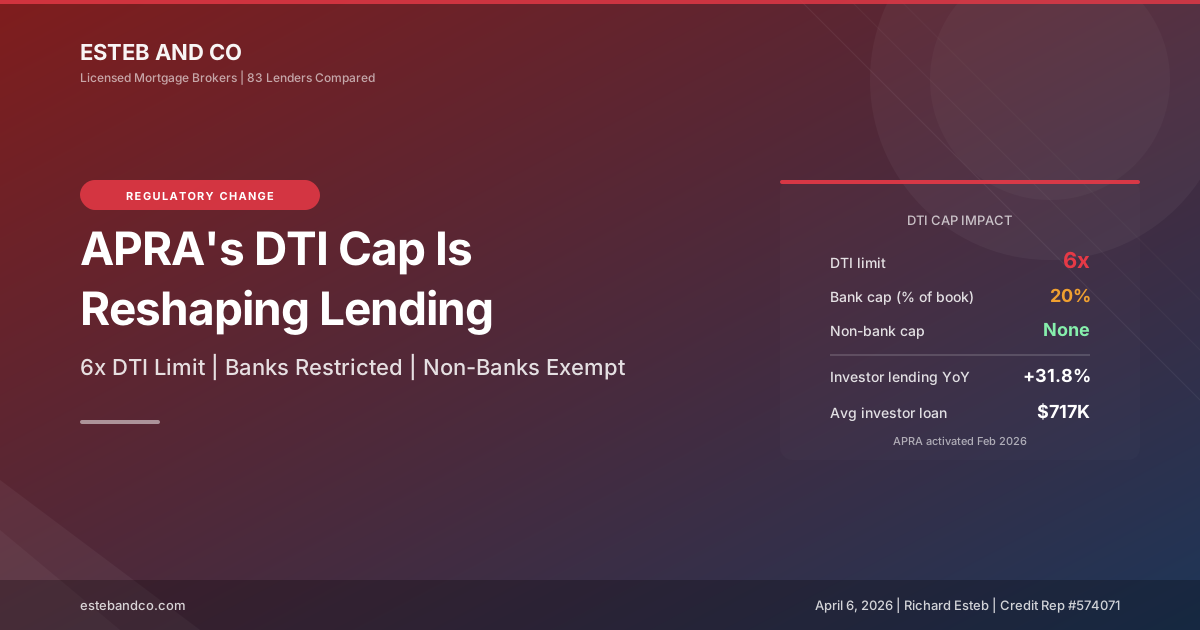
In February 2026, APRA activated a macroprudential tool it had been preparing for years: a debt-to-income (DTI) limit on bank lending. The rule is straightforward but the consequences are significant.
Here’s how it works:
- Any loan where total debt ÷ gross income ≥ 6x is classified as “high DTI”
- Banks must limit high-DTI loans to no more than 20% of new mortgage lending
- The cap applies separately to owner-occupier and investor loan books
- Non-bank lenders are exempt — they are not APRA-regulated ADIs
In practical terms: if a bank has already filled its 20% high-DTI quota for the month, your application gets declined or delayed — even if you can clearly afford the repayments.
Why APRA Acted Now
The numbers made it unavoidable. ABS data for December Quarter 2025 shows:
| Metric | Value | Change |
|---|---|---|
| Investor lending (quarterly) | $42.9 billion | +31.8% YoY |
| Avg investor loan size | $717,000 | +$43,000 YoY |
| First home buyer loans | Record high | +15.5% by value |
| Total housing commitments | Up 9.5% by value | Quarterly |
Investor lending growing at 31.8% year-on-year while rates sit at 4.10% is exactly the scenario APRA was designed to manage. The last time investor lending surged this hard (2014–2017), APRA imposed a 10% growth cap. This time they’re using DTI limits instead — a more targeted tool.
APRA’s concern is not that individual borrowers can’t afford their loans. It’s that the banking system is accumulating concentration risk in high-leverage lending.
Who’s Affected
Every bank regulated by APRA — which includes all four majors (CBA, ANZ, NAB, Westpac) plus every credit union, building society, and mutual bank.
Here’s how a DTI of 6x translates to real numbers:
| Gross Household Income | Max Debt at 6x DTI | Typical Scenario |
|---|---|---|
| $100,000 | $600,000 | Single income, modest loan |
| $150,000 | $900,000 | Couple, median Sydney property |
| $200,000 | $1,200,000 | Dual income professional couple |
| $120,000 | $720,000 | Couple with existing $200K debt = only $520K new borrowing |
The last row is where it bites hardest. Existing debt — car loans, HECS, credit cards — all count toward your total debt. An investor with a $500K home loan applying for a $400K investment loan on $120K income has a DTI of 7.5x. That’s firmly in the restricted zone at any bank.
The Non-Bank Opportunity
Non-bank lenders — Pepper Money, Liberty Financial, La Trobe Financial, Resimac, Bluestone — are regulated by ASIC but are not APRA-supervised ADIs. The DTI cap simply does not apply to them.
Our matching engine data confirms this shift is already happening. Across our panel of 50 lenders, here are the top matches over the past 6 months:
| Lender | Type | Matches | Avg Score |
|---|---|---|---|
| Pepper Money | Non-bank | 59 | 96.4 |
| Harmoney | Non-bank | 45 | 98.2 |
| Latitude | Non-bank | 45 | 98.2 |
| MoneyMe | Non-bank | 45 | 98.2 |
| Wisr | Non-bank | 44 | 96.8 |
| Liberty Financial | Non-bank | 33 | 93.9 |
| ANZ | Bank | 31 | 93.4 |
| Westpac | Bank | 31 | 93.4 |
| ING | Bank | 30 | 93.7 |
| NAB | Bank | 29 | 92.9 |
Non-bank lenders already dominate the top of our matching results. With the DTI cap now active, the gap will widen — especially for investors and borrowers with existing debt.
Bank vs Non-Bank: What’s Different
| Factor | Bank (APRA-regulated) | Non-Bank (ASIC-regulated) |
|---|---|---|
| DTI cap | 6x limit, 20% quota | No limit |
| Serviceability buffer | 3.0% (APRA mandated) | 2.0–2.75% (own policy) |
| Best variable rate (OO P&I) | 5.49–5.99% | 5.54–6.20% |
| Investor IO rates | 6.09–6.59% | 5.99–6.49% |
| Turnaround time | 5–15 business days | 2–7 business days |
| Max LVR (investor) | 80% (some 90% with LMI) | 80–90% |
| Income verification | Strict full-doc | Full-doc + low-doc options |
| Credit history flexibility | Limited | More flexible |
The rate gap between banks and non-banks has narrowed significantly. In many cases, non-bank rates are now competitive or cheaper than the big four — and they approve faster with less red tape.
What This Means for Investors
If you’re an investor — or want to be — here’s the strategic calculus:
Strategy 1: Non-bank first, refinance later
Use a non-bank lender to get the investment loan approved now (no DTI cap, lower buffer, faster approval). After 12 months, refinance to a bank if you want their rate or offset features. By then your equity position and rental income improve your DTI.
Strategy 2: Restructure existing debt first
Pay down or consolidate existing debts before applying. A $20,000 car loan on a $150K income adds 0.13x to your DTI — small individually, but these stack up. Close unused credit cards (the full limit counts, not the balance).
Strategy 3: Income stacking
Some non-bank lenders will count 100% of rental income from your existing portfolio (banks typically count only 80%). This effectively lowers your DTI by boosting the denominator.
What This Means for First Home Buyers
The DTI cap has less direct impact on most first home buyers because you typically don’t have existing mortgage debt pushing your DTI above 6x. However:
- HECS counts. A $40,000 HECS debt on $80K income is 0.5x DTI before you even borrow
- Credit card limits count. A $10,000 credit card limit counts as $10,000 debt, even if the balance is zero
- Car loans compound the problem. If you’re buying in Sydney at $900K+ with a car loan, you could hit 6x on a dual income of $140K
The solution is the same: close unused credit products, understand your DTI before you apply, and use a broker who can match you to the right lender — bank or non-bank — for your specific numbers.
Frequently Asked Questions
What is APRA’s DTI cap?
Banks must now limit new mortgage lending where total debt exceeds 6 times gross income to no more than 20% of their total new lending. Non-bank lenders are exempt from this rule.
Are non-bank lenders safe to borrow from?
Yes. Non-bank lenders like Pepper Money, Liberty, and La Trobe are ASIC-regulated and hold Australian Credit Licences. They fund loans through securitisation and wholesale markets rather than deposits, which is why APRA does not supervise them. Your loan contract is just as enforceable and your consumer protections are identical.
How do I calculate my DTI?
Total debt (new loan + existing loans + credit card limits + HECS) ÷ gross annual household income. A $700K mortgage + $30K car loan + $15K HECS on $120K income = ($700K + $30K + $15K) / $120K = 6.2x DTI.
Will the DTI cap push up non-bank rates?
Possibly, if demand surges. But non-bank lenders fund through capital markets, not deposits, so their pricing is driven by bond yields and investor appetite rather than APRA policy. So far, non-bank rates have remained competitive.
See where you stand
Compare your options across our panel of 50 lenders in about 2 minutes. Free, and it won’t affect your credit score.
Start complimentary assessment →No obligation · Richard Esteb, Credit Rep #574071
Richard Esteb
Ricky founded Esteb & Co to give everyday Australians access to the same loan comparison technology used by the big banks. He compares products from a panel of 50 lenders to find the right fit for each client’s situation.