May RBA Decision: Another Hike or a Pause? What to Watch and What to Do

In this article
The May 5 Decision at a Glance
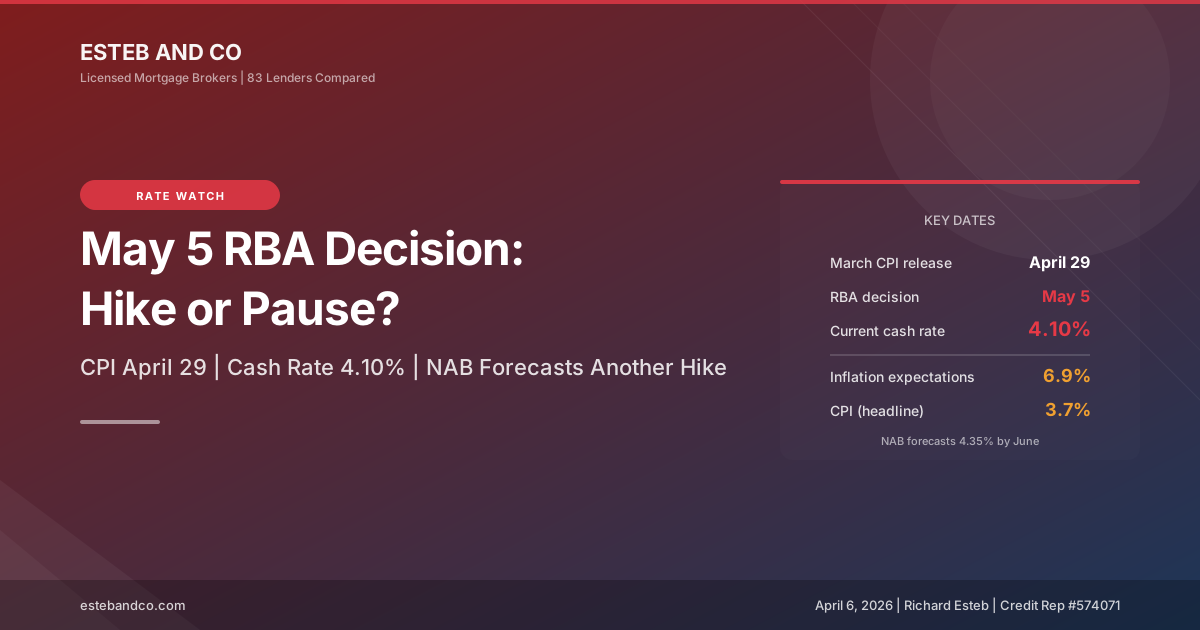
The RBA Board meets May 4–5, with the decision announced at 2:30pm AEST on Monday May 5. This is arguably the most consequential meeting of 2026 so far. Here’s the timeline:
| Date | Event | Why It Matters |
|---|---|---|
| April 29 | March monthly CPI release | The single most important data point — 6 days before the decision |
| May 4–5 | RBA Board meeting | Two-day format with SoMP released simultaneously |
| May 5, 2:30pm | Rate decision announced | Cash rate: hold at 4.10% or hike to 4.35% |
| May 5 | Statement on Monetary Policy | Updated inflation and growth forecasts |
| May 13 | March quarter Wage Price Index | Wage growth direction — informs June decision |
The current cash rate is 4.10% following back-to-back hikes of 25bp each in February and March. That’s 50bp of tightening in two months — the most aggressive move since the 2022–2023 hiking cycle.
The Case for a Hike
There are four data points pushing toward another increase:
1. Inflation is still above target
Headline CPI sits at 3.7%, trimmed mean at 3.3%. Both are above the RBA’s 2–3% target band. Until trimmed mean is sustainably below 3%, the RBA has no room to ease — and may need to tighten further.
2. Inflation expectations have spiked
The ANZ–Roy Morgan consumer inflation expectations index jumped to 6.9% in mid-March, up 1.6 percentage points from February. This is a red flag. When consumers expect higher inflation, they bring forward purchases and demand higher wages — both of which make inflation self-fulfilling.
3. Investor lending is booming
ABS data shows investor lending up 31.8% year-on-year to a record $42.9 billion. Asset price inflation driven by leverage is exactly what rate hikes are designed to cool.
4. The weak AUD is importing inflation
AUD/USD at $0.687 means imported goods, fuel, and materials cost more in Australian dollar terms. Brent crude at $100–110/barrel compounds the problem. A weaker currency effectively undermines the RBA’s domestic tightening.
The Case for a Pause
1. Fuel excise cut reduces headline CPI
The government cut fuel excise by 50% (26.3c/L) from April 1 for three months. This will temporarily drag down the transport component of CPI. The RBA knows this is a one-off — but it still shows up in the data and gives them cover to pause.
2. Unemployment is rising
Unemployment has crept up to 4.1–4.3% from 3.7% a year ago. The labour market is softening. Hiking into rising unemployment risks triggering a recession — something the RBA is desperate to avoid.
3. Rate hikes work with a lag
The February and March hikes haven’t fully flowed through to consumer spending yet. Monetary policy typically takes 6–18 months to have full effect. The RBA may choose to pause and wait for the existing hikes to do their work.
4. Consumer sentiment is falling
Households are already stretched. Real wages are negative (3.4% wage growth vs 3.7% inflation). Mortgage stress indicators are rising. Another hike risks tipping vulnerable borrowers into default.
What the Banks Expect
| Bank | May Forecast | Year-End Forecast | Rationale |
|---|---|---|---|
| NAB | Hike to 4.35% | 4.35–4.60% | Inflation too sticky, expectations spiking |
| CBA | Hold at 4.10% | 4.10% | Cumulative hikes need time, fuel excise helps |
| Westpac | Hold at 4.10% | 4.10% | Labour market softening, pause warranted |
| ANZ | Hold at 4.10% | 3.85–4.10% | Possibly one cut late 2026 if data improves |
NAB is the outlier forecasting a hike. The other three expect a hold. The April 29 CPI release will almost certainly decide it.
The April 29 CPI Release: Why It Matters More Than Usual
The March monthly CPI indicator drops on Tuesday April 29 — just 6 days before the RBA decision. This is the last major data point the Board will see before making their call.
Here’s what to watch:
| CPI Outcome | Likely RBA Response | What It Means for You |
|---|---|---|
| Above 3.7% (higher) | Hike very likely | Lock in rates now if you can |
| 3.5–3.7% (stable) | Coin flip — could go either way | Prepare for both scenarios |
| Below 3.5% (falling) | Pause likely | Relief rally in markets, variable rates safe for now |
| Below 3.0% (target) | Pause confirmed, cuts on table | Very unlikely but would be a game-changer |
The fuel excise cut complicates the reading. Transport CPI should drop in March data, but the RBA will strip this out and focus on trimmed mean. If core inflation is still above 3.3%, the case for a hike remains strong regardless of the headline number.
Impact on Your Repayments
If the RBA hikes 25bp to 4.35% and your lender passes it on in full (all Big 4 have passed on the last two hikes in full):
| Loan Size | Current Repayment (6.10%) | After Hike (6.35%) | Monthly Increase | Annual Increase |
|---|---|---|---|---|
| $500,000 | $3,030 | $3,108 | +$78 | +$936 |
| $750,000 | $4,545 | $4,662 | +$117 | +$1,404 |
| $1,000,000 | $6,060 | $6,216 | +$156 | +$1,872 |
Remember: this would be on top of the $218/month increase from the February and March hikes on the average $736K loan. Cumulative pain adds up.
Your 5-Point Action Plan Before May 5
1. Check your actual rate right now
Log into your banking app and check the rate you’re paying today. If it’s above 6.00% for an owner-occupier P&I loan, you are almost certainly overpaying relative to the market.
2. Compare across the whole market
Don’t just call your bank. The gap between the best and worst variable rates right now is over 1.50%. A broker can search 50 lenders in minutes. Start a free comparison here.
3. Consider a split loan
Fix part of your loan to lock in current rates (hedge against a May hike). Keep part variable for flexibility and offset access. A 50/50 or 60/40 split is the most common strategy in this environment.
4. Build a buffer
If you’re on a variable rate, prepare for the possibility of 4.35% or higher. That means $117/month more on a $750K loan. Build at least 3 months of repayments into your offset or savings account.
5. Watch April 29
The March CPI release on April 29 will signal the outcome. If CPI drops below 3.5%, a pause is likely and variable-rate borrowers can breathe. If it stays above 3.7%, act before May 5 — refinance applications lodged before the decision will be assessed at current rates.
Frequently Asked Questions
When is the next RBA meeting?
May 4–5, 2026. Decision announced at 2:30pm AEST on May 5.
Will the RBA raise rates again?
NAB forecasts a 25bp hike to 4.35%. CBA, Westpac, and ANZ expect a hold. The March CPI on April 29 will likely decide it. If above 3.5%, hike is probable. Below 3.5%, pause is likely.
How much does a rate hike add to my repayments?
+$78/month on $500K, +$117/month on $750K, +$156/month on $1M (30-year P&I). This is on top of +$218/month from the Feb–Mar hikes on the average $736K loan.
Should I fix before May 5?
Consider a partial fix (split loan) to hedge both directions. Fixed rates already price in expected hikes, so full fixing isn’t necessarily cheaper. A 50/50 split gives certainty on half and flexibility on the rest.
When will rates be cut?
Late 2026 at the earliest, with many economists pushing to 2027. The RBA needs trimmed mean inflation below 3% sustainably. With CPI at 3.7% and consumer expectations at 6.9%, that’s not imminent.
See where you stand
Compare your options across our panel of 50 lenders in about 2 minutes. Free, and it won’t affect your credit score.
Start complimentary assessment →No obligation · Richard Esteb, Credit Rep #574071
Richard Esteb
Ricky founded Esteb & Co to give everyday Australians access to the same loan comparison technology used by the big banks. He compares products from a panel of 50 lenders to find the right fit for each client’s situation.