Inside the Numbers: What 363 Loan Applications Tell Us About the Market Right Now

In this article
Why We Publish This Data
Most lending data you read comes from the ABS, RBA, or industry lobby groups. It’s useful but it’s aggregate — national averages that smooth out the reality of individual borrowers.
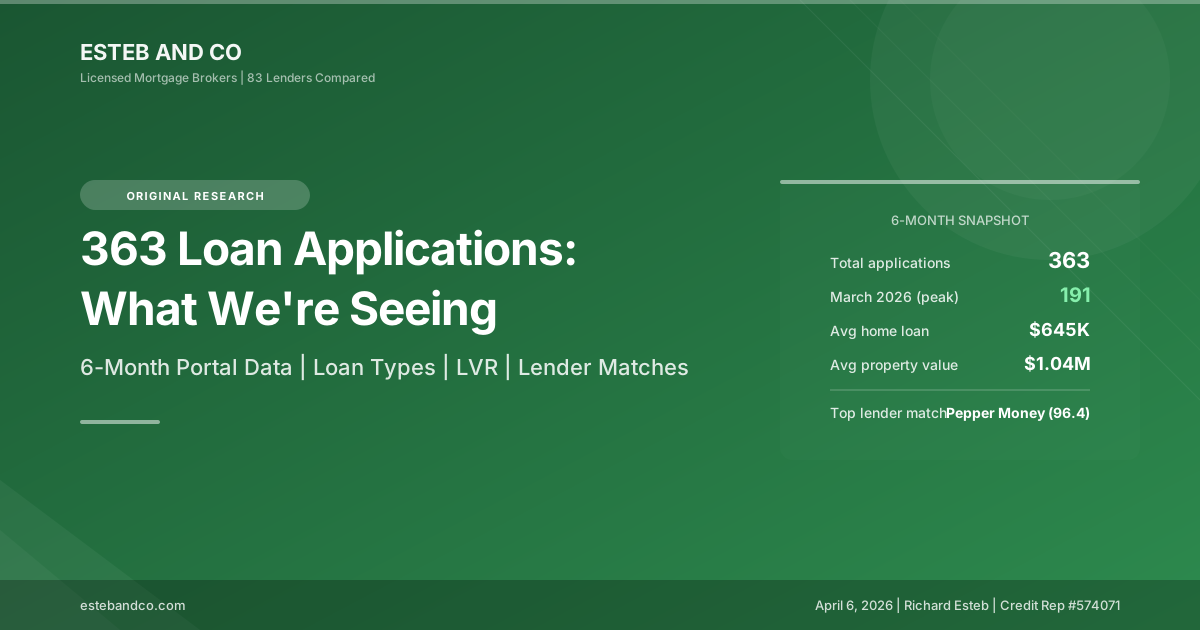
This is different. This is our actual data: 363 loan applications submitted through the Esteb and Co portal between November 2025 and April 2026. Real people, real numbers, real lending scenarios. We publish it because transparency matters, and because the patterns in our data often tell a different story than the national averages.
Monthly Application Volume
| Month | Applications | Avg Loan Amount | Trend |
|---|---|---|---|
| November 2025 | 5 | $996,000 | Launch month |
| December 2025 | 36 | $381,029 | +620% |
| January 2026 | 11 | $95,250 | Holiday dip |
| February 2026 | 88 | $341,365 | +700% |
| March 2026 | 191 | $353,750 | Record month |
| April 2026 (6 days) | 32 | $345,757 | On pace for 160+ |
March 2026 was our record month at 191 applications — more than double February. The January dip was expected (holiday season), but the February–March acceleration reflects both growing brand awareness and a market where borrowers are actively shopping for better deals after back-to-back rate hikes.
April is 6 days in with 32 applications, putting us on pace for roughly 160 for the month.
What People Are Applying For
Here’s the breakdown of the last 30 days of applications:
| Loan Type | Applications | % of Total | Avg Loan | Avg Property |
|---|---|---|---|---|
| Home loan | 94 | 50.3% | $645,346 | $1,036,730 |
| Personal loan | 36 | 19.3% | $23,150 | — |
| Business loan | 15 | 8.0% | $303,000 | $222,500 |
| Car loan | 12 | 6.4% | $43,500 | — |
| Private lending | 9 | 4.8% | $1,175,000 | $1,583,333 |
| SMSF loan | 8 | 4.3% | $407,500 | — |
| Securities lending | 7 | 3.7% | — | — |
| Referral partner | 5 | 2.7% | — | — |
| Refinance | 1 | 0.5% | $850,000 | $2,000,000 |
Home loans are half of all volume, which makes sense — that’s our core service. But the personal loan volume at 19% is notable. We’re seeing a clear pattern of borrowers looking to consolidate debt before applying for a mortgage — clearing car loans, credit cards, and buy-now-pay-later balances to improve their serviceability.
LVR Distribution
Of the 39 applications with valid property and loan data in the last 30 days:
| LVR Band | Applications | % of Total | What It Means |
|---|---|---|---|
| 0–60% LVR | 21 | 54% | Well-capitalised buyers, equity-rich refinancers |
| 61–70% LVR | 2 | 5% | Comfortable deposit range |
| 71–80% LVR | 8 | 21% | Standard 20% deposit — no LMI needed |
| 81–90% LVR | 3 | 8% | LMI zone — first home buyers |
| 91%+ LVR | 5 | 13% | High LVR — guarantee schemes or family pledge |
The standout finding: 54% of applicants are at 60% LVR or below. This isn’t typical first-home-buyer territory — these are equity-rich refinancers, upgraders, and investors using existing property equity. It suggests our audience is relatively financially sophisticated.
Which Lenders Are Matching
Our matching engine scores every application against 50 lender policies. Here are the top 10 most frequently matched:
| # | Lender | Type | Matches | Avg Score |
|---|---|---|---|---|
| 1 | Pepper Money | Non-bank | 59 | 96.4 |
| 2 | Harmoney | Non-bank | 45 | 98.2 |
| 3 | Latitude | Non-bank | 45 | 98.2 |
| 4 | MoneyMe | Non-bank | 45 | 98.2 |
| 5 | Wisr | Non-bank | 44 | 96.8 |
| 6 | SocietyOne | Non-bank | 40 | 98.0 |
| 7 | Liberty Financial | Non-bank | 33 | 93.9 |
| 8 | ANZ | Bank | 31 | 93.4 |
| 9 | Westpac | Bank | 31 | 93.4 |
| 10 | ING | Bank | 30 | 93.7 |
Non-bank lenders hold 7 of the top 10 positions. This reflects their broader lending criteria, lower serviceability buffers, and exemption from APRA’s DTI cap. It does not mean banks are worse — it means non-banks can say “yes” to a wider range of situations.
Home Loan Deep Dive
Across 94 home loan applications in the last 30 days:
- Average loan amount: $645,346
- Average property value: $1,036,730
- Implied average LVR: ~62%
- Median scenario: Borrower buying a $1M property with $400K equity or deposit
The $645K average loan is lower than the national ABS average of $736K for new owner-occupier commitments. This suggests our applicant base includes a higher proportion of refinancers and equity-rich borrowers who are borrowing less than the full property value.
The Personal Loan Surge
36 personal loan applications in 30 days, averaging $23,150 each. This is the second-largest category after home loans.
The pattern is clear: many of these applicants are consolidating debt before a mortgage application. Clearing a $23K personal loan at 12% and replacing it with a structured repayment plan at 6–8% through a non-bank like Harmoney or Wisr achieves two things:
- Reduces the interest rate on the existing debt
- Creates a documented repayment history that improves serviceability for a future home loan
What This Means for You
1. Non-bank lenders should be your starting point
They match more often, approve faster, and have fewer restrictions. Start with the broadest options and narrow down — don’t limit yourself to the big four.
2. Your deposit position matters more than your income
54% of our applicants are at 60% LVR or below. If you have equity in an existing property or a substantial deposit, your options are dramatically wider than someone at 90% LVR.
3. Consolidate before you apply
If you have scattered debts (car loan, credit cards, BNPL), consolidating into a single personal loan can improve your DTI ratio and your chances of home loan approval.
4. The market is getting busier
191 applications in March is our record. More borrowers are comparing options. If you’re planning to buy or refinance, don’t wait — lender turnaround times will blow out as volume increases.
Frequently Asked Questions
Where does this data come from?
Real loan applications submitted through our portal between November 2025 and April 2026. No bought data, no scraping, no estimates.
What is the average home loan amount right now?
$645,346 across our portal in the last 30 days, against an average property value of $1,036,730 (implied 62% LVR).
Which lenders match most often?
Pepper Money leads with 59 matches and a 96.4 average score. Non-bank lenders hold 7 of the top 10 positions in our matching engine.
Why are non-bank lenders matching more than banks?
Broader lending criteria, lower serviceability buffers (2–2.75% vs 3% for banks), and no APRA DTI cap. They can say yes to more situations.
See where you stand
Compare your options across our panel of 50 lenders in about 2 minutes. Free, and it won’t affect your credit score.
Start complimentary assessment →No obligation · Richard Esteb, Credit Rep #574071
Richard Esteb
Ricky founded Esteb & Co to give everyday Australians access to the same loan comparison technology used by the big banks. He compares products from a panel of 50 lenders to find the right fit for each client’s situation.