Fixed vs Variable Home Loan Rates: Which Is Right for You in 2026?

Where Rates Actually Sit Right Now
I went through our 104-lender panel this week, and the picture has shifted meaningfully since the RBA’s two consecutive hikes pushed the cash rate to 4.10%. Variable rates are currently cheaper than fixed — but only just — and that gap tells a story about where the market thinks rates are heading.
Here’s what I’m seeing across the market right now for owner-occupier principal and interest loans:
- Best variable rate: 5.54% (QLD Country Bank)
- Best 2-year fixed rate: 5.74% (HSBC)
- Big bank discounted variable: 5.78%–5.99% (ANZ, CBA, Westpac, NAB)
- Big bank standard variable rate: 6.34%–6.59%
That 0.20% gap between the best variable and the best fixed is important. Variable is cheaper today, but if the RBA hikes again in May, that advantage evaporates overnight. Fixed rates have already priced in some expectation of further tightening — they’re essentially a bet on where rates will be over the next 2–3 years.
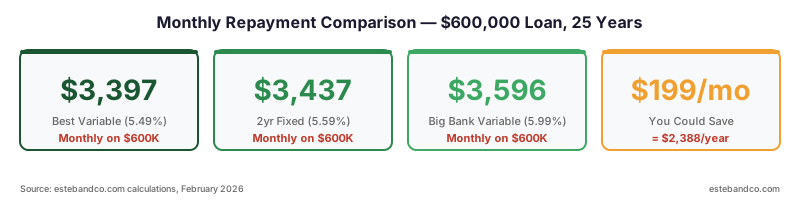
On a $600,000 loan over 25 years, here’s what those rates actually cost each month:
| Rate Type | Rate | Monthly Repayment | Difference |
|---|---|---|---|
| Best variable (QLD Country Bank) | 5.54% | $3,639 | — |
| Best 2yr fixed (HSBC) | 5.74% | $3,743 | +$104/mo |
| Big bank discounted variable | 5.99% | $3,875 | +$236/mo |
| Big bank SVR | 6.59% | $4,120 | +$481/mo |
If you’re on a big four standard variable rate right now, you’re paying $481 per month more than you need to. Over a year, that’s $5,772. I see this constantly — borrowers who haven’t reviewed their rate in years and don’t realise how much they’re leaving on the table.
The latest ABS Lending Indicators show fixed rate loans now make up about 35% of new lending, up from 15% in 2022. Borrowers are hedging again. When I see that kind of shift, it tells me uncertainty is the dominant mood — people want a foot in both camps.
How Variable Rate Loans Work
A variable rate moves with the market. When the RBA changes the cash rate, your lender typically adjusts your rate within a few weeks. Sometimes they pass on the full change, sometimes only part of it — and occasionally they move rates independently of the RBA altogether (the “out-of-cycle” moves that make headlines).
The advantages I see in practice
Offset accounts. This is the single biggest feature advantage variable loans have over fixed. A 100% offset account lets you park your savings against your mortgage balance. If you owe $600,000 and have $50,000 in your offset, you only pay interest on $550,000. At 5.54%, that $50,000 offset saves you roughly $2,770 per year in interest. I’ve had clients save tens of thousands over their loan life just from disciplined offset use.
Unlimited extra repayments. You can throw as much extra money at a variable loan as you want. Got a bonus? Tax refund? Inheritance? Straight onto the mortgage. Most fixed rate loans cap extra repayments at $10,000–$20,000 per year — anything above that and you cop penalty fees.
No break costs. If you need to sell your property, refinance, or make changes to your loan, there are no penalties. With a fixed rate, break costs can run into tens of thousands of dollars — I’ve seen break fees of $25,000+ on a $700,000 loan when rates moved against the borrower.
Redraw facility. Most variable loans let you redraw any extra repayments you’ve made. It’s not as tax-effective as an offset for investment properties, but for owner-occupiers it provides a safety net if cash gets tight.
The downside
Your repayments change when rates move. After the two 2026 hikes, a borrower with $600,000 at the best variable rate of 5.54% is paying $3,639 per month. If the RBA hikes another 0.25% in May, that rate could push to 5.79% or higher, adding approximately $96 per month. That uncertainty compounds psychologically — it’s not just about the dollars, it’s about not knowing what your largest monthly expense will be next quarter.
How Fixed Rate Loans Work
A fixed rate locks your interest rate for a set period — typically 1, 2, 3, or 5 years. Your repayments stay exactly the same regardless of what the RBA does during that period. Right now the best 2-year fixed rate is 5.74% from HSBC, with Bank of China at 5.79% and Newcastle Permanent matching at 5.79%.
When I recommend fixing
You’re on a tight budget with no room for rate rises. If a $100–$200 monthly increase would cause genuine stress, fixing removes that risk entirely. I had a young couple — first home buyers — last month whose combined income left them with about $350 per month buffer after their mortgage. I told them straight: fix at least 60–70% of your loan, because one more hike at the May meeting would put them under pressure.
You believe rates will rise further. The March 2026 hike was decided on a 5–4 vote. That’s a razor-thin margin that says the Board itself is divided. If inflation stays sticky through the March quarter CPI data (released April 29), another hike in May is very much on the table. Fixed rate borrowers won’t feel any of that.
You want certainty for financial planning. If you’re budgeting for a renovation, starting a family, or one partner is taking parental leave, knowing your exact mortgage repayment for the next 2–3 years has real value that transcends the pure rate comparison.
The trade-offs
Limited extra repayments. Most lenders cap additional repayments at $10,000–$20,000 per year during the fixed period. If you come into money, you can’t aggressively pay down the loan.
No offset account (usually). Some lenders offer offset on fixed loans, but most don’t. CBA is one of the few that offers a partial offset on their fixed rate products. For most borrowers with significant savings, the loss of offset eats into whatever rate advantage fixing provides.
Break costs. If you need to break your fixed rate early — to sell, refinance, or switch — the lender calculates a break cost based on the difference between your rate and current wholesale rates. Break costs can range from $2,000 to $30,000+ depending on rate movements and remaining term. The calculation always favours the lender.
You might miss rate cuts. If the RBA eventually cuts rates during your fixed period, you’re locked in at the higher rate. This is exactly what happened to borrowers who fixed at 6%+ in late 2023 — variable rates came down while they were stuck paying more.
The Real Cost Comparison: 3 Scenarios
I ran the numbers using current rates from our panel on a $600,000 owner-occupier loan over 25 years. The right choice depends entirely on what happens to rates over the next two years — so I modelled three scenarios.
Scenario 1: Rates stay where they are
| Option | Rate | Monthly Repayment | Total Interest Over 2 Years |
|---|---|---|---|
| Best variable (5.54%) | 5.54% | $3,639 | $64,296 |
| Best 2yr fixed (5.74%) | 5.74% | $3,743 | $66,792 |
| Big bank variable (5.99%) | 5.99% | $3,875 | $69,576 |
If rates don’t move, the variable borrower saves $2,496 over two years compared to the best fixed rate. The variable advantage is clear — but only if rates actually stay flat, which is far from guaranteed in the current environment.
Scenario 2: Rates rise another 0.50% (two more hikes)
| Option | Rate After Hikes | Monthly Repayment | Approx. Total Interest Over 2 Years |
|---|---|---|---|
| Variable (was 5.54%) | 6.04% | $3,901 | $69,600 |
| 2yr fixed (locked at 5.74%) | 5.74% | $3,743 | $66,792 |
| Big bank variable (was 5.99%) | 6.49% | $4,078 | $73,200 |
With two more hikes, the fixed borrower saves roughly $2,800 over two years compared to the variable borrower who started at the best rate, and a whopping $6,400 compared to the big bank variable. Fixed wins decisively when rates go up — that’s its entire reason for existing.
Scenario 3: Rates fall 0.50% (two cuts)
| Option | Rate After Cuts | Monthly Repayment | Approx. Total Interest Over 2 Years |
|---|---|---|---|
| Variable (was 5.54%) | 5.04% | $3,390 | $59,400 |
| 2yr fixed (locked at 5.74%) | 5.74% | $3,743 | $66,792 |
| Big bank variable (was 5.99%) | 5.49% | $3,619 | $63,480 |
If rates fall, the variable borrower saves over $7,000 compared to the fixed borrower over two years. Even the big bank variable borrower comes out ahead of the person who locked in.
The takeaway: variable wins if rates stay flat or drop. Fixed wins if rates rise. Nobody knows which scenario will play out — which is precisely why splitting your loan is the pragmatic move for most borrowers.
The Split Loan Strategy
Here’s what I recommend to the majority of my clients, and it’s what I’d do myself: split the loan.
A split loan divides your mortgage into two portions — one fixed, one variable. You get the certainty of fixed repayments on part of your loan, plus the flexibility and offset benefit on the rest. It’s not fence-sitting; it’s risk management.
How I typically structure it
The two most common splits I set up for clients:
- 60% fixed / 40% variable — for borrowers who prioritise certainty and have less savings to offset. The larger fixed portion gives you more protection against rate rises.
- 70% variable / 30% fixed — for borrowers with significant savings (say $40,000+) who want maximum offset benefit. The smaller fixed portion still gives you a hedge.
On a $600,000 loan with a 60/40 split:
- $360,000 fixed at 5.74% = $2,246/month
- $240,000 variable at 5.54% = $1,456/month
- Total: $3,702/month
If you have $40,000 in your offset account against the variable portion, you’re effectively paying interest on $200,000 variable — which drops that portion to about $1,213/month and your total to $3,459/month.
Now if the RBA hikes 0.50%, only your $240,000 variable portion is affected. Instead of the full $600,000 jumping in cost, your exposure is limited to 40% of the loan. Your fixed portion doesn’t budge. That’s the whole point.
Every major lender and most non-bank lenders on our panel offer split loans. It’s not exotic — it’s the standard way smart borrowers manage interest rate risk in an uncertain cycle.
Current Lender Rates: Fixed vs Variable Compared
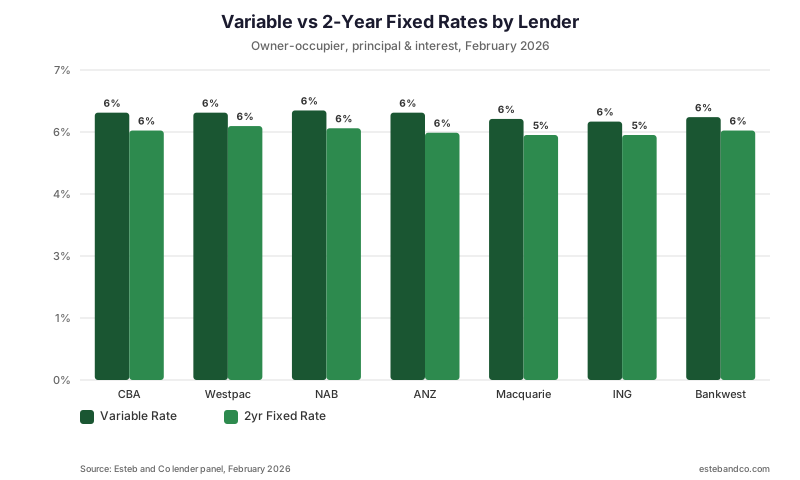
I pulled these from our panel this week. All rates are owner-occupier, principal and interest.
Variable rates (sorted by rate)
| Lender | Variable Rate | Notes |
|---|---|---|
| QLD Country Bank | 5.54% | Lowest on panel |
| Firefighters Mutual / Teachers Mutual / UniBank | 5.64% | Restricted membership |
| Bank of China | 5.68% | Also strong on fixed |
| HSBC | 5.69% | Full offset available |
| GMCU / Bank of Sydney | 5.69% | |
| QBANK / Heritage / Hume Bank | 5.74% | |
| Newcastle Permanent | 5.74% | |
| BCU / Peoples Choice | 5.74% | |
| ANZ | 5.78% | Best of the Big 4 |
| Credit Union SA / Great Southern Bank | 5.79% | |
| AMP Bank | 5.82% | |
| NAB | ~5.94% | |
| CBA | ~5.99% | |
| Westpac | ~5.99% | |
| Big 4 SVR (undiscounted) | 6.34%–6.59% | Don’t pay this |
Fixed rates (2-year term, sorted by rate)
| Lender | 2yr Fixed Rate | Notes |
|---|---|---|
| HSBC | 5.74% | Lowest 2yr fixed on panel |
| Bank of China | 5.79% | Same rate for OO + investment |
| Newcastle Permanent | 5.79% | |
| Hume Bank | 5.84% | |
| QLD Country Bank | 5.99% | Variable is better here |
| Heritage | 6.04% | |
| QBANK | 6.09% | |
| ANZ | 6.34% | Big 4 premium |
Investment property rates
| Rate Type | Lender | Rate |
|---|---|---|
| Best investment variable | QLD Country Bank | 5.74% |
| Second-best investment variable | HSBC | 5.79% |
| Best investment fixed | Bank of China | 5.79% |
Rates are indicative, based on owner-occupier P&I loans at max 80% LVR unless noted. Subject to change. April 2026.
A few things jump out. QLD Country Bank has the best variable rate but its fixed rate is mediocre — if you want to split, you might need two different lenders or accept the compromise. HSBC is competitive on both sides, which makes it a strong option for split loans. Bank of China is particularly interesting for investors because the 5.79% fixed rate applies to both owner-occupier and investment loans — most lenders charge a premium for investment.
The Big 4 banks are consistently the most expensive on both fixed and variable. ANZ’s 2-year fixed at 6.34% is a full 0.60% above HSBC. On a $600,000 loan, that’s roughly $1,800 per year in extra interest for no tangible benefit.
The RBA Factor: What the Rate Cycle Tells Us
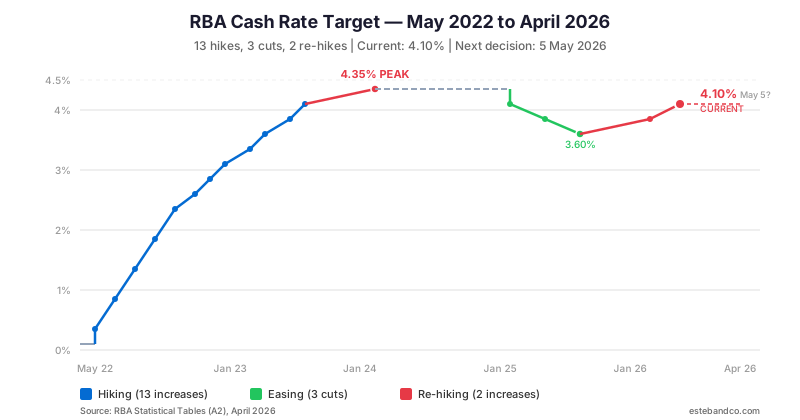
Understanding the rate cycle is critical for making the fixed-versus-variable decision. Here’s the journey:
- April 2020: Cash rate at 0.10% (emergency COVID levels)
- May 2022 – Nov 2023: Aggressive hiking cycle, cash rate rises to 4.35%
- Dec 2023 – Aug 2025: Gradual easing, cash rate cuts down to 3.60%
- Feb 2026: Surprise hike to 3.85% as inflation re-accelerates
- March 18, 2026: Another hike to 4.10% — decided on a tight 5–4 vote
- Next decision: May 5, 2026
That 5–4 vote on the March hike is the most important detail in this entire article. Four of the nine Board members voted to hold rates. That tells you the Board is genuinely split on whether more tightening is needed. One more dissenter and they would have paused.
What the 5–4 split means for your decision
It means nobody knows what happens next — not the RBA, not the banks, not the market. The March quarter CPI data (released April 29) will likely swing the May decision one way or the other. Market pricing currently suggests another hike is possible but not certain.
For fixed-versus-variable purposes, this uncertainty actually strengthens the case for a split loan. If the experts can’t agree, why would you bet your entire mortgage on one outcome?
What happens if rates go higher?
If the RBA hikes to 4.35% or beyond, every variable borrower will see their rate jump by the same amount. On the best variable rate of 5.54%, a 0.25% hike pushes you to 5.79%. A further 0.25% after that puts you at 6.04% — suddenly above the fixed rate you could have locked in at 5.74%.
What happens if rates are cut?
Rate cuts look unlikely before late 2026 at the earliest. The RBA needs trimmed mean inflation sustainably within their 2–3% target band before it can ease. With the cash rate at 4.10% and inflation still elevated, most economists are pushing cut expectations into 2027. If you fix for 2 years now, there’s a chance rates will be lower when your fixed term expires — but that’s 2028, and a lot can change.
The Mortgage Cliff: What Happened to Borrowers Who Fixed in 2021–2022
This is essential context for anyone considering fixing right now. During COVID, the RBA dropped the cash rate to 0.10% and lenders offered fixed rates below 2%. Hundreds of thousands of Australians locked in at rates between 1.89% and 2.50%.
Those fixed terms have now largely expired. The RBA’s own analysis found that around 14% of those fixed-rate borrowers faced mortgage payment increases of more than 60% when they rolled off. On a $500,000 loan, going from 2.00% to 5.99% means your monthly repayment jumps from $2,121 to $3,596 — an extra $1,475 per month.
I helped dozens of these borrowers through the transition. The ones who planned ahead — building savings, cutting expenses before their fixed term ended, or refinancing early to lock in a competitive variable rate — managed the shift without major stress. The ones who ignored the expiry date got a nasty surprise when they rolled onto the lender’s standard variable rate.
The lesson for 2026
The 2021–2022 fixed rate borrowers fixed at historically abnormal levels. Today’s fixed rates (5.74%–6.34%) are already at elevated levels, so the “cliff” risk when your fixed term expires is much smaller. You’re not locking in at 2% only to roll off at 6% — you’re locking in at 5.74% and probably rolling off somewhere in the 5–6% range.
That said, the core lesson still applies: always set a calendar reminder 3–4 months before your fixed term expires. Your lender will roll you onto their standard variable rate (SVR) by default — and SVRs of 6.34%–6.59% are money down the drain. Contact a broker before expiry and refinance to a competitive rate.
How to Decide: My Framework
After years of having this conversation with hundreds of borrowers, I’ve developed a simple framework. Answer these four questions:
1. Can you absorb a $200–$300/month increase without stress?
If yes, variable gives you better long-term flexibility. The offset, unlimited extra repayments, and no break costs are powerful features. If a rate rise would cause genuine financial strain, fix at least a portion of your loan.
2. Do you have significant savings to put in an offset?
If you have $30,000+ sitting in savings, a variable loan with offset will save you more than the 0.20% rate difference between fixed and variable. At 5.54%, $30,000 in offset saves you $1,662 per year — far more than the $1,248 annual difference between 5.54% and 5.74% on a $600,000 loan. Keep the variable portion large enough to maximise this benefit.
3. Are you planning to sell or make major changes within 3 years?
If yes, stay variable. Break costs on fixed loans can cost you thousands if you need to sell, refinance, or restructure before the fixed term ends. Life changes — jobs, relationships, kids, relocations — are the number one reason I see borrowers regret fixing.
4. How do you sleep at night?
This isn’t a joke. Some borrowers are fine with rate uncertainty — they can handle the variable swings and focus on the long-term average. Others lie awake before every RBA meeting wondering what their repayment will be next month. If certainty has value for your mental health and your relationship, that’s a legitimate reason to fix. You don’t need a financial model to justify peace of mind.
My default recommendation for most borrowers in April 2026: a split loan with 60% fixed at 5.74% and 40% variable with full offset. It protects against further hikes, preserves flexibility, and lets you benefit from offset savings on the variable portion.
Frequently Asked Questions
Is fixed or variable better in 2026?
Currently variable is about 0.20% cheaper, with the best variable at 5.54% versus the best 2-year fixed at 5.74%. But with the RBA having hiked twice already in 2026 and the cash rate at 4.10%, fixing offers valuable certainty if rates continue climbing. Most of my clients are opting for a split loan to cover both outcomes. If rates stay flat or fall, you win on the variable portion. If rates rise, you’re protected on the fixed portion.
What is the lowest fixed rate in Australia right now?
HSBC at 5.74% for a 2-year fixed owner-occupier principal and interest loan. Bank of China follows at 5.79% — notably, that rate also applies to investment loans, which is unusual. Newcastle Permanent matches at 5.79%. These are from our 104-lender panel as of April 2026 and are subject to change.
What is the lowest variable rate in Australia right now?
QLD Country Bank at 5.54% for owner-occupier principal and interest. Firefighters Mutual, Teachers Mutual, and UniBank follow at 5.64% (restricted membership). Bank of China sits at 5.68%, HSBC at 5.69%. Among the Big 4, ANZ leads at 5.78%. CBA and Westpac sit around 5.99%, and their standard variable rates run 6.34%–6.59%.
Can I split my loan between fixed and variable?
Yes. Most lenders allow split loans, and it’s by far the most popular strategy among my clients in the current environment. The common structures are 60% fixed / 40% variable or 70% fixed / 30% variable. The variable portion gives you access to an offset account and unlimited extra repayments, while the fixed portion locks in your rate for 2–3 years. On a $600,000 loan, a 60/40 split means $360,000 fixed and $240,000 variable.
What are break costs on a fixed rate loan?
Break costs can range from $2,000 to $30,000+ depending on rate movements and remaining term. Banks charge more when market rates drop below your fixed rate — the bigger the gap and the longer the remaining term, the higher the cost. Always request a break cost estimate from your lender before making any changes. It’s free to ask, and the number might surprise you in either direction.
Will rates go up again in May 2026?
The March hike was a close 5–4 vote on the RBA Board, which means the decision could have gone either way. The March quarter CPI data, released April 29, will be the single most important input for the May 5 decision. Market pricing suggests another hike is possible but not certain. If inflation stays above 3.5%, a hike becomes more likely. If it falls, the RBA may hold and wait for the previous two hikes to take effect. Read our full May RBA decision preview for the detailed breakdown.
See where you stand
Compare your options across our panel of 50 lenders in about 2 minutes. Free, and it won’t affect your credit score.
Start complimentary assessment →No obligation · Richard Esteb, Credit Rep #574071
Richard Esteb
Ricky founded Esteb & Co to give everyday Australians access to the same loan comparison technology used by the big banks. He compares products from a panel of 50 lenders to find the right fit for each client’s situation.