First Home Buyer Complete Guide Australia 2026: ABS Data, Grants and Lender Comparison

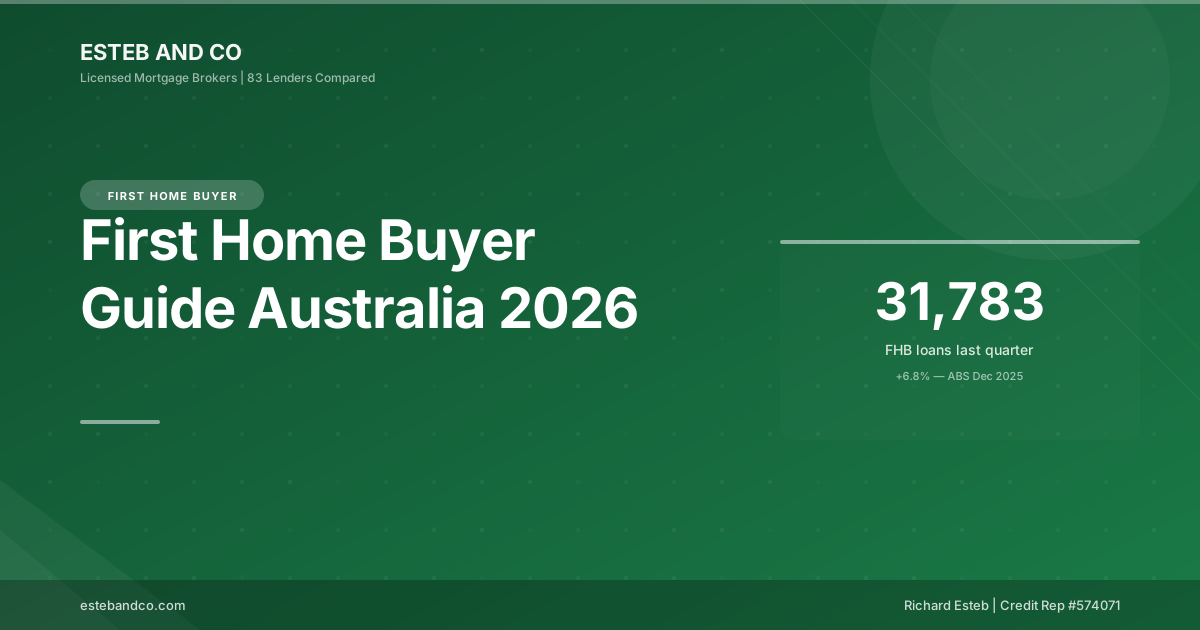
I sat down this week and went through the latest ABS Lending Indicators for December Quarter 2025. The first home buyer numbers stopped me in my tracks.
31,783 first home buyer loans were written last quarter. That's a 6.8% jump - the biggest quarterly rise since December 2023. The average loan size hit $607,624, up 8.5% in a single quarter. Total FHB lending reached $19.3 billion.
Those numbers tell me something important: despite two consecutive RBA rate hikes in 2026 pushing the cash rate to 4.10%, first home buyers aren't sitting on the sidelines. They're finding ways in. And the ones doing it smartly are using government schemes, comparing across dozens of lenders, and getting proper advice before they commit.
This guide is everything I tell my first home buyer clients in their initial strategy session. Real ABS data, actual rates from our 104-lender panel, government grants as they stand today, and the mistakes I see people make every week. No fluff, no generic advice - just what you actually need to know to buy your first home in 2026.
The Numbers Right Now: First Home Buyers in 2026
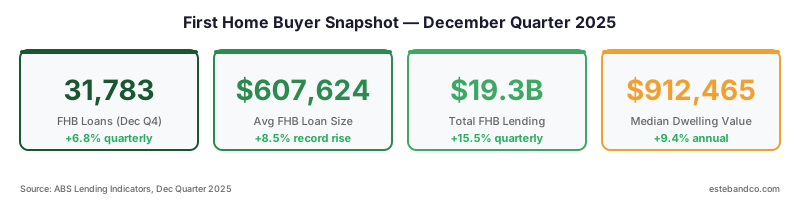
Let me lay out the landscape before we get into the how-to. These numbers are from the ABS Lending Indicators released for December Quarter 2025, plus Cotality (formerly CoreLogic) dwelling values from February 2026.
The key numbers
- 31,783 first home buyer loans written in Dec Quarter 2025 (up 6.8%)
- $607,624 average FHB loan size (up 8.5% - record single-quarter rise)
- $19.3 billion total FHB lending for the quarter (up 15.5%)
- $912,465 national median dwelling value (January 2026)
- $1,005,418 national median house price (Cotality, February 2026)
- $693,801 average owner-occupier loan size
- $3,935/month average owner-occupier repayment at 5.49%
- 5.49% average interest rate on new home loans (ABS)
The headline that matters: the national median house price has crossed $1 million for the first time. That changes the maths on deposits, stamp duty, and borrowing power significantly. But it also means first home buyers are gravitating toward units, townhouses, and regional areas where the entry point is lower.
The rate environment
The RBA has hiked twice in 2026. February saw the cash rate move from 3.60% to 3.85%, and March pushed it to 4.10%. These were the first hikes after a period of holds, and they caught a lot of people off guard. The next RBA decision is May 5, 2026 - and market pricing suggests they'll hold at 4.10% for now.
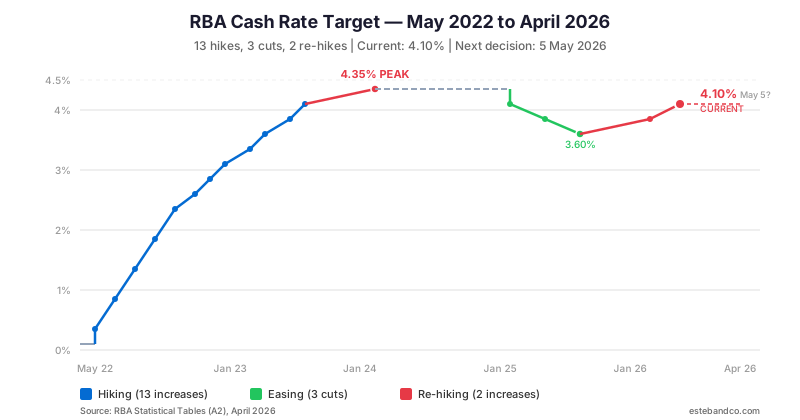
What this means for first home buyers: every lender assesses your borrowing power using a buffer rate of at least 3% above the product rate (APRA requirement for banks). So if you're applying for a rate of 5.69%, the lender tests whether you can afford repayments at 8.69%. The two rate hikes haven't changed the buffer requirement, but they have pushed up the actual rates lenders offer, which in turn pushes up the buffer rate and reduces your maximum borrowing amount.
At a 4.10% cash rate with typical lender margins, an average first home buyer couple earning $180,000 combined can borrow roughly $750,000-$850,000 depending on their expenses and existing debts. That was $50,000-$70,000 more six months ago.
How Much Deposit Do You Actually Need?
This is the first question every first home buyer asks me. The answer used to be simple - save 20%. But in 2026, with the national median house price at $1,005,418, a 20% deposit means $201,084. Most first home buyers don't have that sitting around, and the reality is they don't need to.
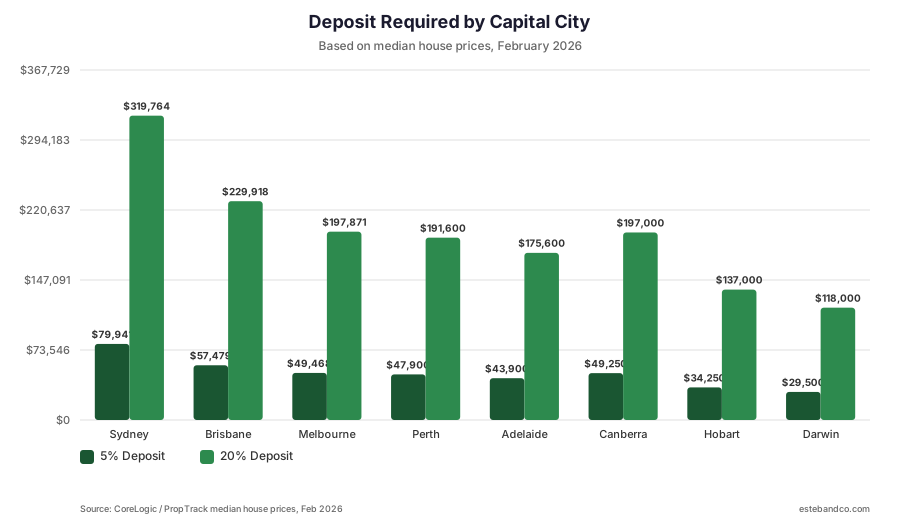
Deposit requirements by capital city
Here's what you need at 5%, 10%, and 20% based on the Cotality median house prices from February 2026:
| City | Median House Price | 5% Deposit | 10% Deposit | 20% Deposit |
|---|---|---|---|---|
| Sydney | $1,607,046 | $80,352 | $160,705 | $321,409 |
| Melbourne | $977,579 | $48,879 | $97,758 | $195,516 |
| Brisbane | $1,175,981 | $58,799 | $117,598 | $235,196 |
| Perth | $1,032,032 | $51,602 | $103,203 | $206,406 |
| Adelaide | $980,815 | $49,041 | $98,082 | $196,163 |
| Canberra | $1,051,977 | $52,599 | $105,198 | $210,395 |
| Hobart | $779,059 | $38,953 | $77,906 | $155,812 |
| Darwin | $709,975 | $35,499 | $70,998 | $141,995 |
Look at Sydney. A 20% deposit on the median house is $321,409. That's not realistic for most first home buyers, even with dual incomes. This is exactly why the government guarantee schemes exist - and why 5% deposits have become the norm for FHBs.
The three deposit pathways
Pathway 1: 5% deposit with the First Home Guarantee. The federal government guarantees the difference between your 5% deposit and the 20% threshold, meaning you pay no LMI. This is the most popular route I see - 35,000 places are available each financial year, and they don't last long.
Pathway 2: 2% deposit with Help to Buy. The government's shared equity scheme lets you buy with just 2% deposit. The government contributes up to 40% of the purchase price for new homes or 30% for existing homes, and takes a proportional equity stake. You own the rest. When you sell or your circumstances improve, you buy back the government's share.
Pathway 3: 10-20% deposit on your own. If you don't qualify for a scheme or prefer full ownership from day one, you'll need more deposit. At 10% you'll pay LMI (typically $8,000-$25,000 depending on the loan size), and at 20% you avoid LMI entirely.
My honest advice: if you qualify for the First Home Guarantee, use it. Saving from 5% to 20% takes most people 3-5 additional years, and in that time property prices typically move more than you can save. The scheme exists specifically to solve this problem.
Where does your deposit come from?
Lenders want to see "genuine savings" - money you've saved yourself over at least 3-6 months. But they also accept:
- Gifts from parents - most lenders accept a signed statutory declaration confirming the gift doesn't need to be repaid
- First Home Super Saver Scheme (FHSSS) - voluntary super contributions (up to $50,000) that you can withdraw for a first home purchase. The tax benefit means your savings grow faster inside super.
- Sale of assets - shares, crypto, a car
- Government grants - the FHOG counts toward your deposit in some states
What they don't accept: personal loans or credit card cash advances used as a deposit. Lenders run bank statement checks and they will catch this.
Government Grants and Schemes 2026
The government support available to first home buyers in 2026 is genuinely substantial. I see clients every week who don't realise they're eligible for $30,000+ in grants and fee savings. Here's the full picture.
First Home Owner Grant (FHOG) by state
| State | Grant Amount | Eligibility | Key Conditions |
|---|---|---|---|
| NSW | $10,000 | New homes up to $600,000 (house & land) or $750,000 (vacant land + build) | Must be a new build or substantially renovated. Not available for established homes. |
| QLD | $30,000 | New homes up to $750,000 | New builds, off-the-plan, or substantially renovated. The most generous grant in Australia. |
| VIC | $10,000 | New homes up to $750,000. $20,000 in regional Victoria. | Regional buyers get double. Build must be under $750,000 total value. |
| WA | $10,000 | New homes up to $750,000 (house) or $750,000 (land + build) | Contract must be entered after 20 Sept 2023. Must live in the property for 12 months. |
| SA | $15,000 | New homes up to $650,000 | Must be a new build. Apply within 12 months of completion. |
| TAS | $30,000 | New homes up to $600,000 | Matches QLD as the highest. Must live in property for 12 months. |
| NT | $10,000 | New and established homes | The only jurisdiction offering the grant on established homes. No price cap. |
| ACT | Nil (abolished) | N/A | ACT replaced FHOG with stamp duty concessions. First home buyers pay no stamp duty. |
The critical detail most people miss: FHOG is almost exclusively for new builds. If you're buying an established house or apartment (which most first home buyers do), the FHOG won't apply in most states. The NT is the exception - they offer $10,000 on any home purchase.
First Home Guarantee (federal)
This is the scheme I recommend most often. Here's how it works:
- 35,000 places available per financial year (from 1 July 2025)
- Buy with just 5% deposit - the government guarantees the lender for the remaining 15%
- No LMI - saving you $8,000-$35,000 depending on your loan size
- Income cap: $125,000 for singles, $200,000 for couples (taxable income)
- Property price caps vary by location (e.g., $900,000 in Sydney, $700,000 in Brisbane, $600,000 in regional areas)
- Available through participating lenders only - not all 104 on our panel, but we know exactly which ones
The places run out fast. In 2024-25, all spots were filled by April. If you're thinking about buying in the second half of 2026, register your interest now.
Regional First Home Buyer Guarantee
Same deal as the First Home Guarantee but specifically for buyers in regional areas. Same 5% deposit, no LMI. This has separate places allocated, so if the main guarantee is full, regional spots may still be available.
Help to Buy (shared equity)
The newest federal scheme. The government co-purchases with you:
- You need just 2% deposit
- Government contributes up to 40% of the purchase price for new homes, 30% for existing homes
- You own the remainder and take out a smaller mortgage
- Income cap: $90,000 singles, $120,000 couples
- When you sell, you repay the government's proportional share at the then-current value
- You can buy back the government's share at any time in minimum 5% increments
The trade-off is clear: smaller mortgage and lower repayments now, but you share the capital growth with the government. For buyers who just need to get into the market, it's a legitimate pathway. For buyers who can stretch to 5% and use the First Home Guarantee instead, I generally recommend that route because you keep 100% of the equity.
Stamp duty concessions for first home buyers
Every state has some form of stamp duty relief for FHBs. This can save you $10,000-$40,000:
- NSW: Full exemption on properties under $800,000. Concession on $800,001-$1,000,000.
- VIC: Full exemption under $600,000. Concession on $600,001-$750,000.
- QLD: Concession on homes under $550,000 ($500,000 for vacant land). Full concession saves up to $17,350.
- WA: Full exemption under $430,000. Concessional rate on $430,001-$530,000.
- SA: Full exemption on properties under $650,000 (new builds only since June 2023).
- TAS: 50% discount on stamp duty for homes under $750,000.
- ACT: Complete stamp duty abolition for all eligible home buyers (not just FHBs).
- NT: Full stamp duty exemption for established homes under $650,000.
The problem: in Sydney, the median house is $1,607,046. The FHB stamp duty exemption caps at $800,000. So the concession only helps buyers purchasing well below the median - apartments, townhouses, or properties in outer suburbs. This is another reason I push FHB clients toward units and townhouses when the budget is tight. You still build equity, and you can upgrade later.
What Lenders Look At
I've submitted thousands of loan applications across our 104-lender panel. Here's exactly what they assess and what trips up first home buyers.
Income
Lenders want to see stable, verifiable income. For PAYG employees, that means:
- Latest 2 payslips (some lenders accept 1)
- Most recent PAYG summary or tax return
- Employment contract if you've recently changed jobs
- A letter from your employer confirming your role and salary
For self-employed buyers, it's tougher. Most major banks want 2 years of tax returns and financial statements. Some non-bank lenders will work with 1 year of business bank statements (low-doc loans), but the rates are higher.
Overtime, bonuses, and commission: Lenders typically shade these by 20-50%. If you earn $20,000 in overtime, they might only count $12,000. This catches a lot of first home buyers who are stretching to qualify.
The rental income trap: Some first home buyers who've been living at home want to buy an investment property first (because it's cheaper in some markets). Be aware that lenders only count 70-80% of expected rental income and still assess the full repayment against your personal income.
Genuine savings
Most lenders want to see at least 5% of the purchase price held as genuine savings for at least 3 months. This means money in your bank account that you've accumulated over time - not a lump sum that appeared last week.
Some lenders are flexible. A rental history showing consistent payments over 12 months can substitute for genuine savings with certain lenders. This is one of those cases where knowing which lender to approach matters enormously.
Credit history
Your credit report shows every loan application, credit card, and payment default from the last 5-7 years. Lenders check:
- Credit score: Generally above 600 for mainstream lenders, above 500 for specialist lenders
- Defaults: Even a $150 unpaid phone bill can appear as a default and cause problems
- Credit enquiries: Multiple applications in a short period signals desperation to lenders
- Buy now pay later: Afterpay, Zip, etc. - lenders now count these as liabilities. Close any BNPL accounts you're not using before you apply.
My advice: pull your own credit report for free from Equifax or illion before you start the process. Fix any errors and pay off any outstanding small debts. It takes 2 minutes and I've seen it make the difference between approval and decline.
Employment stability
Banks ideally want to see at least 6-12 months in your current role. Probation periods are a problem - most major banks won't lend to someone in their probation period, though several non-bank lenders will.
If you've recently changed jobs, some lenders will accept your new employment contract plus one payslip. If you're in the same industry and moved for a higher salary, most lenders are reasonable about it.
Living expenses
Post-Royal Commission, lenders scrutinise your spending. They'll go through 3 months of bank statements and categorise your expenses. They use the higher of your declared expenses or the Household Expenditure Measure (HEM) benchmark.
Before you apply: reduce discretionary spending for 3 months. Cancel unused subscriptions. Don't make large purchases on credit. The statements you provide are a snapshot of your financial behaviour, and lenders take them seriously.
Best Rates for First Home Buyers Right Now
I pulled this data from our lender panel this week. We have 104 active lenders and 10,226 products, and I've filtered for owner-occupier principal and interest loans suitable for first home buyers.
Best variable rates (owner-occupier, P&I)
| Lender | Variable Rate From | Type | Notes |
|---|---|---|---|
| QLD Country Bank | 5.54% | Credit Union | Lowest on panel. QLD-based but lends nationally. |
| Firefighters Mutual / Teachers Mutual / UniBank | 5.64% | Mutual Banks | Eligibility restrictions apply (industry/profession). Excellent rates if you qualify. |
| Bank of China (Australia) | 5.68% | Bank | Strong rates, particularly for higher loan amounts. |
| HSBC | 5.69% | Bank | No branch network but excellent digital platform. Also best fixed rate. |
| ANZ | 5.78% | Big 4 | Fastest turnaround of the big four. Same-day conditional approval. |
Best fixed rates (owner-occupier, P&I)
| Lender | Fixed Rate From | Term | Notes |
|---|---|---|---|
| HSBC | 5.74% | 2 years | Currently the sharpest fixed rate on our panel. |
| Bank of China | 5.79% | 2 years | Competitive fixed offering, strong for larger loans. |
Fastest turnaround lenders
| Lender | Turnaround Time | Notes |
|---|---|---|
| Macquarie Bank | ~2 days total | Consistently the fastest end-to-end on our panel. |
| ANZ | Same-day conditional | Formal approval takes longer, but conditional within hours. |
| CBA | Same-day conditional | Strong digital application process. |
| NAB | Same-day conditional | Good for straightforward applications. |
| Bankwest | Same-day conditional | CBA-owned, consistently quick. |
A word on rate vs. speed: when you're a first home buyer at auction or competing with other offers, turnaround time matters as much as rate. An unconditional approval from Macquarie in 2 days beats a better rate from a lender that takes 3 weeks. I always factor this into my recommendations based on how you're buying.
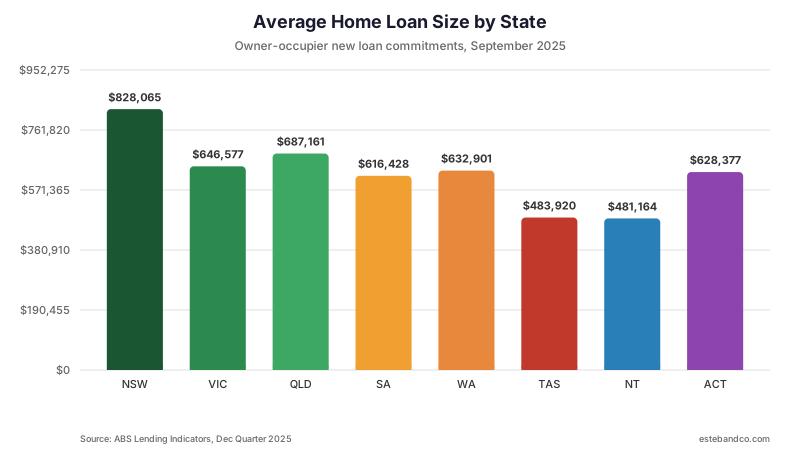
Average loan sizes and repayments by state
These are the actual numbers from the ABS for owner-occupier borrowers. Monthly repayments are calculated at the ABS average rate of 5.49%.
| State | Average OO Loan | Monthly Repayment |
|---|---|---|
| NSW | $828,065 | $4,696 |
| QLD | $687,161 | $3,897 |
| VIC | $646,577 | $3,667 |
| WA | $632,901 | $3,590 |
| ACT | $628,377 | $3,564 |
| SA | $616,428 | $3,496 |
| TAS | $483,920 | $2,745 |
| NT | $481,164 | $2,729 |
NSW stands out. An average monthly repayment of $4,696 requires a household income of at least $145,000 just to meet the 30% benchmark (the point where mortgage stress begins). This is why I see more NSW first home buyers looking at apartments and outer suburbs than any other state.
The Real Cost of Buying Your First Home
The purchase price is just the start. I see first home buyers budget for the deposit and then get blindsided by the additional costs. Here's the full list, with realistic estimates.
Upfront costs breakdown
| Cost | Typical Range | Notes |
|---|---|---|
| Stamp duty (transfer duty) | $0 - $45,000+ | Varies massively by state and FHB concessions. Could be $0 if under threshold. |
| Conveyancing / solicitor | $1,500 - $3,000 | Legal fees for property transfer. Get quotes from 2-3 firms. |
| Building & pest inspection | $400 - $800 | Non-negotiable for houses. Can be skipped for newer apartments (but I don't recommend it). |
| Strata report (apartments) | $200 - $350 | Essential for apartments/townhouses. Reveals building issues, levies, sinking fund. |
| Lender application fee | $0 - $600 | Many lenders waive this for FHBs. Always negotiate. |
| Valuation fee | $0 - $500 | Most lenders cover this. Some charge for regional properties. |
| Lenders Mortgage Insurance (LMI) | $0 - $35,000+ | Only if borrowing more than 80% LVR without a guarantee scheme. |
| Mortgage registration fee | $150 - $200 | Government fee to register the mortgage on the property title. |
| Title search fee | $20 - $100 | Small fee to confirm the property's title details. |
| Loan settlement fee | $200 - $500 | Some lenders charge this, many don't. |
LMI: the big variable
Lenders Mortgage Insurance is the cost that catches first home buyers the most. If you're borrowing more than 80% of the property value (i.e., you have less than a 20% deposit) and you're not using the First Home Guarantee or Help to Buy, you'll need to pay LMI.
Here's a realistic example. Buying a $750,000 property with a 10% deposit ($75,000):
- Loan amount: $675,000
- LVR: 90%
- Estimated LMI: $13,000 - $18,000
That LMI can be added to the loan (capitalised), which means you don't need to find the cash upfront. But you'll pay interest on it for the life of the loan. On a $15,000 LMI premium at 5.69% over 30 years, that's roughly $31,400 in total cost. This is why the First Home Guarantee - which eliminates LMI entirely - is so valuable.
Read our full guide on LMI costs in Australia 2026 for a detailed breakdown by loan size and LVR.
Budget rule of thumb
I tell first home buyer clients to budget 3-5% of the purchase price on top of their deposit for buying costs. On a $700,000 purchase, that's $21,000-$35,000 in addition to your deposit. If you're in a state with stamp duty exemptions, the lower end applies. If you're above the exemption threshold, budget at the higher end.
The Step-by-Step Process
I walk first home buyers through this every week. The whole process takes 8-16 weeks from first conversation to settlement. Here's what to expect at each stage.
Step 1: Work out your numbers (Week 1)
Before you look at a single property, know your budget. This means:
- Your deposit amount and source (genuine savings, gift, FHSSS)
- Your combined household income (after tax)
- Your existing debts and commitments (car loans, HECS-HELP, credit cards, BNPL)
- Your living expenses for the last 3 months
Use our borrowing power calculator for a quick estimate, but speak to a broker for the real number. Calculators can't factor in lender-specific policies, and I regularly see a $100,000+ difference between what a calculator says and what you can actually borrow from the best lender for your situation.
Step 2: Get pre-approved (Weeks 1-3)
Pre-approval (also called conditional approval) is a lender's written confirmation that they'll lend you a specific amount, subject to finding a suitable property. It typically lasts 3-6 months.
Why it matters: real estate agents take you more seriously, you can bid at auction with confidence, and you won't fall in love with a property you can't afford.
What you'll need to provide:
- ID (driver's licence, passport)
- Payslips (latest 2)
- Bank statements (3 months of all accounts)
- Tax return or PAYG summary
- Details of any existing debts
Step 3: Find your property (Weeks 3-10)
This is the part you can't rush and can't fully control. My tips:
- Set up alerts on realestate.com.au and Domain for your criteria
- Attend open homes and take notes (you'll forget details after the 10th one)
- Look at properties that have been listed for 30+ days - these vendors are more motivated to negotiate
- Don't skip the building and pest inspection to save $500. I've seen $500 inspections save clients from $80,000 problems.
Step 4: Make an offer or bid at auction (Week 10)
Once you've found the property:
- Private sale: Submit a written offer through the agent. This is negotiable. Your conveyancer can include conditions (subject to finance, subject to building inspection).
- Auction: No conditions. You need your pre-approval in place and a bank cheque for the deposit (usually 10%) on the day. This is why pre-approval matters.
Step 5: Formal approval (Weeks 10-12)
Once your offer is accepted, we submit the full application to the lender with the property details. They'll order a valuation, verify your documents, and issue formal (unconditional) approval. This takes 3-10 business days depending on the lender. With Macquarie Bank, we regularly see 2-day turnarounds. With some smaller lenders, it can stretch to 2-3 weeks.
Step 6: Exchange and cooling off
You sign the contract, pay the deposit (held in trust by the agent or conveyancer), and - in most states - have a cooling off period of 2-5 business days where you can pull out (with a small penalty, usually 0.25% of the purchase price). No cooling off at auction.
Step 7: Settlement (Weeks 12-16)
Your conveyancer and the lender handle this. The lender releases the funds, the vendor's mortgage (if any) is discharged, the title transfers to your name, and you get the keys. Settlement is typically 4-6 weeks after exchange.
On settlement day, do a final inspection of the property to make sure it's in the same condition as when you bought it and that all inclusions (appliances, fixtures) are there.
Common Mistakes First Home Buyers Make
I've been doing this long enough to see the same mistakes repeat. Here are the ones that cost first home buyers the most money and stress.
1. Not getting pre-approved before they start looking
I had a couple come to me last month who'd spent 4 months attending open homes every weekend, fell in love with three different properties, and missed all of them because they didn't have pre-approval in place. When we finally ran their numbers, their borrowing capacity was $80,000 less than they'd assumed. All that time wasted looking at properties they couldn't afford.
Get pre-approved first. It takes a week and saves you months of heartache.
2. Going straight to their own bank
Your everyday bank will offer you their products and their rates. That's it. They won't tell you that QLD Country Bank has a rate 0.30% lower, or that Macquarie will approve you faster, or that you qualify for the First Home Guarantee through a different lender.
74% of Australian home loans are now written through brokers. That number is even higher for first home buyers. There's a reason.
3. Forgetting about the First Home Super Saver Scheme
The FHSSS lets you make voluntary contributions to your super (up to $15,000/year, $50,000 total) and then withdraw them for a first home purchase. Because super contributions are taxed at 15% instead of your marginal rate, you save money on the way in. And the deemed earnings rate inside super is typically higher than a savings account.
The catch: you need to have made the contributions before you apply to withdraw. If you're 12+ months away from buying, start making FHSSS contributions now. it's complimentary money.
4. Maxing out their borrowing capacity
Just because a lender will lend you $800,000 doesn't mean you should borrow $800,000. The assessment buffer of 3% means the lender thinks you can survive at that amount. Surviving is not the same as living comfortably.
My rule: your mortgage repayments should be no more than 30% of your after-tax household income. Beyond that, you're in mortgage stress territory and every rate hike will hurt. The ABS average repayment of $3,935/month at 5.49% already puts many first home buyers close to this threshold.
5. Not budgeting for ongoing costs
Owning a home costs more than renting, even before the mortgage. Budget for:
- Council rates: $1,200-$3,000/year
- Water rates: $800-$1,200/year
- Home and contents insurance: $1,500-$3,000/year
- Strata levies (apartments): $2,000-$8,000/year
- Maintenance: budget 1% of the property value per year ($7,000-$10,000)
6. Ignoring the government schemes
I estimate that 30% of the first home buyers I see aren't aware they qualify for the First Home Guarantee, and even more don't know about the FHSSS. These schemes exist to help you. Not using them costs you real money - $10,000-$35,000 in LMI savings alone from the guarantee scheme.
7. Making large purchases before settlement
Do not buy a car, furniture, or anything else on finance between approval and settlement. Lenders run a final credit check before settlement, and any new debt can trigger a reassessment or even a decline. I've seen settlements fall through because someone bought a $15,000 car the week before. Wait until after you get the keys.
State-by-State Guide
Every state has a different combination of prices, grants, and stamp duty rules. Here's the breakdown for each.
New South Wales
- Median house price (Sydney): $1,607,046
- Average OO loan: $828,065 ($4,696/month)
- FHOG: $10,000 (new builds up to $600,000)
- Stamp duty: Full exemption under $800,000, concession $800,001-$1,000,000
- Reality check: Sydney is the most expensive market in Australia. Most FHBs buying a house here are looking at the outer suburbs (Penrith, Campbelltown, Central Coast) where median prices are $700,000-$900,000. Apartments in inner suburbs are the other entry path. The stamp duty exemption at $800,000 is well below the Sydney house median, so it effectively targets apartment and townhouse buyers.
Victoria
- Median house price (Melbourne): $977,579
- Average OO loan: $646,577 ($3,667/month)
- FHOG: $10,000 metro, $20,000 regional (new builds up to $750,000)
- Stamp duty: Full exemption under $600,000, concession $600,001-$750,000
- Reality check: Melbourne has had softer price growth than other capitals, making it relatively more accessible. The $20,000 regional grant is generous - consider Geelong, Ballarat, or Bendigo where median prices are $500,000-$700,000 and you get double the grant.
Queensland
- Median house price (Brisbane): $1,175,981
- Average OO loan: $687,161 ($3,897/month)
- FHOG: $30,000 (new builds up to $750,000)
- Stamp duty: Concession for homes under $550,000
- Reality check: Brisbane has been one of the strongest price growth markets in Australia and the median house price has moved past $1.1 million. But the $30,000 FHOG for new builds is the equal highest in the country. If you can find a new build under $750,000 (house and land packages in the growth corridors - North Lakes, Springfield, Yarrabilba), you're getting $30,000 of free money plus potential stamp duty savings. I'm based on the Gold Coast and I see a lot of FHBs targeting these areas.
Western Australia
- Median house price (Perth): $1,032,032
- Average OO loan: $632,901 ($3,590/month)
- FHOG: $10,000 (new builds up to $750,000)
- Stamp duty: Exemption under $430,000, concessional $430,001-$530,000
- Reality check: Perth has experienced rapid price growth after years of being undervalued. The stamp duty exemption threshold of $430,000 is very low relative to the median, meaning most FHBs will pay some stamp duty unless buying well below median. The mining industry creates high-income borrowers who push up average loan sizes.
South Australia
- Median house price (Adelaide): $980,815
- Average OO loan: $616,428 ($3,496/month)
- FHOG: $15,000 (new builds up to $650,000)
- Stamp duty: Exemption for new builds under $650,000
- Reality check: Adelaide has been a strong performer. The $15,000 FHOG plus stamp duty exemption on new builds makes the northern suburbs (Elizabeth, Gawler, Munno Para) attractive for FHBs. Established homes are more affordable than other capitals but don't benefit from the grant or stamp duty concession.
Tasmania
- Median house price (Hobart): $779,059
- Average OO loan: $483,920 ($2,745/month)
- FHOG: $30,000 (new builds up to $600,000)
- Stamp duty: 50% discount on homes under $750,000
- Reality check: The lowest average loan in the country combined with the joint-highest grant makes Tasmania one of the most accessible markets. A $500,000 new build with $30,000 FHOG means you effectively only need a deposit on $470,000. Monthly repayments of $2,745 are manageable on a modest household income.
Northern Territory
- Median house price (Darwin): $709,975
- Average OO loan: $481,164 ($2,729/month)
- FHOG: $10,000 (new AND established homes - no price cap)
- Stamp duty: Exemption for established homes under $650,000
- Reality check: The NT is unique because the $10,000 grant applies to established homes, not just new builds. Combined with the stamp duty exemption, an established home under $650,000 in Darwin gets the grant plus no stamp duty. It's the most FHB-friendly policy combination in Australia for established homes.
Australian Capital Territory
- Median house price (Canberra): $1,051,977
- Average OO loan: $628,377 ($3,564/month)
- FHOG: None (abolished)
- Stamp duty: Abolished for all eligible home buyers
- Reality check: No FHOG, but also no stamp duty. On a $700,000 property, stamp duty savings of approximately $17,000-$25,000 more than compensate for the lack of a $10,000 grant. Canberra's high average incomes (public service) support higher borrowing capacity, which explains the above-average loan sizes despite similar prices to Adelaide and Perth.
Frequently Asked Questions
How much deposit do I need for my first home in 2026?
It depends on the scheme you use. With the First Home Guarantee, you need just 5% deposit and pay no Lenders Mortgage Insurance. The new Help to Buy scheme requires only 2% deposit in exchange for the government taking a shared equity stake. Without any scheme, you'll need 20% to avoid LMI - that's $182,493 on the national median of $912,465. But most first home buyers don't put down 20%. The ABS data shows the average FHB loan is $607,624, which means most are buying with 5-10% deposits and either wearing LMI or using a government guarantee.
What is the average first home buyer loan in Australia?
According to the ABS Lending Indicators for December Quarter 2025, the average first home buyer loan is $607,624. That's up 8.5% in just one quarter - the biggest single-quarter rise on record. Total FHB lending hit $19.3 billion, with 31,783 loans written. The average varies significantly by state: NSW leads at $828,065 while Tasmania is lowest at $483,920.
Can I get a home loan with bad credit as a first home buyer?
Yes, though your options are more limited and rates will be higher. Several non-bank lenders on our 104-lender panel specialise in borrowers with credit blemishes - paid defaults, previous judgments, or low credit scores. You'll typically pay 1-3% above prime rates. The key is knowing which lender will actually approve you without wasting credit enquiries. A broker can assess your credit file and match you to the right lender first time. See our guide on bad credit home loans for more detail.
What government grants are available for first home buyers in 2026?
There are several layers. The First Home Owner Grant (FHOG) varies by state: QLD and TAS offer $30,000 for new builds, SA offers $15,000, while NSW, VIC, and WA offer $10,000. The federal First Home Guarantee provides 35,000 places per year where you can buy with 5% deposit and no LMI. The Regional First Home Buyer Guarantee extends the same benefit to regional areas. The Help to Buy shared equity scheme lets you buy with 2% deposit, with the government co-owning a portion. Most states also offer stamp duty exemptions or concessions under certain price thresholds.
How much does stamp duty cost for first home buyers?
Varies significantly by state, and many offer full exemptions for first home buyers under certain thresholds. NSW: no stamp duty under $800,000. VIC: exempt under $600,000. QLD: concessions under $550,000. ACT has abolished stamp duty for all eligible buyers. Where duty applies, it typically ranges from $15,000 to $45,000 depending on property value and state. It's one of the biggest upfront costs most buyers underestimate - read our deposit guide for more detail.
Should I use a finance broker or go direct to a bank?
74% of Australian home loans are now written through brokers, and the number is even higher for first home buyers. A broker compares options across multiple lenders (we access 50 lenders and over 10,000 products), the service is complimentary because the lender pays us, and we handle the paperwork and lender negotiation. Going direct to one bank means you only see that bank's products. As a first home buyer, you don't know what you don't know - a broker identifies grants you're eligible for, flags issues before they become problems, and matches you to the right lender for your specific situation.
Your Next Step
If you've read this far, you're already more prepared than most first home buyers I meet. The data is clear: 31,783 Australians bought their first home last quarter despite a 4.10% cash rate. They did it by using government schemes, comparing across lenders, and getting proper advice.
Your first move is simple: find out what you can actually borrow and which schemes you qualify for. You can start with our 2-minute smart form - it'll match you against our 50 lenders and tell you which government schemes apply to your situation. Or call me on 0485 091 282 and we'll have a 15-minute chat about where you stand.
No cost, no obligation. We get paid by the lender when your loan settles, not by you.
See where you stand
Compare your options across our panel of 50 lenders in about 2 minutes. Free, and it won’t affect your credit score.
Start complimentary assessment →No obligation · Richard Esteb, Credit Rep #574071
Richard Esteb
Ricky founded Esteb & Co to give everyday Australians access to the same loan comparison technology used by the big banks. He compares products from a panel of 50 lenders to find the right fit for each client’s situation.