Investment Property Lending Hits Record High: What Investors Need to Know in 2026

In this article
- The headline: $42.9 billion in one quarter
- Why investment lending is at record levels
- Average investor loan size by state
- Investor vs owner-occupier: how the loans compare
- What lenders want from investors in 2026
- Negative gearing and capital gains: the tax angle
- The risks nobody’s talking about
- What smart investors are doing right now
- Frequently asked questions
The Headline: $42.9 Billion in One Quarter
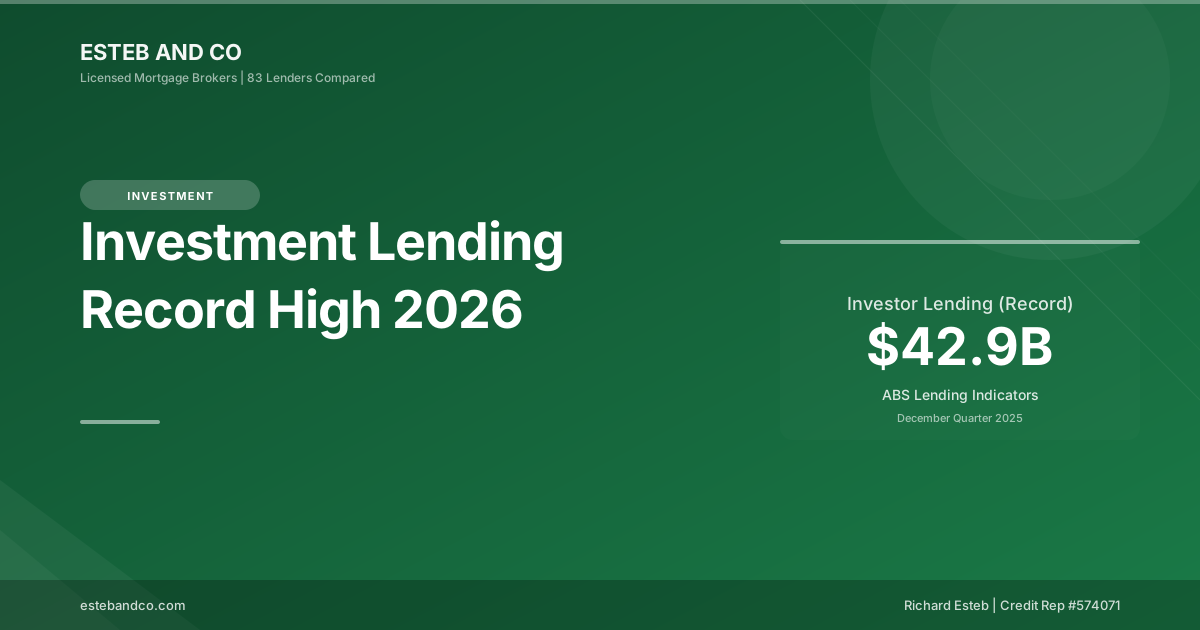
Investment property lending in Australia has hit a record $42.9 billion in the December Quarter 2025. That’s not a typo. In a single quarter, Australian investors borrowed nearly $43 billion to buy investment properties.
The key numbers from the latest ABS Lending Indicators:
- Total value: $42.9 billion (record high)
- Year-on-year growth: +31.8%
- Quarterly growth: +5.5% (number), +7.9% (value)
- Number of investor loans: 60,455
- Average investor loan: $717,000 (up $43,000 year-on-year)
To put the 31.8% year-on-year growth in context: that means investor lending grew almost six times faster than overall housing lending (which grew 5.1% for the quarter). Investors are piling in at a rate we haven’t seen since the pre-APRA intervention days of 2015.
As a broker, I’m seeing this in real time. Investor enquiries have more than doubled in the last 12 months. Many are existing homeowners leveraging equity from rising property values to buy their first or second investment property.
Why Investment Lending Is at Record Levels
1. The 2025 rate cuts improved cash flow
Three rate cuts in 2025 (February, May, August) took the cash rate from 4.35% to 3.60%. For investors, lower rates mean better cash flow — the gap between rental income and mortgage costs narrows. A $717,000 investment loan at 6.0% costs $4,299 per month. At 5.75%, it costs $4,185 — a saving of $114 per month or $1,368 per year. Multiply that across a portfolio and the numbers become significant.
2. Equity growth has been extraordinary
The national median home value reached $912,465 in January 2026. Homeowners who bought in 2020–2021 have seen significant equity growth. That equity is the fuel for investment lending — borrowers are using their home as a springboard to purchase investment properties without needing additional cash savings.
3. Rental yields remain strong
Vacancy rates across most capital cities remain at or near record lows. Strong rental demand means investors can expect consistent rental income, which improves both cash flow and lender serviceability assessments. Gross yields of 4–5% are achievable in many markets, particularly in regional areas and outer suburbs of capital cities.
4. Tax benefits remain intact
Negative gearing and the 50% capital gains tax discount continue to make investment property attractive from a tax perspective. For higher-income earners on marginal tax rates of 37% or 45%, the after-tax cost of holding an investment property is significantly lower than the headline numbers suggest.
5. Lack of attractive alternatives
Term deposit rates have fallen alongside cash rate cuts. Sharemarket volatility makes many investors uncomfortable. Property remains the default “understandable” investment for many Australians — you can see it, touch it, and it has a long track record of capital growth in Australia.
Average Investor Loan Size by State
The ABS provides partial state-level data for investor loans. The differences are striking:
| State | Avg Investor Loan | vs National Avg ($717K) | Est. Monthly Repayment (5.89%) |
|---|---|---|---|
| NSW | $873,000 | +$156,000 | $5,173 |
| WA | $644,000 | -$73,000 | $3,816 |
| SA | $622,000 | -$95,000 | $3,686 |
| NT | $460,000 | -$257,000 | $2,726 |
| National average: $717,000 — $4,248/month at 5.89% (investor rate) | |||
Repayments based on 30-year P&I at estimated investor variable rate of 5.89% (owner-occupier average 5.49% + 0.40% investor premium).
NSW is the only state where the average investor loan exceeds the national benchmark. An $873,000 loan at investor rates costs over $5,173 per month in repayments. That requires substantial rental income or personal income to service — typically a combined household income of $200,000+ for lender approval.
Investor vs Owner-Occupier: How the Loans Compare
| Feature | Owner-Occupier | Investor |
|---|---|---|
| Average loan size | $693,801 | $717,000 |
| Average interest rate | 5.49% | ~5.89% (estimated) |
| Monthly repayment (avg loan) | $3,935 | $4,248 |
| Typical max LVR | 95% (with LMI) | 90% (with LMI) |
| LVR without LMI | 80% | 80% |
| Interest-only available | Limited | Commonly offered (1–5 years) |
| Rental income assessment | N/A | 70–80% of rental income counted |
| Tax deductibility | No | Yes (interest, expenses, depreciation) |
| Quarterly growth (Dec 2025) | +4.8% | +5.5% |
| Year-on-year growth | Moderate | +31.8% (record) |
The key differences: investors pay higher rates (typically 0.25–0.50% more), have slightly lower maximum LVR options, and have their rental income discounted by lenders (usually 20–30% haircut). On the flip side, investors can claim tax deductions on interest payments, which owner-occupiers cannot.
For the full comparison of investor vs owner-occupier loans, read our investment property loans guide.
What Lenders Want from Investors in 2026
Serviceability assessment
Lenders assess your ability to repay at the actual rate plus a buffer (currently 3% for most lenders). On a $717,000 investor loan at 5.89%, the lender tests you at approximately 8.89%. They also discount rental income — typically counting only 70–80% of the expected rent to account for vacancies and expenses.
LVR requirements
Most lenders cap investor loans at 80% LVR without LMI. That means a 20% deposit is the standard — on the average investor loan of $717,000, that’s $143,400. Some lenders allow up to 90% with LMI, but the premiums are higher for investors than for owner-occupiers. Most of my investor clients use equity from their home rather than cash savings.
Documentation
- Rental appraisal or lease agreement for the property being purchased
- Existing property statements if you already have investment properties
- Tax returns (last 2 years) to verify declared rental income
- Standard income documentation (payslips, group certificates, or business financials for self-employed)
Rate loading
Expect to pay 0.25–0.50% more than the equivalent owner-occupier rate. This “investor loading” has been a feature of the market since APRA first intervened in 2015. Shopping around matters here — the spread between the cheapest and most expensive investor rates can exceed 1.5%. A broker saves you from overpaying.
For more on how lenders calculate your borrowing power, see our borrowing power guide.
Negative Gearing and Capital Gains: The Tax Angle
For many investors, the tax benefits are a significant part of the investment case.
Negative gearing
If your rental income doesn’t cover all your expenses (interest, rates, insurance, maintenance, property management, depreciation), the loss is “negatively geared” and can be offset against your other income. On a $717,000 loan at 5.89%, annual interest is approximately $42,251. If your rental income is $35,000 per year and other expenses total $8,000, your total deductible loss is around $15,251 per year. At a 37% marginal tax rate, that reduces your tax by $5,643 — effectively subsidising the cost of holding the property.
Capital gains tax discount
When you sell an investment property held for more than 12 months, you receive a 50% discount on the capital gain. If you buy at $717,000 and sell at $900,000 (a gain of $183,000), you only pay tax on $91,500. At a 37% marginal rate, that’s $33,855 in tax instead of $67,710. The discount makes long-term holding particularly attractive.
Depreciation
Building depreciation and plant and equipment depreciation provide non-cash deductions that reduce your taxable income without actually costing you anything out of pocket. A quantity surveyor’s depreciation schedule (typically costing $600–$800) can identify $5,000–$15,000 per year in deductions for newer properties. This is one of the most overlooked tax benefits in property investment.
Important: Tax implications vary based on individual circumstances. Always consult a qualified tax professional for advice specific to your situation.
The Risks Nobody’s Talking About
Record-high lending levels should make investors cautious, not euphoric. Here are the risks that the headline numbers don’t capture:
1. APRA intervention is a real possibility
When investor lending surged in 2014–2017, APRA (the Australian Prudential Regulation Authority) stepped in with macroprudential measures: a 10% growth cap on investor lending, restrictions on interest-only lending, and higher serviceability buffers. With investor lending now growing at 31.8% year-on-year, those same conditions are present. If APRA acts, it could tighten lending criteria overnight — making it harder to refinance existing investor loans or access equity for new purchases.
2. The February 2026 rate hike shows rates can surprise
After three cuts in 2025, many investors assumed rates would continue falling. The February 2026 hike back to 3.85% was a sharp reminder that the RBA will reverse course when needed. If you’re buying based on current interest rates, stress-test your cash flow at rates 1–2% higher.
3. Vacancy risk in oversupplied markets
Not all rental markets are equally tight. Some inner-city apartment markets (particularly Brisbane and Melbourne CBD) have seen new supply come online that could push vacancy rates higher. A vacant investment property still costs you the full mortgage, rates, and insurance — without any rental income to offset the cost.
4. When everyone’s buying, be selective
Record lending volumes often coincide with peak market conditions. This doesn’t mean the market will crash, but it does mean competition is fierce, and overpaying is easy. The investors who perform best over the long term are those who buy on fundamentals (yield, population growth, infrastructure investment) rather than following the herd.
5. Interest-only loan expiry
Many investors use interest-only loans (typically 1–5 year terms) to maximise cash flow and tax deductions. When the interest-only period expires, repayments jump significantly as you begin paying principal. On a $717,000 loan at 5.89%, interest-only repayments are approximately $3,519 per month. When it converts to P&I, repayments jump to $4,248 — an increase of $729 per month. Plan for this transition before it happens.
What Smart Investors Are Doing Right Now
1. Leveraging equity, not savings
Most successful investors I work with aren’t saving up $143,000 in cash for a deposit. They’re using the equity in their existing property. If your home is worth $900,000 and you owe $450,000, you have $450,000 in equity. Most lenders will let you access up to 80% of your home’s value ($720,000) minus your existing loan ($450,000) = $270,000 in usable equity. That’s enough for a 20% deposit plus costs on most investment properties.
2. Focusing on yield, not just growth
In a rising rate environment, cash flow matters more than ever. Smart investors are targeting properties with gross yields of 5%+ to minimise out-of-pocket holding costs. A property yielding 5% on a $600,000 purchase generates $30,000 per year in rent ($577/week) — covering a significant portion of the mortgage and expenses.
3. Getting pre-approved before shopping
With 60,455 investor loans issued in one quarter, competition is fierce. Pre-approval from a strong lender gives you negotiating power and the ability to move quickly when the right property appears. Without pre-approval, you risk losing opportunities to better-prepared buyers.
4. Using a broker to compare investor policies
Investor lending policies vary dramatically between lenders. Some offer better rates, some have more favourable rental income assessments, some allow higher LVRs, and some are faster. On a $717,000 loan, a 0.3% rate difference saves $133 per month ($1,596 per year). Over 10 years, that’s $15,960 — just from choosing the right lender.
5. Stress-testing at higher rates
Before committing to a purchase, run the numbers at your current rate plus 2%. If you can still afford the holding costs at 7.89%, you’ll weather any likely rate scenario without being forced to sell at the wrong time.
Frequently Asked Questions
How much has investment lending grown in Australia?
Investment lending hit a record $42.9 billion in December Quarter 2025, up 31.8% year-on-year. The number of investor loans reached 60,455 — the highest level ever recorded by the ABS.
What is the average investment property loan size?
The national average is $717,000, up $43,000 from the previous year. NSW has the highest average at $873,000, while the NT has the lowest at $460,000.
Do investors pay higher interest rates than owner-occupiers?
Yes, typically 0.25–0.50% higher. With the owner-occupier average at 5.49%, investors are generally paying 5.74–5.99% for P&I loans. Interest-only loans carry a further premium of 0.20–0.40%.
What LVR do I need for an investment property?
Most lenders allow up to 80% LVR without LMI. On the average investor loan of $717,000, a 20% deposit is $143,400. Many investors use equity from their existing home rather than cash savings.
Can I use equity from my home to buy an investment property?
Yes — this is the most common approach. If your home is worth $800,000 and you owe $400,000, most lenders will let you access up to $240,000 in usable equity (80% of value minus existing loan). That’s more than enough for a deposit plus costs on most investment properties.
Will APRA tighten investor lending in 2026?
It’s a real possibility. When investor lending previously surged (2014–2017), APRA introduced a 10% growth cap and interest-only restrictions. With 31.8% year-on-year growth, the conditions for intervention are present. Any action would likely involve growth caps, higher serviceability buffers, or LVR restrictions.
See where you stand
Compare your options across our panel of 50 lenders in about 2 minutes. Free, and it won’t affect your credit score.
Start complimentary assessment →No obligation · Richard Esteb, Credit Rep #574071
Richard Esteb
Ricky founded Esteb & Co to give everyday Australians access to the same loan comparison technology used by the big banks. He compares products from a panel of 50 lenders to find the right fit for each client’s situation.