What 290 Q1 2026 Portal Applications Tell Us About Australian Borrowers Right Now

In this article
Most "state of the Australian mortgage market" articles are built on ABS Lending Indicators — the official, lagging, census-level dataset published seven or eight weeks after a quarter ends. That data is authoritative, but by the time it lands, the quarter it describes is already two months in the rear-view mirror.
This post does something different. It walks through the 290 mortgage-related applications submitted through Esteb and Co's portal between 1 January and 31 March 2026. Our sample is tiny next to the ABS's — but it's real, first-party, and current.
What we're looking at and why
Every application lodged through portal.estebandco.com writes a row into our applications table, whether it's a home loan enquiry, a personal loan quote request, a business finance lead, or anything else on our 50-lender panel. We filtered for Q1 2026 submissions (n=290) and broke them down by loan type, property profile, traffic source, and funnel stage.
A few caveats up front: (1) we're one small brokerage, not a national dataset — this isn't "the Australian market", it's "what Australians who found our portal this quarter did". (2) Facebook-paid lead generation is our largest channel, which skews the sample to Facebook's targeting bias (30–50 year olds, East-coast cities, middle income). (3) Completeness varies by funnel stage — early-stage leads often don't have property values or deposit data yet.
With those disclaimers, here's what the data shows.
The loan-type mix: home dominates, personal surprises
| Loan type | Applications | Share |
|---|---|---|
| Home loan | 143 | 49.3% |
| Personal loan | 80 | 27.6% |
| Business loan | 20 | 6.9% |
| Car loan | 15 | 5.2% |
| SMSF loan | 12 | 4.1% |
| Private lending | 10 | 3.4% |
| Securities lending | 7 | 2.4% |
| Construction, refinance, debt consolidation | 3 | 1.0% |
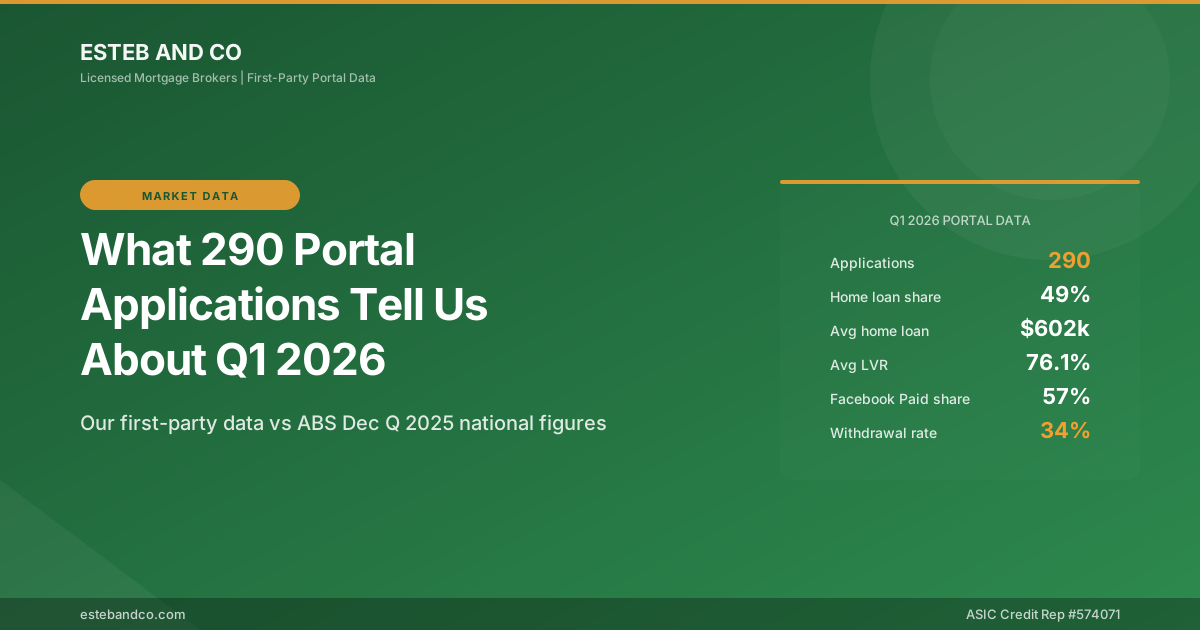
Home loans at 49% is the expected anchor. Personal loans at 28% is the surprise: almost three in every ten enquiries through our portal are for short-dollar personal finance rather than property. With an average ticket of $14,701 (range $400 to $65,000), personal loans signal something beyond housing — they're a read on short-term household cashflow pressure.
The pattern holds against ABS Household Spending Indicator data from February 2026, which showed discretionary spending down 1.2% YoY and essential-goods (groceries, utilities, fuel) up 3.8% YoY. When discretionary falls and essentials rise, households tap personal credit for the bridge. Our 80 personal loan enquiries are a version of that same story at the household level.
SMSF at 4% (12 applications) is above what I'd have expected — reflecting the post-FY-end scramble for self-managed super borrowing and the run of sub-6% SMSF rates we had in late 2025.
The average Q1 2026 home loan
Of the 143 home loan applications, 55 reached the stage where both loan amount and property value were captured. Here's the shape of that subset:
How we compare to ABS Dec Q 2025
The most useful external benchmark is the ABS Lending Indicators, December Quarter 2025 — the most recent official release. It reports:
- National FHB average loan: $607,624
- National owner-occupier average loan: $693,801
- NSW owner-occupier average loan: $828,065
- FHB quarterly loan count: 31,783 (+6.8% QoQ)
- Investor lending: $42.9B record quarter
Our $602,727 average home loan sits almost exactly on the ABS FHB national average of $607,624 — 0.8% below. That's a striking alignment given our sample is a mix of FHB, upgrader, investor and refinance. It suggests the Facebook-paid channel delivers borrowers whose financial profile is close to the national FHB centre of mass.
Where we diverge: LVR. The national FHB LVR distribution skews toward 85–95% (heavy FHB Scheme usage), whereas our 76.1% average reflects upgraders with existing-property equity. A 76% LVR file avoids LMI and unlocks the full cheapest-rate tier on our 50-lender panel — which is one reason why our matching engine's recommended rates tend to cluster in the 5.64–5.84% band rather than the 5.99–6.19% tier typical of high-LVR FHB files.
Where borrowers actually come from
| Traffic source | Applications | Share |
|---|---|---|
| Facebook Paid | 165 | 56.9% |
| Unknown (cleared UTM / shared links) | 64 | 22.1% |
| Referral (accountants, LinkedIn partners) | 24 | 8.3% |
| Instagram Paid | 14 | 4.8% |
| Social Organic | 14 | 4.8% |
| Direct (typed URL, bookmark) | 9 | 3.1% |
Facebook Paid at 57% is the channel that drives volume. Referrals at 8% drive quality — the conversion-to-lender-submission rate on referral is materially higher than Facebook (because accountant/LinkedIn-partner referrals arrive pre-qualified). Direct and organic-social are small but typically the most engaged.
The interesting read isn't the ranking — it's the 64 "Unknown" applications. These are borrowers who arrived with no UTM parameters: either a cleared referrer, a shared text-message link, or a direct type-in that didn't parse. A lot of Australian borrowers still share broker URLs via SMS and WhatsApp, which drops UTM. Worth remembering when interpreting any ad-attribution report — up to 20% of portal volume can't be back-attributed to a campaign.
The completion funnel: 290 in, 75 out
| Stage | Applications | Share |
|---|---|---|
| Started (incomplete) | 118 | 40.7% |
| Withdrawn | 98 | 33.8% |
| Documents pending | 37 | 12.8% |
| Submitted to broker | 18 | 6.2% |
| Handed off / in meeting | 14 | 4.8% |
| Documents complete | 2 | 0.7% |
| With BDM / lender | 3 | 1.0% |
Three things worth calling out:
34% withdrawal rate. Of 290 applications, 98 were explicitly withdrawn — the borrower either lost interest, went direct to a bank, found an alternative, or the financial qualification was too tight. A 34% withdrawal rate is within normal brokerage-industry range (25–40%) and actually lower than Facebook-originated lead averages.
41% stuck at "started". These are partial applications where the borrower started the smart-form wizard but didn't reach the email-gated report stage. Our smart-form abandonment analytics (borrowing-power calculator etc.) show most of this drop-off happens at the income/employment step — the question that signals real commitment. A lot of casual browsers don't want to share their income with a broker they haven't met.
26% (75 applications) progressed past the started stage. Of those, 37 are waiting on documents, 18 have submitted complete packages, 14 are in active broker conversations, and a handful have reached lender submission. The mid-funnel conversion is healthy — once a borrower gets past the commitment step, most progress to a real application.
What this means for Australian borrowers in April 2026
If you're a FHB: the ABS average FHB loan of $607,624 is close to what borrowers through our portal are writing. The 85–90% LVR band is where FHB Scheme and 95% LVR products matter — see our Bankwest 98% LVR and Hume Bank standalone 98% profiles for the specific lenders still writing that tier.
If you're considering a personal loan: 28% of our Q1 2026 applications are personal finance. If you're bridging cashflow, it's worth comparing our panel against the Big 4 — our typical personal loan rates land 2–4 percentage points below Big-4 credit-card and unsecured rates. See personal loans.
If you're a property investor: investor lending hit $42.9B nationally in Q4 2025 — a record. We've only seen a small number of investor applications in Q1 2026 (typically they come direct to accountants first), but the 90%+ investor LVR tier on our panel remains open. More on that in the non-bank section of our comparison page.
If you're looking to refinance: the case is stronger now than it was in December. The 25bps March hike passed through partially — so if you haven't rate-reviewed since Q4 2025, the delta between your current rate and the cheapest panel rates has likely widened. We ran the rate pass-through analysis in a separate post.
Frequently asked questions
How representative is a 290-application sample?
Not very, at a national level. The ABS publishes census-level lending data and should be your reference for market-wide claims. Our sample is useful as a current-quarter directional read: what borrowers who found our portal in Q1 2026 actually did. The 0.8% alignment between our average home loan ($602,727) and the ABS FHB average ($607,624) is reassuring, but shouldn't be over-read.
What's the difference between "started" and "withdrawn"?
"Started" means the borrower began the smart form but didn't explicitly opt out — the application is frozen at whatever step they reached. "Withdrawn" means the borrower either requested deletion, marked the application as "not proceeding", or failed to respond to follow-up for 14+ days. The distinction matters for our nurture sequences — started leads get re-activation emails, withdrawn leads don't.
Why is LVR so low in your portal data?
Because our sample is skewed to upgraders and refinancers arriving with existing-property equity. Pure FHBs typically sit at 85–95% LVR; our 76.1% average pulls down the mean because a meaningful portion of the 55 completed files are upgraders with $300k+ equity roll-overs.
Do you publish this data every quarter?
We'll aim to run this analysis each quarter if the sample is large enough to be directionally useful. Q2 2026 (April–June) data will be published in mid-July after month-end reconciliation.
See where you stand
Compare your options across our panel of 50 lenders in about 2 minutes. Free, and it won’t affect your credit score.
Start complimentary assessment →No obligation · Richard Esteb, Credit Rep #574071
Richard Esteb
Ricky founded Esteb & Co to give everyday Australians access to the same loan comparison technology used by the big banks. He compares products from a panel of 50 lenders to find the right fit for each client’s situation.