ABS Lending Data December Quarter 2025: Loan Commitments Up 5.1%, Investor Surge Continues

In this article
The Headline Numbers
The Australian Bureau of Statistics has released its latest Lending Indicators data for the December quarter 2025, and the numbers tell a story of a housing market that’s still accelerating despite higher interest rates.
The key figures:
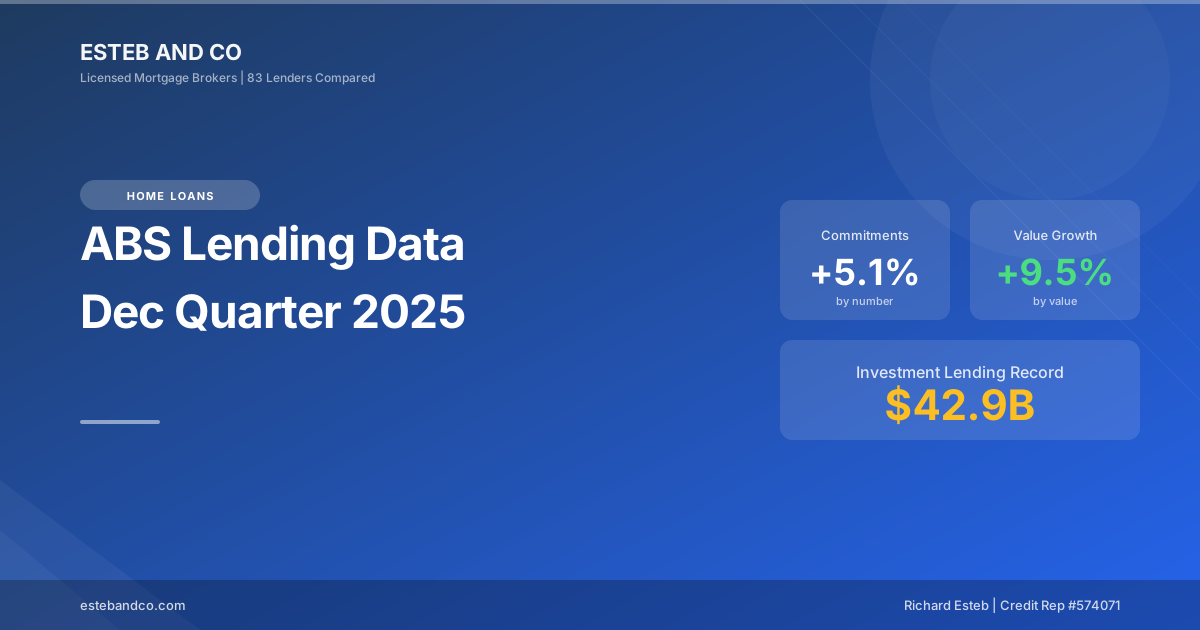
- Total loan commitments: Up 5.1% in number, up 9.5% in value
- Owner-occupier loans: Up 4.8% in number, up 10.6% in value
- Investor loans: Up 5.5% in number, up 7.9% in value
- Investment lending total: $42.9 billion — a record high
- Year-on-year investor growth: 31.8%
- Average owner-occupier loan: $693,801
- Average investor loan: $717,000
- First home buyer loans: 31,783 (up 6.8%), worth $19.3 billion
The gap between growth in loan numbers (5.1%) and loan values (9.5%) is telling. People aren’t just borrowing more frequently — they’re borrowing bigger amounts. Average loan sizes continue to climb as property prices rise, particularly in Sydney and regional Queensland.
The lending data tells a clear story: Australians are borrowing more, in larger amounts, with investors leading the charge at record levels. This has significant implications for both interest rates and market dynamics heading into 2026.
Owner-Occupier Lending: Steady Growth
Owner-occupier lending remains the backbone of the housing market, accounting for roughly 60% of all new housing loan commitments. The December quarter showed solid growth:
- Number of loans: Up 4.8%
- Value of loans: Up 10.6%
- Average loan size: $693,801
- Average variable rate: 5.49%
- Average monthly repayment: $3,935
The 10.6% growth in value (versus 4.8% in number) reflects rising property prices pushing up loan sizes. In practical terms, borrowers are taking on bigger debts to buy in the same markets. For a household earning the median income, the average loan now represents a debt-to-income ratio of approximately 9.6x — historically elevated.
Where owner-occupiers are borrowing
The growth isn’t uniform across the country. The strongest activity is in:
- Queensland: Strong interstate migration continues to drive demand, particularly in South East Queensland and regional areas
- Western Australia: Resource sector strength and relative affordability are attracting both local and interstate buyers
- NSW: Despite the highest average loan sizes ($828,065), volumes remain robust, particularly for refinancing
Investment Lending Hits a Record $42.9 Billion
The standout number in this data release is the $42.9 billion in investment lending for the quarter — a record high, up 31.8% year-on-year. The average investor loan sits at $717,000, roughly $23,000 more than the average owner-occupier loan.
What’s driving the investor surge?
1. Record-low vacancy rates
Rental vacancy rates remain below 1% in many capital city markets. This means strong rental yields and minimal risk of extended vacancies — making investment property an attractive proposition.
2. Capital growth expectations
Despite higher interest rates, property prices in most markets have continued to rise, driven by supply shortages and population growth. Investors are betting that capital gains will more than offset higher borrowing costs.
3. Tax advantages
Negative gearing and the 50% capital gains tax discount remain in place. For higher-income investors, the tax benefits of property investment are significant — particularly when rental yields are strong and the property is negatively geared.
4. Equity recycling
Many existing property owners have seen substantial equity growth in their current holdings. This equity can be used as a deposit for additional investment properties without needing to save additional cash. Read our investment property loans guide for more detail.
Should the RBA be concerned?
A 31.8% year-on-year surge in investment lending is exactly the kind of number that gets the RBA’s attention. Rapid investor credit growth can fuel asset price inflation, increase household leverage, and create financial stability risks. This data point alone may be enough to keep the RBA on a tightening bias — even if other indicators improve.
First Home Buyers: 31,783 Loans and Climbing
First home buyer activity continues to grow despite affordability challenges. In the December quarter:
- Number of FHB loans: 31,783 (up 6.8%)
- Total value: $19.3 billion
- Average FHB loan: ~$607,000
Several factors are helping first home buyers get into the market:
- Home Guarantee Scheme: Allows purchase with just 5% deposit and no LMI, with 35,000 places available annually
- State grants: First Home Owner Grants of $10,000-$30,000 for new builds (varies by state)
- Stamp duty concessions: Most states offer full or partial stamp duty exemptions for first buyers below certain thresholds
- Family support: The “Bank of Mum and Dad” remains a significant contributor, with many first buyers receiving family guarantor support or deposit gifts
For a complete rundown of options, see our first home buyer guide and deposit guide.
Average Loan Sizes by State
The variation in loan sizes across Australia reflects the vast differences in property prices between states:
| State | Avg Owner-Occupier Loan | Monthly Repayment (5.49%) |
|---|---|---|
| NSW | $828,065 | $4,696 |
| QLD | $687,161 | $3,897 |
| VIC | $646,577 | $3,667 |
| WA | $632,901 | $3,590 |
| ACT | $628,377 | $3,564 |
| SA | $616,428 | $3,496 |
| TAS | $483,920 | $2,745 |
| NT | $481,164 | $2,729 |
| National | $693,801 | $3,935 |
The gap between NSW ($828,065) and the NT ($481,164) is $347,000 — or almost $2,000 per month in repayments. This explains why interstate migration to Queensland, WA, and South Australia continues to accelerate. Borrowers are discovering they can buy a comparable (or better) home for significantly less by moving state.
For state-by-state detail, read our repayments by state breakdown.
What the Data Means for the RBA and Rates
The lending data has significant implications for interest rate expectations:
The hawkish case (rates stay or go up)
Strong lending volumes suggest the February rate hike hasn’t cooled demand. If anything, the data shows borrowers accelerating activity — possibly to get ahead of further increases. The RBA will see this as evidence that monetary policy isn’t restrictive enough. The 31.8% investment lending surge is particularly concerning from a financial stability perspective.
The dovish case (rates hold or eventually fall)
This data covers the period before the February hike took effect. The true impact of the rate increase won’t show up until the March quarter data. If lending volumes cool meaningfully in Q1 2026, the case for holding rates steady strengthens.
What I expect
The RBA will hold at 3.85% through at least Q1 2026, waiting for the March quarter CPI and lending data. If investment lending continues to surge and inflation stays above 3.3%, a further hike in May becomes likely (as CBA is forecasting). If both moderate, we could see an extended hold.
What Borrowers Should Take from This Data
Whether you’re an owner-occupier, investor, or first home buyer, this data has practical implications:
For owner-occupiers
- Competition is real: With lending volumes up 5.1%, you’re competing with more buyers. Being pre-approved and ready to act quickly gives you an edge
- Average loan sizes are growing: At $693,801, the national average is higher than ever. Make sure you can comfortably service repayments at rates 1% above current — stress-test at 6.49%
- Refinancing remains strong: If you’re paying above-market rates, joining the refinancing trend could make a real difference to what you pay. Our refinancing guide explains how
For investors
- Record activity means more competition: The $42.9 billion quarter means you’re competing with a lot of capital. Due diligence on rental yields and location fundamentals is more important than ever
- Regulatory risk: If investment lending continues at these levels, APRA may consider macroprudential measures (tighter lending standards for investors). This happened in 2017 and could happen again
- Investor rates are higher: Expect to pay 0.3-0.6% above owner-occupier rates. Read our investment lending analysis
For first home buyers
- You’re not alone: 31,783 first home buyers got loans last quarter. Government schemes are making it possible with less deposit than ever
- Act on schemes while they last: The Home Guarantee Scheme has limited places. If you’re eligible, apply early in the financial year
- Consider new builds: First home buyer grants are typically only available for new constructions. With building approvals surging, there’s more new product to choose from
Frequently Asked Questions
How much did housing lending grow in the December quarter 2025?
Total new housing loan commitments grew 5.1% in number and 9.5% in value. Owner-occupier loans rose 4.8% (number) and 10.6% (value). Investor loans grew 5.5% (number) and 7.9% (value). Investment lending reached a record $42.9 billion.
What is the average home loan size in Australia?
The average owner-occupier home loan is $693,801 as of December 2025. The average investor loan is $717,000. These vary significantly by state — NSW averages $828,065 while Tasmania averages $483,920. See full statistics here.
Why is investment lending at record levels?
Investment lending surged 31.8% year-on-year to $42.9 billion, driven by record-low rental vacancy rates, strong capital growth expectations, negative gearing tax advantages, and existing owners recycling equity from appreciated properties.
How many first home buyer loans were approved?
31,783 first home buyer loans were approved in the December quarter, worth $19.3 billion — up 6.8% from the previous quarter. Government schemes including the Home Guarantee Scheme are helping drive activity. Read our FHB analysis.
What does this data mean for interest rates?
Strong lending volumes, particularly the 31.8% investor surge, give the RBA reason to maintain or increase rates. However, this data covers the period before the February hike. The March quarter data will show whether the rate increase has cooled demand.
See where you stand
Compare your options across our panel of 50 lenders in about 2 minutes. Free, and it won’t affect your credit score.
Start complimentary assessment →No obligation · Richard Esteb, Credit Rep #574071
Richard Esteb
Ricky founded Esteb & Co to give everyday Australians access to the same loan comparison technology used by the big banks. He compares products from a panel of 50 lenders to find the right fit for each client’s situation.