Self-Employed Home Loans: What Lenders Actually Look For

Why Self-Employed Borrowers Get Treated Differently
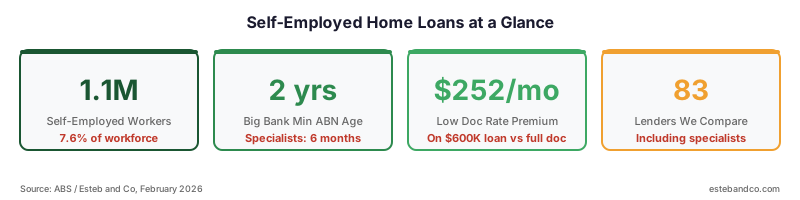
I looked up the latest ABS employment data this week. There are 1.1 million independent contractors in Australia - 7.6% of the workforce - and that doesn't include the hundreds of thousands of sole traders, company directors, and small business owners who fall under the "self-employed" umbrella. The number of owner-managers without employees jumped by 50,200 in a single month last year.
That's a lot of Australians running their own show. And nearly all of them face the same frustrating reality when they try to get a home loan: lenders treat them differently from PAYG employees.
I've been broking for over 11 years, and before that I sat on the lender side assessing loan applications. Self-employed applications made up roughly a quarter of what came across my desk, and they were consistently the most misunderstood - both by borrowers and by the bank assessors reviewing them.
The core problem is simple. A PAYG employee earning $120,000 hands over two payslips and a lender can verify their income in minutes. A self-employed person earning the same amount has to prove it through tax returns, financials, BAS statements, and accountant letters - and the lender might calculate their "usable income" at $80,000 or less after applying their own assessment rules.
I've seen tradies turning over $400,000 a year get declined by one bank, then approved by another for $650,000. The difference wasn't the borrower - it was the lender's assessment method. That's what this article is about.
The Two Paths: Full Doc vs Low Doc
Every self-employed borrower falls into one of two categories when it comes to documentation.
Full doc (standard verification)
This is the standard approach and gets you the best rates. You provide:
- 2 years of personal tax returns (most lenders require these; some accept 1 year)
- 2 years of business tax returns (if you operate through a company or trust)
- 2 years of business financials (profit & loss statement, balance sheet)
- Most recent Notice of Assessment from the ATO
- 6 months of business bank statements
The lender takes your taxable income (or company/trust distributions) and uses that as your income for servicing purposes. This is where the problem starts for most self-employed borrowers - because your accountant has been legitimately minimising your taxable income for years, and now that low number is working against you.
Low doc (alternative verification)
Low doc loans are specifically designed for borrowers who can't provide full tax returns. Instead, you might provide:
- Accountant's letter declaring your income for the past 1-2 years
- 6-12 months of business bank statements showing revenue
- BAS (Business Activity Statements) from the last 12 months
- Signed self-declaration of income
The trade-off: low doc loans typically come with higher rates (0.50-1.00% above standard), lower maximum LVR (usually 80% max, sometimes 60%), and fewer lender options. But they exist for a good reason - they let borrowers with genuinely strong businesses get approved when the paperwork doesn't tell the full story.
I always try the full doc path first. Low doc is a fallback, not a first choice.
How Lenders Calculate Your Income (This Is Where It Gets Complicated)
This is the part that catches most self-employed borrowers off guard. Your income for home loan purposes is almost never the number you think it is.
Sole traders
Relatively straightforward. The lender takes your net business income from your tax return (revenue minus expenses) as your assessable income. If your tax return shows $95,000 net profit, that's your income.
Company directors
Here's where it gets tricky. If you operate through a company (Pty Ltd), your income for loan purposes is typically your director's salary plus any dividends paid to you personally. The company's profit stays in the company - the lender doesn't count retained earnings as your income unless you draw them out.
I had a client last year who ran a plumbing business through a company. Revenue was $1.2 million, company profit was $180,000, but his salary was only $70,000. From the lender's perspective, his income was $70,000 - not $180,000. We had to restructure how he paid himself before reapplying.
Trust structures
The most complex. If you operate through a family trust, the lender looks at the distributions made to you personally. Some lenders will also consider the trust's underlying profit if you're the sole beneficiary, but many won't. And if distributions vary year to year (which they often do for tax planning), some lenders average them while others use the lowest year.
Add-backs: the number that changes everything
This is the insider knowledge that separates a good broker from a bad one. "Add-backs" are legitimate business expenses that lenders will add back to your income because they're non-cash or non-recurring. Common add-backs include:
- Depreciation - a non-cash expense that reduces your taxable income but isn't an actual outgoing
- Interest on business loans - the new home loan will replace this debt
- One-off expenses - fitout costs, equipment purchases, non-recurring business costs
- Motor vehicle expenses - some lenders add back a portion, recognising the personal use component
- Superannuation contributions - some lenders add back your personal super contributions
The difference add-backs make is enormous. I've seen a client's assessable income go from $85,000 (on paper) to $135,000 (after add-backs). That's the difference between a $450,000 loan and a $700,000 loan.
But here's the thing: every lender has different add-back policies. Some are generous (Macquarie, Liberty, Pepper Money). Some are extremely conservative (most major banks). This is the single biggest reason self-employed borrowers need a broker - we know which lender's add-back policy best suits your financials.
Which Lenders Are Best for Self-Employed Borrowers?
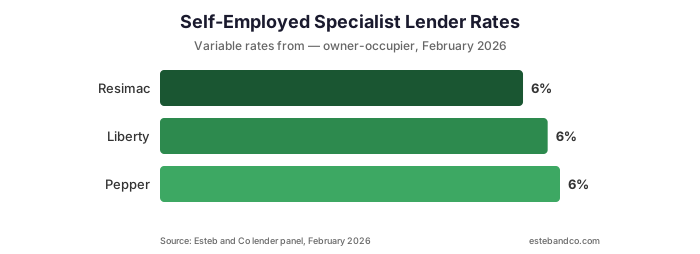
I went through our panel this week and identified the lenders that genuinely cater to self-employed borrowers - not just the ones that technically accept them but make the process painful.
| Lender | Variable From | Min ABN Age | Tax Returns Required | Low Doc Option | Best For |
|---|---|---|---|---|---|
| Pepper Money | 6.49% | 6 months | 1 year | Yes | New ABN, non-standard income |
| Liberty Financial | 6.29% | 12 months | 1 year | Yes | Complex structures, trusts |
| Resimac | 5.89% | 12 months | 1 year | Yes | Competitive alt-doc rates |
| Macquarie Bank | 5.85% | 24 months | 2 years | No | Best full-doc rates, generous add-backs |
| La Trobe Financial | 6.59% | 6 months | 1 year | Yes | Difficult scenarios, low LVR |
| CBA | 5.99% | 24 months | 2 years | Limited | Full doc with strong financials |
| NAB | 5.99% | 24 months | 2 years | Limited | Full doc, relationship pricing |
| Suncorp | 5.89% | 24 months | 2 years | No | QLD-based business owners |
Rates are indicative only for owner-occupier principal and interest loans. Self-employed rates may vary from advertised rates depending on documentation type. February 2026.
Notice the spread. Pepper Money will look at you with just 6 months of ABN history and 1 year of tax returns. CBA wants 2 years of everything. The rate difference reflects the risk - Pepper at 6.49% vs Macquarie at 5.85%. But getting approved at 6.49% beats being declined at 5.85% every time.
For most of my self-employed clients, the path looks like this: if you have 2 years of strong, clean financials, we go to Macquarie or one of the big four for the best rate. If your financials are complex, recent, or don't tell the full story, we go to a specialist like Liberty, Pepper, or Resimac.
The ABN Age Trap
Your ABN registration date matters more than you'd think. Most major banks want 2 years of ABN history. Some specialist lenders accept 12 months. A few (like Pepper Money) will consider applications with just 6 months.
But here's a trap I see regularly: a client who's been a self-employed electrician for 8 years calls me, but they changed from sole trader to a company structure 10 months ago. They got a new ABN for the company. As far as the lender is concerned, the business is 10 months old - regardless of the fact they've been doing the same work for nearly a decade.
When I was on the lender side, I saw this scenario weekly. The solution depends on the lender. Some will accept a letter from your accountant confirming continuity of business. Others won't budge. Knowing which lender takes which approach is worth thousands - and it's exactly the kind of knowledge that comes from doing this every day.
Preparing Your Application: The 12-Month Checklist
The best time to start preparing for a self-employed home loan is 12 months before you plan to apply. Here's what I tell every business owner who walks through my door:
12 months before applying
- Lodge your tax returns on time. Behind on your tax? Get current immediately. Overdue returns are a red flag that gives the lender an easy reason to decline.
- Talk to your accountant about your income strategy. If your accountant has been aggressively minimising your taxable income, you may need to accept a slightly higher tax bill this year to show sufficient income for your loan. A $5,000 higher tax bill is nothing compared to the cost of being declined.
- Separate personal and business banking. Lenders will look at your bank statements. Mixed personal and business transactions make assessment harder and raise questions.
6 months before applying
- Reduce personal debts. Pay down credit cards, close BNPL accounts, consolidate personal loans if possible. Every dollar of existing debt reduces your borrowing power.
- Build up genuine savings. Even if you have a large deposit, lenders want to see a savings pattern. Regular deposits into a separate savings account for 3-6 months.
- Get your BAS statements in order. Make sure all BAS lodgements are current and accurate. Lenders cross-reference BAS against tax returns.
3 months before applying
- Get your financials prepared. Ask your accountant to prepare up-to-date profit and loss and balance sheet statements. Some lenders accept management accounts (not yet audited) if they're signed by your accountant.
- Clean up your bank statements. No gambling transactions, minimal BNPL, limited discretionary spending. Lenders look at the last 90 days in detail.
- Check your credit score. Get your free report from Equifax. Fix any errors before applying.
Common Mistakes Self-Employed Borrowers Make
After processing thousands of self-employed applications from both sides of the desk, these are the patterns I see repeatedly:
Applying to the wrong lender first. A declined application leaves a credit enquiry on your file. Two or three declines in quick succession makes the next lender nervous. This is the number one reason self-employed borrowers should use a broker - we know which lender will say yes before we submit.
Over-minimising taxable income. Your accountant's job is to minimise your tax. But if your tax return shows $55,000 and you want to borrow $600,000, the numbers don't work at any lender. There's a balance between tax efficiency and loan eligibility, and you need to plan for it a year in advance.
Not understanding how their structure affects assessment. Company profits aren't your income. Trust distributions vary. Partnership income splits in ways lenders may not accept. If you don't understand how a lender views your structure, you'll either undershoot (apply for less than you can get) or overshoot (apply for too much and get declined).
Mixing personal and business finances. I see this constantly with sole traders. Personal expenses running through the business account, business income landing in the personal account. It creates confusion for the lender and makes assessment take twice as long.
Waiting for "perfect" financials. Some clients put off applying for years waiting until their tax returns show the perfect number. Meanwhile, property prices climb $50,000-$100,000 per year. Sometimes a low doc loan at a slightly higher rate today is better than a full doc loan at a better rate in two years - after you've missed $150,000 in price growth. And once you've built equity and have clean financials, you can always refinance to a sharper rate down the track.
Low Doc vs Full Doc: Running the Numbers
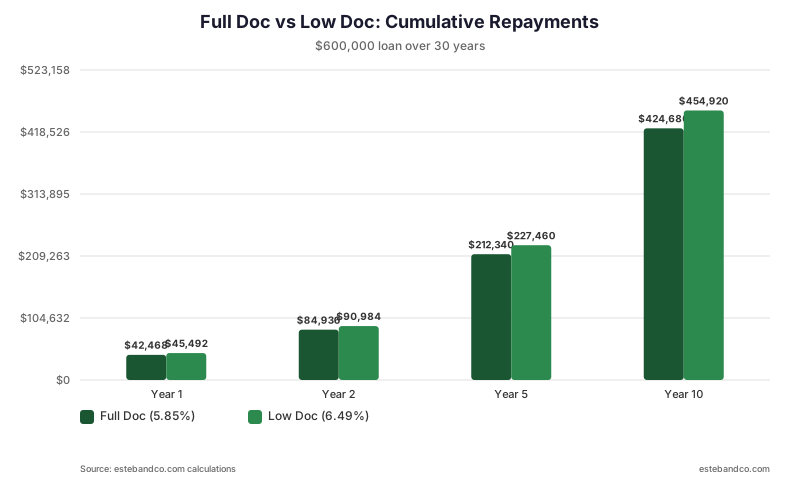
Let me show you the actual cost difference so you can make an informed decision.
On a $600,000 loan over 30 years:
| Loan Type | Rate | Monthly Repayment | Total Interest Over 30 Years |
|---|---|---|---|
| Full doc (best rate) | 5.85% | $3,539 | $674,040 |
| Low doc (specialist) | 6.49% | $3,791 | $764,760 |
| Difference | 0.64% | $252/month | $90,720 |
I always frame low doc as a bridge, not a destination. Get into the market now, build equity, get your paperwork sorted, then refinance to a cheaper product.
What If You've Been Declined?
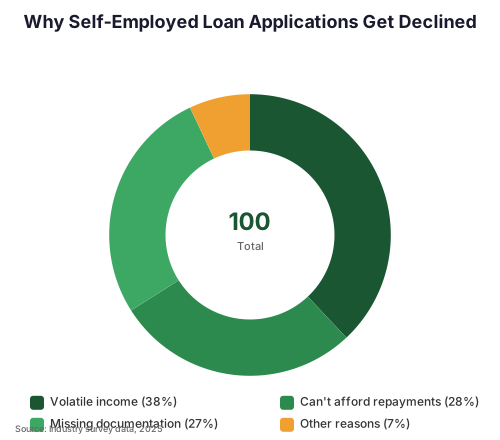
A declined application isn't the end of the road. The three most common reasons for self-employed declines are:
- Insufficient income on paper - usually fixable by finding a lender with better add-back policies or waiting one financial year to lodge stronger returns
- ABN age too short - specialist lenders like Pepper Money can help, or wait until you hit the minimum threshold
- Incomplete documentation - the most frustrating reason because it's entirely preventable. Work with your accountant and broker to ensure everything is complete before submitting
I've placed loans for self-employed clients who were declined by 2-3 banks before coming to me. The borrower hadn't changed - their income, savings, and deposit were identical. What changed was finding the right lender for their specific situation.
If you've been declined, don't apply again immediately. Get a broker to review the decline reason, identify which lender's policies suit you, and submit one targeted application. See our guide on low doc loan options for more detail.
Frequently Asked Questions
How long do I need to be self-employed to get a home loan?
Most major banks require 2 years of ABN registration and 2 years of tax returns. Some specialist lenders accept 12 months, and Pepper Money will consider applications with as little as 6 months of ABN history. If you've recently changed business structures (e.g., from sole trader to company), some lenders will accept a letter confirming continuity of business from your accountant.
Can I get a home loan if my tax returns show low income?
Yes, through add-backs and alternative documentation. A broker can identify non-cash expenses (depreciation, one-off costs) that lenders add back to your assessable income. If your tax returns still don't support the loan amount, low doc options let you verify income through BAS statements and bank deposits instead. The rates are higher, but approval is achievable.
Do I need a bigger deposit if I'm self-employed?
For full doc loans, deposit requirements are the same as for PAYG employees - you can borrow up to 95% LVR with some lenders. For low doc loans, most lenders cap LVR at 80%, meaning you need at least a 20% deposit. Some specialist lenders will go to 90% LVR on low doc, but expect higher LMI and rates. A guarantor loan can help bridge the deposit gap.
Should I use my business to buy the property?
Buying in a personal name is simpler and gives you access to better rates and the owner-occupier exemptions (CGT, land tax). Buying through a company or trust has tax advantages for investment properties but generally isn't suitable for owner-occupier purchases. Always get advice from your accountant before structuring - it's very expensive to change later.
Can I use my company's income instead of my personal income?
Not directly. The lender looks at what the company pays you (salary and dividends). Retained profits in the company aren't counted as your personal income. If your company is profitable but you're drawing a low salary, consider increasing your personal drawings for 12 months before applying. Some lenders are more flexible with how they assess company income - your broker can identify which ones.
What's the difference between a sole trader and a company for loan purposes?
A sole trader's business income is assessed as personal income - it's all one entity. A company is a separate legal entity, so the lender only counts what the company pays you personally. Trust structures add another layer of complexity around distributions. The structure affects your borrowing power significantly - I've seen identical businesses with $200,000+ differences in borrowing capacity depending on the entity they operate through. We help clients compare their options based on their specific structure.
Your Next Move
Self-employed borrowers have more options right now than at any point in the last five years. Specialist lenders are competing hard for your business, and even the major banks have loosened their policies. When I look at the ABS data, the self-employed workforce is growing - and lenders know that ignoring 1.1 million potential borrowers isn't good for their bottom line.
The key is preparation and knowing which lender fits your situation. If you're self-employed and thinking about buying or refinancing, book a complimentary assessment with us. Bring your last two tax returns and we'll tell you within 30 minutes which lenders will approve you, how much you can borrow, and whether full doc or low doc is the smarter path.
See where you stand
Compare your options across our panel of 50 lenders in about 2 minutes. Free, and it won’t affect your credit score.
Start complimentary assessment →No obligation · Richard Esteb, Credit Rep #574071
Richard Esteb
Ricky founded Esteb & Co to give everyday Australians access to the same loan comparison technology used by the big banks. He compares products from a panel of 50 lenders to find the right fit for each client’s situation.