How Much Deposit Do You Need for a Home Loan in Australia?

The Short Answer (and Why It's Not That Simple)
The standard advice is 20%. But I pulled the latest ABS Lending Indicators this week and the average first home buyer loan is now $607,624 - which means a 20% deposit on a typical first home buyer purchase is around $135,000. For most Australians under 35, saving that kind of money while paying rent feels like trying to fill a bathtub with the plug out.
Here's what I tell my clients after 11 years in the industry: 20% is ideal, but it's not the minimum. You can get into a home with as little as 2-5% deposit right now, depending on your circumstances. The question isn't whether you can buy with less - it's understanding what each deposit level costs you.
I went through the numbers this week using current rates and property prices across every state. Let me show you exactly what the deposit landscape looks like in 2026.
Deposit Levels Explained: What Each Percentage Actually Means
20% deposit - the gold standard
No Lenders Mortgage Insurance, access to the best interest rates, and the strongest position when negotiating with both agents and lenders. On the national median dwelling value of $912,465, that's $182,493.
In practice, 20% deposits are increasingly rare among first home buyers. When I look at the data from my own pipeline, I'd estimate fewer than 1 in 5 first home buyers we help have a full 20% saved. Most are coming in between 5% and 15%.
10-15% deposit - the practical middle ground
This is where most of my owner-occupier clients land. You'll pay Lenders Mortgage Insurance (more on the cost below), but you get into the market years earlier than if you kept saving to 20%. On a $700,000 property:
- 15% deposit ($105,000): LMI roughly $3,500-$5,000
- 10% deposit ($70,000): LMI roughly $8,000-$12,000
The LMI stings, but here's how I explain it to clients: if property prices grow by even 3% per year, waiting two more years to avoid $8,000 in LMI could cost you $42,000 in higher purchase price. The maths almost always favours getting in sooner.
5% deposit - government-backed options
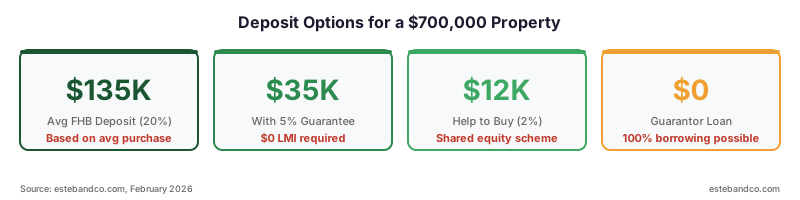
Since October 2025, the expanded First Home Guarantee scheme lets all first home buyers purchase with just 5% deposit and zero LMI. The government guarantees the remaining 15%. On a $700,000 property, that's just $35,000.
This is a genuine shift. The old scheme had limited places and income caps. The expansion removed income caps and made places unlimited - meaning if you're a first home buyer, this is now available to everyone. I've been putting a lot of clients through this scheme in the last few months and it's working well.
2% deposit - shared equity
The Help to Buy scheme lets eligible buyers in with just 2% deposit. The government takes an equity stake of up to 40% in a new home or 30% in an existing property. On a $600,000 property, your deposit could be as low as $12,000.
The catch: when you sell, the government takes their percentage of the sale price. If your home goes from $600,000 to $800,000 and the government owns 30%, they take $240,000 back - not the original $180,000 they contributed. You're sharing your capital gains.
0% deposit - guarantor loans
If you have a parent or family member who owns property, a guarantor loan lets you borrow 100% of the purchase price - sometimes even 100% plus costs. The guarantor uses equity in their own property to secure part of your loan.
Most lenders limit the guarantee to 20% of the property value. So on a $600,000 purchase, the guarantor provides security over $120,000 of the loan. Once your LVR drops below 80% (through repayments or property growth), the guarantor can be released.
I process a lot of guarantor loans. The biggest thing I tell families: the guarantor doesn't make repayments and isn't liable for the full loan - only the guaranteed portion. But they do need independent legal advice, and their own borrowing capacity may be affected while the guarantee is in place.
What a Deposit Actually Looks Like by State
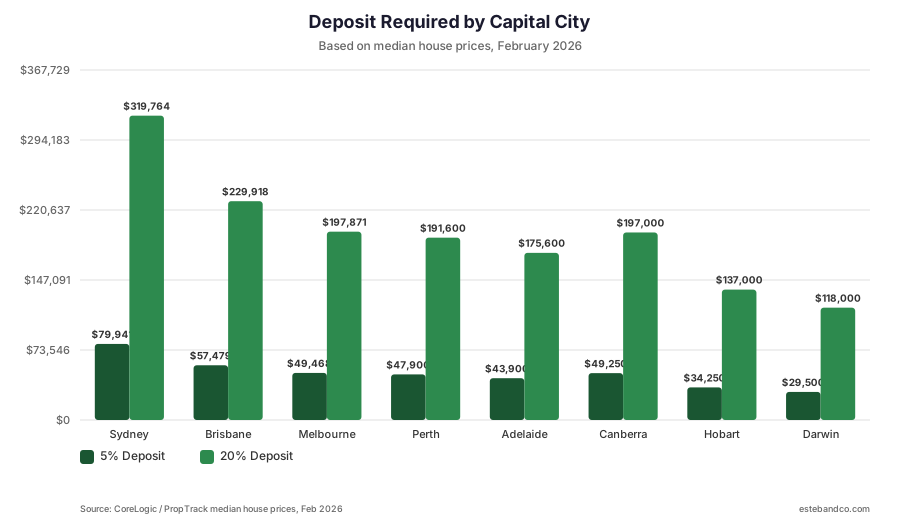
I went through the latest property data this week and calculated what different deposit levels look like in each capital city. The numbers are eye-opening.
Based on median house prices (February 2026)
| City | Median House Price | 20% Deposit | 10% Deposit | 5% Deposit |
|---|---|---|---|---|
| Sydney | $1,598,819 | $319,764 | $159,882 | $79,941 |
| Melbourne | $989,356 | $197,871 | $98,936 | $49,468 |
| Brisbane | $1,149,589 | $229,918 | $114,959 | $57,479 |
| Perth | $958,000 | $191,600 | $95,800 | $47,900 |
| Adelaide | $878,000 | $175,600 | $87,800 | $43,900 |
| Hobart | $685,000 | $137,000 | $68,500 | $34,250 |
| Canberra | $985,000 | $197,000 | $98,500 | $49,250 |
| Darwin | $590,000 | $118,000 | $59,000 | $29,500 |
Look at the difference. A 5% deposit in Darwin ($29,500) is less than a tenth of what you'd need for 20% in Sydney ($319,764). Where you buy has more impact on your deposit than almost any other factor.
And these are house prices. Units are significantly cheaper in every city. The median unit in Melbourne is $639,145 - a 5% deposit on that is $31,957. Suddenly we're talking about achievable numbers.
The Real Cost of Lenders Mortgage Insurance (LMI)
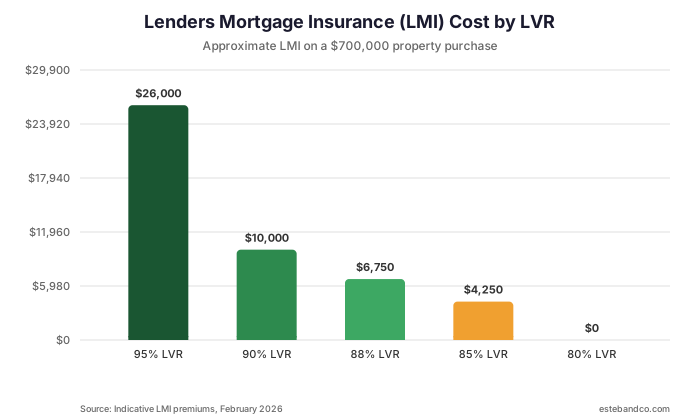
LMI is the premium you pay when your deposit is less than 20%. It protects the lender (not you) if you default. Most borrowers either add it to their loan or pay it upfront.
I pulled current LMI estimates from our panel for a typical owner-occupier purchase. These are approximate - your actual premium depends on your lender, loan amount, and LVR.
LMI cost estimates on a $700,000 property
| Deposit | Deposit Amount | LVR | Approximate LMI |
|---|---|---|---|
| 5% | $35,000 | 95% | $24,000-$28,000 |
| 10% | $70,000 | 90% | $8,000-$12,000 |
| 12% | $84,000 | 88% | $5,500-$8,000 |
| 15% | $105,000 | 85% | $3,500-$5,000 |
| 20% | $140,000 | 80% | $0 |
One thing most people don't realise: LMI is not refundable. If you refinance two years later, you don't get any of it back. And if you add it to your loan (which most borrowers do), you're paying interest on the LMI premium for the life of the loan. That $12,000 LMI at 90% LVR actually costs you closer to $20,000 over 30 years once you account for the interest.
What Counts as a Deposit? (Not Everything Qualifies)
Lenders are specific about what they'll accept as a deposit. I've had applications delayed because a client assumed something counted as genuine savings when it didn't.
Accepted by all lenders
- Savings in a bank account accumulated over 3+ months (this is the most straightforward)
- Term deposits held for 3+ months
- Equity in another property - if you own another home, the equity counts
- Gift from family - most lenders accept this, but you'll need a signed statutory declaration from the family member confirming it's a gift, not a loan
- First Home Super Saver Scheme (FHSSS) - up to $50,000 of voluntary super contributions can be withdrawn for a home deposit through the ATO's FHSSS
Accepted by some lenders
- Shares or managed funds - most major banks accept these at current market value
- Tax refunds - accepted if they've been in your account for 3+ months
- Inheritance - accepted with probate documentation
- Sale of personal assets (car, boat, etc.) - some lenders accept, others don't
Not accepted by most lenders
- Cryptocurrency - the vast majority of lenders still won't accept crypto as genuine savings. I've had exactly one lender on our panel consider it, and only after it was converted to AUD and held for 90 days
- Borrowed money - personal loans, credit card advances, or BNPL balances used as a deposit will be flagged and likely declined
- Cash with no paper trail - if you can't show where the money came from, lenders won't count it
The genuine savings requirement
Most lenders want to see "genuine savings" - typically 5% of the purchase price saved over at least 3 months. Even if you have a gifted deposit or a guarantor, lenders usually want evidence that you can save money independently. This can be especially tricky if you're self-employed, where business and personal finances often overlap.
When I was on the lender side, this was one of the most common reasons for application delays. Someone would have $80,000 in savings but it was a lump sum inheritance that landed two weeks ago. The lender wanted to see a savings pattern - regular deposits showing the borrower could manage money - not just a balance.
How to Build Your Deposit Faster
Strategy 1: First Home Super Saver Scheme
This is the most tax-effective way to save. You make voluntary super contributions (up to $15,000 per year, $50,000 total), and those contributions are taxed at 15% instead of your marginal tax rate. If you earn $90,000 per year, you're saving at a 34.5% tax rate. The FHSSS saves you 19.5 cents on every dollar you contribute. Over two years of maximising contributions, that's roughly $5,850 in tax savings.
The downside: the process of withdrawing takes 4-6 weeks through the ATO, which can slow down your purchase timeline. I always tell clients to start the FHSSS withdrawal process before they start property hunting.
Strategy 2: Government grants as deposit boosters
The First Home Owner Grant varies by state but can add $10,000-$30,000 to your deposit. Queensland and Tasmania are the most generous at $30,000 each for new builds. That grant on top of 5% savings can get you into a $600,000 property with just a $1,000 gap in some states.
Strategy 3: Rent-vesting
Some of my clients buy an investment property in a more affordable area while continuing to rent where they want to live. A $450,000 unit in regional Queensland might only need a $22,500 deposit with the First Home Guarantee. The rental income helps cover repayments, and you're building equity instead of paying someone else's mortgage.
Strategy 4: Buying with a partner, friend, or family member
Two incomes, two sets of savings. Buying with someone else roughly doubles your borrowing power and deposit pool. I've helped siblings buy together, friends buy together, and couples who aren't married buy together. The key is getting a co-ownership agreement drawn up by a solicitor - it costs $500-$1,000 and saves enormous headaches if the relationship changes.
Strategy 5: Negotiate the purchase price
A 5% discount on a $700,000 property saves you $35,000. That's equivalent to having another year of deposit savings in your pocket. Properties that have been on the market for 60+ days, deceased estates, and motivated vendors are all negotiation opportunities. Your buyer's agent or conveyancer can help here.
The Deposit vs Time Trade-off
This is the conversation I have most often with first home buyers. They come in asking "should I keep saving for a bigger deposit?" The answer depends on what property prices are doing.
I went through the ABS data on total dwelling values and the national median dwelling value grew 9.4% over the past 12 months. That's $85,572 in extra purchase price on a median-priced home. If you're saving $2,000 per month toward your deposit, you saved $24,000 in the same period - but the goal post moved by $85,572.
This is why I tell most clients: if you have enough deposit to get into the market now - even with LMI - the cost of waiting is almost always higher than the cost of the LMI itself. The exception is if you're only a few months away from a meaningfully lower LVR tier (say 92% vs 90%), where the LMI difference can be significant.
Frequently Asked Questions
Can I buy a house with no deposit at all?
Yes, with a guarantor. A parent or close family member can use equity in their own property to guarantee part of your loan, allowing you to borrow up to 100% of the purchase price - sometimes even 105% to cover stamp duty and legal fees. Most major banks and several non-bank lenders offer guarantor home loans. The guarantor doesn't make repayments; they provide security only.
How long does it take to save a 20% deposit?
On the national median dwelling value of $912,465, a 20% deposit is $182,493. If you're saving $2,000 per month, that takes about 7.6 years. At $3,000 per month, about 5.1 years. This is exactly why most first home buyers don't wait for 20% - they use government schemes, guarantors, or accept LMI to get in sooner.
Is it better to pay LMI or keep saving?
In most markets, buying sooner with LMI beats waiting. I ran the numbers: on a $700,000 property growing at 5% per year, waiting 2 years to save an extra $48,000 and avoid $10,000 in LMI means you'd be buying a $771,750 property instead. You avoided $10,000 in LMI but paid $71,750 more for the same home. The maths overwhelmingly favours buying earlier - unless property prices are flat or falling in your area.
Does a bigger deposit mean a lower interest rate?
Yes. Most lenders have rate tiers based on LVR. The biggest rate drop usually happens at 80% LVR (no LMI territory). Some lenders offer even better rates at 70% or 60% LVR. The difference between a 90% LVR rate and an 80% LVR rate is typically 0.10-0.30% - which on a $600,000 loan is $60-$180 per month. See our fixed vs variable rate comparison for current rate tiers across lenders.
Can I use the First Home Owner Grant as part of my deposit?
In most states, yes - the FHOG can contribute to your deposit, but lenders still want to see genuine savings alongside it. The grant is typically paid at settlement, so you may need to demonstrate your deposit capacity without the grant at the application stage. Talk to your broker about timing.
What if my parents want to give me money for a deposit?
Gifted deposits are accepted by most lenders, but you'll need a signed gift letter or statutory declaration from your parents confirming it's a genuine gift with no repayment expected. Some lenders also want to see the money sitting in your account for at least one statement period before applying. If your parents are lending you money (rather than gifting), that's treated as a debt and reduces your borrowing power.
The Bottom Line
When I look at the ABS lending data, 31,783 first home buyers got loans last quarter - a 6.8% jump. The average loan was $607,624 with an 8.5% increase in average loan size. The majority of those buyers did not have 20% deposits. They used government schemes, family support, and accepted LMI to get into the market.
The deposit question isn't "how much do I need?" - it's "what's the smartest way to get in with what I have?" That answer is different for every buyer, which is why it's worth a conversation with someone who can run the numbers for your specific situation. Book a complimentary consultation and we'll map out your options - including schemes you might not know about.
See where you stand
Compare your options across our panel of 50 lenders in about 2 minutes. Free, and it won’t affect your credit score.
Start complimentary assessment →No obligation · Richard Esteb, Credit Rep #574071
Richard Esteb
Ricky founded Esteb & Co to give everyday Australians access to the same loan comparison technology used by the big banks. He compares products from a panel of 50 lenders to find the right fit for each client’s situation.