RBA Holds Cash Rate at 3.85% in March 2026: What Borrowers Should Know

In this article
- The March decision — a hold, but a hawkish one
- Why the RBA held — the data behind the decision
- CBA’s May hike forecast: should you be worried?
- What another hike would cost borrowers
- The inflation picture: CPI 3.8% and climbing
- Labour market: tight at 4.1% unemployment
- What borrowers should do right now
- Frequently asked questions
The March Decision — a Hold, but a Hawkish One
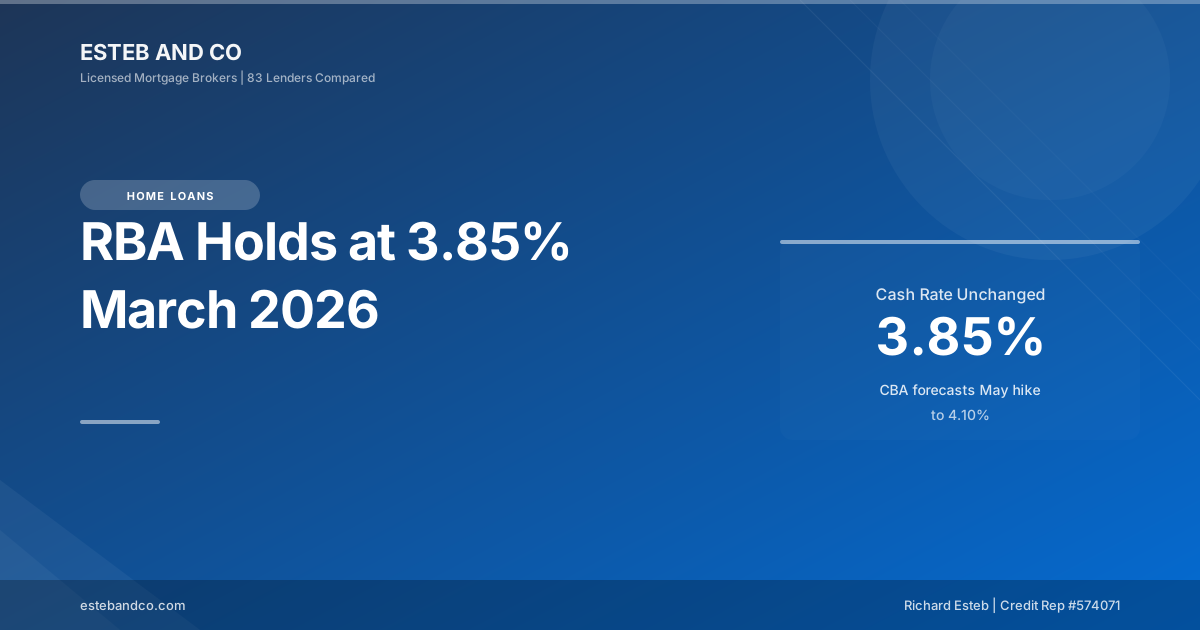
The Reserve Bank of Australia kept the cash rate on hold at 3.85% at its March 2026 meeting, following the surprise hike in February that took rates from 3.60% back up to 3.85%. For borrowers hoping the February increase was a one-off, the RBA’s statement offered cold comfort.
While the Board chose not to move this month, the accompanying statement made clear that further tightening remains firmly on the table. The language was notably hawkish: the Board “remains prepared to act” if inflation does not continue to moderate.
“The Board will continue to rely upon the data and the evolving assessment of risks to guide its decisions. The Board remains resolute in its determination to return inflation to target.” — RBA Monetary Policy Statement, March 2026
Translation: don’t assume rates are staying here. The RBA is in wait-and-see mode, but the bias is towards tightening if the numbers don’t improve.
Why the RBA Held — the Data Behind the Decision
Several factors weighed in the Board’s decision to pause rather than hike again immediately:
Inflation is elevated but the trend is mixed
The headline CPI annual rate came in at 3.8% for the December quarter 2025 — well above the RBA’s 2-3% target band. However, the trimmed mean (the RBA’s preferred measure that strips out volatile items) was 3.3%, showing some improvement from earlier readings.
The Board wants to see whether the February rate hike, combined with the end of some temporary government energy subsidies, pushes underlying inflation lower in Q1 2026. The March quarter CPI data (due late April) will be critical.
The labour market remains tight
ABS Labour Force data shows unemployment holding at 4.1% with employment rising by 24,700 in the most recent month. This is a labour market that’s still generating jobs and keeping wage pressures elevated.
The Wage Price Index showed annual growth of 3.4%, with quarterly growth of 0.8%. While wages aren’t accelerating, they’re growing faster than productivity, which feeds into inflationary pressure — particularly in labour-intensive services.
Housing credit is still surging
ABS Lending Indicators data shows total new housing loan commitments grew 5.1% in number and 9.5% in value over the December quarter. Investment lending surged 31.8% year-on-year to $42.9 billion. The RBA has flagged strong credit growth as a concern — it can fuel asset price inflation and create financial stability risks.
CBA’s May Hike Forecast: Should You Be Worried?
The Commonwealth Bank — Australia’s largest mortgage lender — is forecasting that the RBA will raise the cash rate by another 0.25% to 4.10% at the May 2026 meeting. This would unwind two of the three rate cuts delivered in 2025.
CBA’s rationale centres on three factors:
- CPI staying above target — At 3.8% headline, inflation is still running hot and the March quarter data may not show enough improvement
- Strong housing market — Lending volumes and property prices remain resilient despite the February hike
- Global inflationary pressures — Supply chain disruptions and commodity price movements are adding upward pressure on imported inflation
Not all economists agree. Westpac and ANZ are forecasting a hold through the rest of 2026, arguing that the February hike was sufficient and that inflation will moderate naturally as base effects wash through. The market is roughly split: interest rate futures are pricing in about a 40% chance of a May hike.
What this means for you: hope for a hold, but plan for a hike.
What Another Hike Would Cost Borrowers
If the RBA does move to 4.10% in May, that would mean two hikes totalling 0.50% since the end of 2025. Here’s the cumulative impact on monthly repayments from the December 2025 low of 3.60%:
| Loan Size | At 3.60% (Dec 2025) | At 3.85% (Now) | At 4.10% (May?) | Total Increase |
|---|---|---|---|---|
| $400,000 | $2,206 | $2,268 | $2,331 | +$125/mo |
| $500,000 | $2,757 | $2,835 | $2,914 | +$157/mo |
| $693,801 (avg) | $3,826 | $3,935 | $4,044 | +$218/mo |
| $800,000 | $4,413 | $4,536 | $4,662 | +$249/mo |
| $1,000,000 | $5,516 | $5,670 | $5,828 | +$312/mo |
For the average borrower, that’s an extra $218 per month or $2,616 per year compared to what they were paying at the end of 2025. That’s real money — and it comes on top of the cumulative hikes from the 2023-2024 tightening cycle.
The Inflation Picture: CPI 3.8% and Climbing
Let’s dig into why inflation is causing the RBA so much concern. The latest ABS Consumer Price Index data for the December quarter 2025 showed:
- Headline CPI: 3.8% annual (up from earlier quarters)
- Trimmed mean CPI: 3.3% annual (the RBA’s preferred measure)
- Key drivers: Housing costs (+4.8%), insurance (+13.2%), food (+3.7%)
The gap between headline and trimmed mean tells an important story. Headline inflation has been pushed higher partly by the unwinding of government electricity subsidies — a technical effect that will eventually wash through. But the trimmed mean at 3.3% shows that broad-based price pressures remain sticky.
For mortgage borrowers, the practical impact is clear: as long as inflation stays above 3%, the RBA has no reason to cut rates. And if it accelerates further, more hikes are on the cards.
What to watch in April
The March quarter CPI data will be released in late April, just before the RBA’s May meeting. This is the single most important data point for determining whether rates go up again. If trimmed mean stays above 3.3%, a May hike becomes much more likely. If it drops towards 3.0%, the RBA will likely hold.
Labour Market: Tight at 4.1% Unemployment
Australia’s labour market continues to defy expectations of softening. The latest ABS data shows:
- Unemployment: 4.1% (historically low)
- Employment growth: +24,700 in the latest month
- Participation rate: Near record highs
- Wage growth: 3.4% annual (WPI), 0.8% quarterly
A tight labour market is normally good news — people have jobs and are earning more. But from the RBA’s perspective, it’s a problem. Strong employment and rising wages keep consumer spending elevated, which keeps demand-side inflation persistent.
The wage-price dynamic is particularly concerning. Wages growing at 3.4% while productivity growth is flat means that unit labour costs are rising. This gets passed through to consumers as higher prices for services — everything from hospitality to healthcare to childcare.
Until unemployment rises meaningfully above 4.5% or wage growth moderates to around 3%, the RBA will remain cautious about easing monetary policy.
What Borrowers Should Do Right Now
Whether or not the RBA hikes in May, the current environment demands a proactive approach. Here’s what I’m telling clients:
1. Stress-test your repayments at 4.10%
If CBA is right about a May hike, your variable rate will likely hit around 5.74%. Run your budget at that rate. Can you handle an extra $218/month on the average loan? If it’s going to cause genuine stress, it’s time to take action now rather than wait.
2. Compare your rate against the market
The gap between what existing borrowers pay and what new customers are being offered remains wide. If you’re paying above 5.60% on a variable rate, you’re almost certainly paying too much. Even a 0.3% improvement on a $693,801 loan saves $130 per month.
3. Consider fixing a portion before May
If you want certainty, now is the time to consider fixing part of your loan. Two-year fixed rates are currently available from around 5.30-5.50% — competitive with current variable rates and protected against further hikes. Fix 50-60% and keep the rest variable with offset access.
4. Build your offset buffer
Every dollar in your offset account reduces your effective interest rate. On a $700,000 loan, having $30,000 in an offset saves roughly $138 per month in interest. If you received a tax refund, bonus, or have savings sitting in a transaction account, move them to your offset.
5. Talk to a broker before May
If you’re on a variable rate and haven’t reviewed your loan in 12+ months, a quick broker conversation could make a real difference to what you pay. We compare 50 lenders and the service is complimentary — we get paid by lenders, not by you. Here’s how refinancing works.
Frequently Asked Questions
Why did the RBA hold rates in March 2026?
The RBA held at 3.85% to assess the impact of the February hike on the economy. While CPI remains elevated at 3.8%, the Board wanted more data before making further changes. The March quarter inflation data (due April) will be critical for the May decision.
Will the RBA raise rates again in May 2026?
CBA is forecasting a hike to 4.10% in May if inflation stays sticky. It depends on the March quarter CPI data. If trimmed mean inflation falls towards 3%, the RBA may hold. Interest rate futures are pricing roughly a 40% chance of a May hike.
What is the current average variable home loan rate?
The average variable rate for owner-occupiers is approximately 5.49% as of March 2026. Competitive rates start from around 5.09% for well-qualified borrowers. If you’re paying above 5.60%, refinancing could make a real difference to what you pay.
Should I lock in a fixed rate before May?
Consider a split loan approach: fix 50-60% for certainty and keep 40-50% variable with an offset. Two-year fixed rates around 5.30-5.50% are competitive and protect against further hikes. Read our fixed vs variable guide for more detail.
How much would another 0.25% hike cost me?
On the average loan of $693,801, each 0.25% increase adds about $109 per month. Two hikes from the 3.60% low (Dec 2025) to 4.10% would cost approximately $218 per month or $2,616 per year extra.
See where you stand
Compare your options across our panel of 50 lenders in about 2 minutes. Free, and it won’t affect your credit score.
Start complimentary assessment →No obligation · Richard Esteb, Credit Rep #574071
Richard Esteb
Ricky founded Esteb & Co to give everyday Australians access to the same loan comparison technology used by the big banks. He compares products from a panel of 50 lenders to find the right fit for each client’s situation.