Construction Loans: How They Work in Australia (2026 Guide)

The State of Building in Australia Right Now
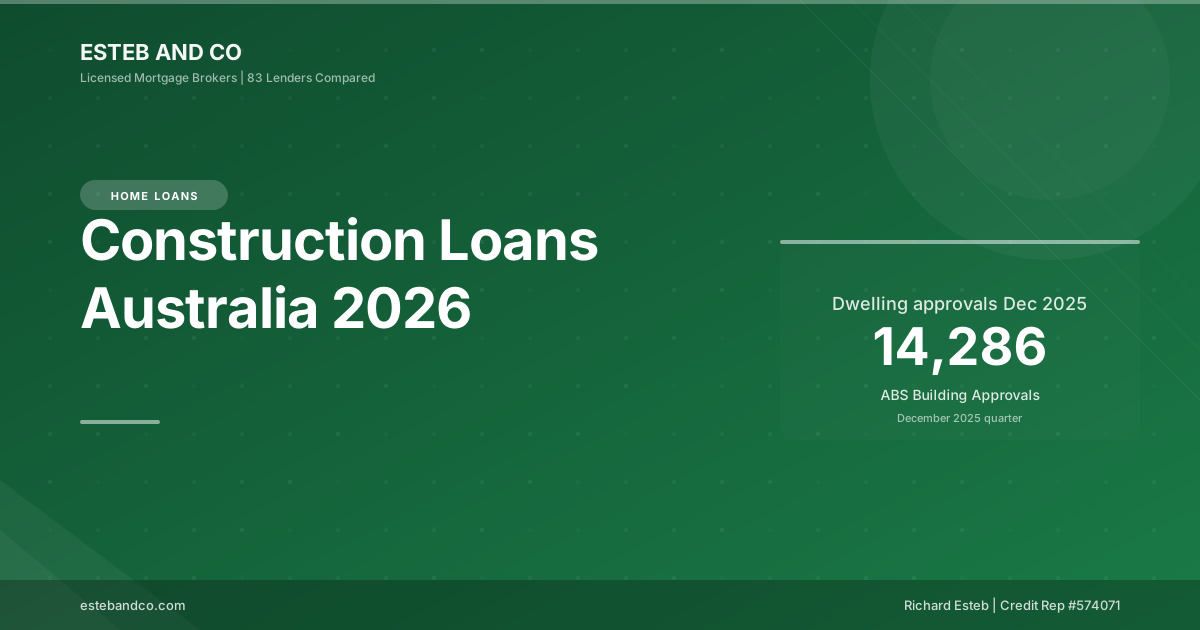
The latest ABS Building Approvals data for December 2025 shows 14,286 dwelling approvals for the month - a solid number, up 3.2% on the previous month. But here's the picture that matters more: total dwelling approvals for the 2025 calendar year came in at approximately 171,000, well short of the 240,000 per year the National Housing Accord says Australia needs.
What this means for you: building new is absolutely still viable, and for many people it's the best path to homeownership - especially with first home buyer grants that apply exclusively to new builds. But construction loans work differently from standard home loans, and the details matter. Let me walk you through everything.
How Construction Loans Differ from Standard Home Loans
With a standard home loan, the lender releases the full loan amount at settlement. The property exists, it's been valued, and the money changes hands in one transaction.
A construction loan doesn't work like that. The property doesn't exist yet (or is only partially built), so the lender releases the money in stages as construction progresses. This is called progressive drawdown, and it's the fundamental difference.
Key differences at a glance
| Feature | Standard Home Loan | Construction Loan |
|---|---|---|
| Funds released | Full amount at settlement | In stages (progressive drawdowns) |
| Interest charged | On full loan from day one | Only on amount drawn so far |
| Repayments during build | N/A | Interest-only on drawn amount |
| Valuation | Based on existing property | Based on land value + estimated completed value ("as-if-complete") |
| Contract required | Sale contract | Building contract (fixed price preferred) |
| Timeframe | 6-12 weeks to settlement | 12-24 months (build period) |
| Rate lock | Variable or fixed from day one | Variable during construction, can fix after completion |
Progressive Drawdown: How the Money Gets Released
This is the part that confuses most people. Your builder sends the lender a progress claim at each stage. The lender inspects the work (sometimes via a desktop valuation, sometimes a physical site visit) and releases the funds for that stage. Here's the typical drawdown schedule:
| Stage | % of Build Cost | Amount (on $400K Build) | What's Completed |
|---|---|---|---|
| 1. Deposit/Base | 5% | $20,000 | Contract signed, site preparation |
| 2. Slab/Base | 15% | $60,000 | Concrete slab poured, foundations complete |
| 3. Frame | 20% | $80,000 | Wall and roof frames erected |
| 4. Lock-up/Enclosed | 20% | $80,000 | Roof on, external walls, windows, doors installed |
| 5. Fixing/Fit-out | 25% | $100,000 | Internal walls, plumbing, electrical, kitchen, bathrooms |
| 6. Completion | 15% | $60,000 | Paint, floor coverings, final fixtures, landscaping |
Percentages are typical and vary by builder and state. Your building contract will specify the exact draw schedule.
Here's the cash flow advantage: during construction, you only pay interest on the amount drawn. In month 1, you might be paying interest on just $20,000 (the deposit stage). By lock-up stage, you're paying interest on $240,000. This means your repayments increase gradually as the build progresses, rather than hitting you with the full amount from day one.
Land and Build vs Turnkey Packages
Land and build (separate contracts)
You buy the land first (or already own it), then engage a builder separately. The construction loan covers both the land purchase and the build. This gives you maximum flexibility - you choose your block and your builder independently. Most lenders handle this smoothly, though you'll need two contracts: one for the land and one for the build.
House and land package (turnkey)
A developer sells you the land and the build together as one package, often through a volume builder like Metricon, Henley, or Simonds. These are simpler from a lending perspective because there's a single contract with a fixed total price. Many first home buyers go this route because it's straightforward and the builder handles council approvals, site preparation, and construction management.
Knockdown rebuild
You own an existing property, demolish it, and build new. This is increasingly common in established suburbs where land values are high. The lending works similarly to a standard construction loan, but the lender values the land at current market value (post-demolition). You need to factor in demolition costs ($15,000-$50,000 depending on size and asbestos).
Fixed Price Contracts: What Lenders Require
Almost every lender requires a fixed price building contract before they'll approve a construction loan. This means the builder commits to completing the build for a set price, regardless of what happens to material costs or labour rates during construction.
Why lenders insist on fixed price
The lender needs certainty that the project will be completed within budget. If costs blow out, the loan could end up larger than the completed property's value - leaving the lender undersecured. A fixed price contract removes this risk.
What happens with cost-plus contracts
Some custom builders use cost-plus contracts, where you pay the actual cost of materials and labour plus a builder's margin (typically 15-25%). These are harder to finance because the total cost is unknown. Very few lenders accept cost-plus contracts, and those that do usually require a larger deposit and detailed quantity surveyor estimates.
Variations during construction
Even with a fixed price contract, variations happen. You might decide to upgrade the kitchen, add a pergola, or the builder discovers rock that needs extra excavation. Each variation needs to be approved by the lender if it increases the total cost. Minor variations are usually handled informally, but significant changes require a formal variation order and potentially a revised loan approval.
My advice: finalise your selections (tiles, fixtures, colours, upgrades) before signing the contract. Variations during the build are expensive - builders charge a premium for changes, and the lender approval process creates delays.
The Owner-Builder Challenge
An owner-builder manages the construction project themselves rather than engaging a licensed builder. You hire individual trades (concreters, framers, plumbers, electricians) and coordinate the build. It can save 15-30% on construction costs, but it comes with significant lending challenges.
Why lenders are cautious
- Higher risk of cost blowouts - Without a builder's fixed price guarantee, the project can exceed budget
- Completion risk - If you can't finish the build, the lender has a partially completed property with limited value
- Quality concerns - Lenders want assurance the finished property will meet building standards
- Insurance gaps - Owner-builders may not have the same warranty coverage as a licensed builder
What you'll need as an owner-builder
- Owner-builder permit (varies by state - typically required for works over $10,000-$16,000)
- Detailed cost breakdown prepared by a quantity surveyor
- Project timeline
- Evidence of building experience or qualifications
- 20-40% deposit (significantly higher than standard construction loans)
- Owner-builder insurance
Most major banks decline owner-builder applications outright. The lenders on our panel who do consider them include La Trobe Financial, some credit unions, and a few second-tier banks - but expect tighter terms and higher rates.
Deposit Requirements for Construction Loans
Construction loan deposits are calculated on the total project cost - that's land plus build plus any associated costs.
| Borrower Type | Min Deposit | LMI | Example ($750K Total Cost) |
|---|---|---|---|
| Standard borrower (20%) | 20% | No | $150,000 |
| Standard borrower (10%) | 10% | Yes ($8K-$18K) | $75,000 |
| First Home Guarantee (5%) | 5% | No (govt guarantee) | $37,500 |
| Owner-builder | 20-40% | Varies | $150,000-$300,000 |
If you're a first home buyer building new, the First Home Guarantee scheme is particularly powerful for construction. You can build with just 5% deposit and avoid LMI entirely. Plus, new builds attract the First Home Owner Grant in every state - that's an additional $10,000-$30,000 depending on your state. Read our deposit guide for the full breakdown.
Comparing Construction Loan Lenders
Not all lenders handle construction loans equally. Some have streamlined digital drawdown processes, others still require physical site inspections at every stage (which can delay payments to your builder). Here's how the key lenders compare:
| Lender | Variable Rate From | Max LVR | Owner-Builder | Drawdown Process |
|---|---|---|---|---|
| CBA | 5.95% | 95% | No | Digital, desktop valuation |
| Westpac | 5.89% | 95% | Limited | Site inspection at key stages |
| NAB | 5.99% | 95% | No | Desktop valuation, fast turnaround |
| ANZ | 6.09% | 95% | No | Desktop valuation |
| Macquarie Bank | 5.75% | 90% | No | Digital, streamlined |
| Bankwest | 5.79% | 90% | No | Desktop valuation, CBA subsidiary |
| St George | 5.89% | 90% | Limited | Site inspection available |
| La Trobe Financial | 6.99% | 80% | Yes | Physical inspection each stage |
| Liberty Financial | 6.79% | 85% | Case by case | Flexible assessment |
Rates are indicative only, based on owner-occupier P&I loans. Construction loan rates may vary during the build phase. Information current as of February 2026.
The key things to compare beyond rate: how fast is the drawdown process (slow drawdowns delay your builder and can cause disputes), does the lender require physical inspections (these cost $200-$400 each and add time), and what's the maximum construction period allowed?
Common Construction Loan Pitfalls
I've seen dozens of construction loans go sideways. Here are the most common issues and how to avoid them:
Builder going bust. This is every borrower's nightmare. If your builder goes into liquidation mid-build, you're left with a partially completed home, a loan that's been partially drawn, and the cost of engaging a new builder to finish (which is always more expensive than the original contract). Choose a builder with a solid financial track record, check their builder registration, and verify they have adequate insurance.
Cost blowouts from variations. "While we're at it, let's upgrade the benchtops" turns into $5,000. "Actually, can we add a butler's pantry?" - $15,000. Variations during construction are the biggest cause of budget overruns. Finalise everything before you sign the contract.
Slow drawdown processing. Your builder invoices for the frame stage, but the lender takes 3 weeks to release funds. Your builder is paying tradies out of pocket and getting frustrated. Some lenders process drawdowns in 2-3 business days, others take 2-3 weeks. Ask your broker which lenders have the fastest drawdown turnaround.
Rate changes during the build. Most construction loans are variable rate during the build phase. If rates go up during your 12-month build, your interest-only repayments increase. Budget for potential rate rises, and if rate certainty matters, ask about lenders who allow fixing during construction.
Construction period expiry. Your lender approved a 12-month construction period, but delays push the build to 16 months. You'll need to apply for an extension, which isn't always granted. Be realistic about timelines - builds almost always take longer than the builder estimates. Pad the timeline by 3-6 months when applying.
Not accounting for site costs. The builder's fixed price might not include site preparation costs like retaining walls, additional piering for reactive soil, rock removal, or connections to sewer and water. These can add $20,000-$80,000 to your total cost. Get a soil test and comprehensive site assessment before signing the contract.
Frequently Asked Questions
How does a construction loan differ from a regular home loan?
Unlike a standard home loan where the full amount is released at settlement, a construction loan uses progressive drawdowns. The lender releases funds in stages as the build progresses - typically 5-6 stages from slab to completion. You only pay interest on the amount drawn, not the full loan. Once construction is complete, the loan converts to a standard home loan with principal and interest repayments.
How much deposit do I need for a construction loan?
Most lenders require 10-20% of the total project cost (land + build). If you're a first home buyer, government schemes like the First Home Guarantee can reduce this to 5%. For example, if land is $350,000 and the build is $400,000, a 20% deposit is $150,000. See our deposit guide for the full breakdown.
Can I get a construction loan as an owner-builder?
Yes, but it's significantly harder. Most major banks won't lend to owner-builders. Those that do typically restrict LVR to 60-70% and require an owner-builder permit, detailed cost breakdowns, and relevant building experience. Specialist lenders like La Trobe Financial are more open to owner-builder applications.
What is a fixed price building contract and why do lenders require it?
A fixed price contract means the builder agrees to complete the build for a set price, regardless of cost increases during construction. Lenders require this because it guarantees the total project cost won't exceed what they've approved. Without a fixed price contract, cost blowouts could leave the loan undersecured.
Do I pay interest during construction?
Yes, but only on the amount drawn - not the full loan amount. At the slab stage, you might have drawn $80,000, so you're paying interest on $80,000. By lock-up, you've drawn $350,000, so interest is calculated on that amount. Once the build is complete, the loan converts to full principal and interest repayments.
How long do I have to complete construction?
Most lenders allow 12-24 months from the date of the first drawdown. If the build runs over time, you'll need to apply for an extension. Some lenders charge fees for extensions. Choosing a reliable builder with a realistic timeline is critical.
Your Next Step
Building a home is one of the most rewarding things you can do - but the finance side is more complex than a standard purchase. The progressive drawdown structure, the need for fixed price contracts, the builder selection, and the lender's construction policies all need to align.
A broker who understands construction lending can save you significant time and money. We know which lenders have the fastest drawdown turnaround, which ones accept your type of contract, and which ones offer the best rates during and after the build phase.
You can book a complimentary consultation with us. We'll assess your situation, compare construction loan options across our panel of 50 lenders, and manage the entire process from pre-approval through to the final drawdown. No obligation, no cost to start.
See where you stand
Compare your options across our panel of 50 lenders in about 2 minutes. Free, and it won’t affect your credit score.
Start complimentary assessment →No obligation · Richard Esteb, Credit Rep #574071
Richard Esteb
Ricky founded Esteb & Co to give everyday Australians access to the same loan comparison technology used by the big banks. He compares products from a panel of 50 lenders to find the right fit for each client’s situation.