First Home Buyer Loans Surge 6.8%: What’s Driving the Boom in 2026

In this article
- The numbers: 31,783 first home buyers in one quarter
- Why first home buyer lending is surging
- Average loan sizes: what first home buyers are borrowing
- The 5% Deposit Guarantee expansion
- Help to Buy scheme: how it works
- State-by-state: where first home buyers are most active
- Affordability reality check
- Tips for first home buyers entering the market now
- Frequently asked questions
The Numbers: 31,783 First Home Buyers in One Quarter
The latest ABS Lending Indicators data for December Quarter 2025 paints a clear picture: first home buyers are back in force.
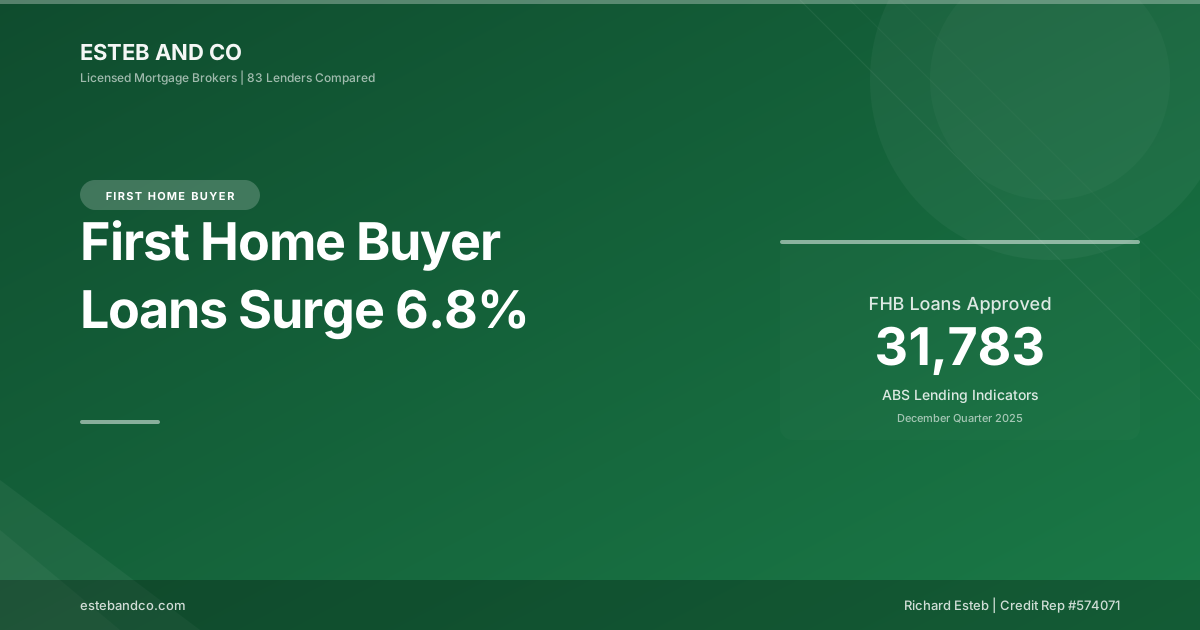
- 31,783 first home buyer loans approved in the quarter
- Total value: $19.3 billion
- Quarterly growth: +6.8% (number), +15.5% (value)
- Average FHB loan: $607,624 (up 8.5% on the quarter)
- The largest quarterly rise since December 2023
That’s nearly 32,000 Australians who went from renting or living at home to owning their first property in just three months. As a broker, I’m seeing this on the ground — first home buyer enquiries have been the strongest segment of my business since late 2025.
To put these numbers in context: total housing loan commitments grew 5.1% in the same period, and even investment lending (which hit record highs) grew at 5.5%. First home buyers are outpacing the rest of the market.
Why First Home Buyer Lending Is Surging
1. Three rate cuts in 2025 boosted confidence
The RBA cut rates three times between February and August 2025, taking the cash rate from 4.35% down to 3.60%. Even with the February 2026 hike back to 3.85%, rates are still well below the peak. Lower rates mean higher borrowing power and lower repayments, making homeownership more achievable for first-time buyers.
At 4.35%, a $600,000 loan costs approximately $3,560 per month. At 3.85% (which flows through as roughly 5.49% variable), the same loan costs around $3,402 — a saving of $158 per month. Over a year, that’s $1,896 back in a first home buyer’s pocket.
2. Government schemes are making a real difference
The expansion of the 5% Deposit Guarantee and the launch of Help to Buy have fundamentally changed the maths for first home buyers. These schemes didn’t exist three years ago, and they’re directly responsible for thousands of buyers entering the market who otherwise couldn’t have.
The ABS specifically notes that “growth [was] supported by expansion of 5% Deposit Guarantee and launch of Help to Buy scheme.”
3. The rental crisis is pushing people to buy
With vacancy rates at record lows in most capital cities and rents consuming an ever-larger share of income, many first home buyers are making the rational calculation: if I’m paying $600+ per week in rent, I might as well be building equity. The gap between renting and buying (on a repayment basis) has narrowed significantly since rates came down from their peak.
Average Loan Sizes: What First Home Buyers Are Borrowing
The average first home buyer loan of $607,624 is significantly below the overall owner-occupier average of $693,801 and the investor average of $717,000. This makes sense — first home buyers typically enter at lower price points, often buying apartments, townhouses, or homes in outer suburbs.
| Borrower Type | Average Loan Size | Monthly Repayment (5.49%) | Annual Repayment |
|---|---|---|---|
| First Home Buyer | $607,624 | $3,446 | $41,352 |
| Owner-Occupier (all) | $693,801 | $3,935 | $47,220 |
| Investor | $717,000 | $4,066 | $48,792 |
The 8.5% quarterly increase in average FHB loan size is the fastest growth rate of any segment. This reflects rising property prices pushing first home buyers to borrow more, but also increased borrowing capacity from the 2025 rate cuts. When rates drop, lenders approve larger loans — and buyers inevitably borrow more.
For a detailed look at how lenders calculate what you can borrow, read our borrowing power guide.
The 5% Deposit Guarantee Expansion
The 5% Deposit Guarantee (formerly the First Home Guarantee, before that the First Home Loan Deposit Scheme) is arguably the single most impactful policy for first home buyers in a decade.
How it works
- You save a 5% deposit (instead of the standard 20%)
- The government guarantees the remaining 15% gap to the lender
- You avoid paying Lenders Mortgage Insurance (LMI) entirely
- You get a standard home loan at normal interest rates
What the expansion changed
The 2025 expansion made several important changes:
- More places available — Significantly increased from the original 35,000 per year
- Higher property price caps — Raised in most regions to reflect actual market prices
- Broader eligibility — Relaxed income thresholds for singles and couples
The real impact
On the average FHB loan of $607,624, the numbers look like this:
| Scenario | Deposit Required | LMI Cost | Total Upfront |
|---|---|---|---|
| 20% deposit (no LMI) | $151,906 | $0 | $151,906 |
| 10% deposit (with LMI) | $75,953 | ~$12,000–$18,000 | ~$88,000–$94,000 |
| 5% Deposit Guarantee | $38,000 | $0 | $38,000 |
The difference between saving $152,000 and saving $38,000 is, for many buyers, the difference between waiting another 5–7 years and buying now. That’s the real power of this scheme. For the full deposit breakdown, read our deposit guide.
Help to Buy Scheme: How It Works
The Help to Buy shared equity scheme launched in 2025 and is already making an impact. It works differently from the Deposit Guarantee:
The mechanics
- The government co-buys with you — Contributing up to 40% of the price for a new home, or 30% for an existing home
- You need a minimum 2% deposit
- You take out a smaller mortgage — On a $600,000 property with 40% government equity, you only need a mortgage of around $348,000
- Your repayments are dramatically lower — Because you’re borrowing less
- When you sell, the government gets their share back — Based on the property’s value at the time of sale
The trade-off
Help to Buy gives you much lower repayments today, but you share the capital growth with the government. If your $600,000 property grows to $800,000, the government’s 40% share is now worth $320,000 (they contributed $240,000). You keep the remaining $480,000 in equity.
For buyers who are priced out of the market entirely, this trade-off is worthwhile — you’re building some equity instead of none, and your repayments can be substantially lower than rent.
Eligibility
- Must be an Australian citizen aged 18+
- Must not currently own property
- Income caps apply (check current thresholds)
- Must occupy the property as your primary residence
- Property price caps apply (vary by region)
State-by-State: Where First Home Buyers Are Most Active
While the ABS doesn’t break down FHB numbers by state in the summary data, we can look at average loan sizes by state to understand where first home buyers are finding opportunities. The overall average loan by state gives a proxy for entry-level pricing:
| State | Avg Loan Size (All Borrowers) | Est. FHB Entry Point | 5% Deposit Required |
|---|---|---|---|
| NSW | $828,065 | ~$650,000–$750,000 | $32,500–$37,500 |
| QLD | $687,161 | ~$550,000–$650,000 | $27,500–$32,500 |
| VIC | $646,577 | ~$500,000–$600,000 | $25,000–$30,000 |
| WA | $632,901 | ~$480,000–$580,000 | $24,000–$29,000 |
| SA | $616,428 | ~$450,000–$550,000 | $22,500–$27,500 |
| ACT | $628,377 | ~$500,000–$600,000 | $25,000–$30,000 |
| TAS | $483,920 | ~$380,000–$450,000 | $19,000–$22,500 |
| NT | $481,164 | ~$370,000–$440,000 | $18,500–$22,000 |
FHB entry points are estimates based on typical first-time purchase price points relative to average loans in each state.
In Tasmania and the NT, a first home buyer using the 5% Deposit Guarantee could be into their own home with under $25,000 saved. In NSW, the bar is higher at $32,500–$37,500, but that’s still dramatically less than the $100,000+ needed without government support at the same price point.
Affordability Reality Check
Let’s be honest about what a $607,624 loan actually costs on a day-to-day basis.
At the current average rate of 5.49% over 30 years:
- Monthly repayment: $3,446
- Annual repayment: $41,352
- Total interest paid over 30 years: ~$633,000
- Total amount repaid: ~$1,240,000
$3,446 per month is substantial. On a single income of $80,000 gross ($5,300 after tax per month), that’s 65% of take-home pay — clearly not sustainable alone. On a combined household income of $140,000 ($9,300 after tax per month), it drops to around 37% — tight but manageable.
The general rule of thumb: your mortgage repayments shouldn’t exceed 30–35% of your after-tax household income. If you’re above that, you’re in what lenders call “mortgage stress” territory.
What I tell first home buyers: budget for the repayment at your current rate plus 1%. If you can afford $3,446 today, make sure you could also handle $3,800 if rates increase. Building that buffer now prevents stress later. The February 2026 RBA rate hike proved that rates can move in unexpected directions.
Tips for First Home Buyers Entering the Market Now
1. Use a broker, not a bank
A single bank shows you their products. A broker compares 30–50 lenders to find the best fit for your situation. First home buyer lending is particularly nuanced — government scheme eligibility, LMI thresholds, and lender policies vary enormously. A broker navigates all of this, paid by the lender on settlement, with any file fee quoted in writing before a lender is recommended.
2. Check your eligibility for government schemes first
Before you start house-hunting, find out which schemes you qualify for. The 5% Deposit Guarantee and Help to Buy can dramatically reduce how much you need to save. Don’t forget state-based First Home Owner Grants (FHOG) — these provide $10,000–$30,000 depending on your state, typically for new builds.
3. Get pre-approved before you start looking
Pre-approval tells you exactly how much you can borrow and gives sellers confidence that you’re a serious buyer. Most pre-approvals last 90 days and lock in a rate. In a competitive market, the buyer with pre-approval wins over the buyer who still needs to apply.
4. Don’t stretch to the absolute maximum
Just because a lender will approve you for $607,000 doesn’t mean you should borrow that much. Leave room for rate increases, unexpected costs, and life changes. The smartest first home buyers I work with borrow 10–15% less than their maximum capacity.
5. Consider the total cost, not just the purchase price
Stamp duty, conveyancing fees, building and pest inspections, moving costs, and the inevitable furniture spending spree all add up. Budget an extra 3–5% of the purchase price for these costs (first home buyers may get stamp duty concessions depending on your state).
6. Start now, even if you’re not ready to buy immediately
If you’re 6–12 months away from being ready, start the conversation now. A broker can help you understand exactly how much you need to save, what your borrowing power looks like, and which schemes you’re eligible for. Having a clear plan makes the saving phase much more focused and motivating.
Frequently Asked Questions
How many first home buyer loans were approved in December 2025?
31,783 first home buyer loans were approved in the December Quarter 2025, worth a total of $19.3 billion. This was a 6.8% increase in the number of loans and a 15.5% increase in value — the biggest quarterly jump since December 2023.
What is the average first home buyer loan size in Australia?
The average first home buyer loan is $607,624 as of December Quarter 2025, up 8.5% from the previous quarter. This is lower than the overall owner-occupier average of $693,801 and the investor average of $717,000.
What is the 5% Deposit Guarantee scheme?
The 5% Deposit Guarantee allows eligible first home buyers to purchase with just a 5% deposit without paying LMI. The government guarantees the remaining 15% gap. It was expanded in 2025 with more places and higher property price caps.
How does the Help to Buy scheme work?
Help to Buy is a shared equity program where the government contributes up to 40% of a new home’s price (30% for existing). You need a minimum 2% deposit and take out a smaller mortgage. When you sell, you repay the government’s share based on the property’s value at that time.
What deposit do first home buyers actually need in 2026?
With the 5% Deposit Guarantee: $30,381 on the average FHB loan of $607,624. With Help to Buy: as little as $12,152 (2%). Without schemes: most lenders require 5–20%, with LMI payable on deposits below 20%.
Is now a good time to buy your first home?
31,783 buyers thought so last quarter. Government schemes, competitive rates, and strong rental growth make the conditions favourable. But the right time depends on your finances — can you comfortably afford repayments if rates rise another 1%? If yes, conditions are supportive. If you’re stretching to the maximum, building a larger buffer first may be smarter.
See where you stand
Compare your options across our panel of 50 lenders in about 2 minutes. Free, and it won’t affect your credit score.
Start complimentary assessment →No obligation · Richard Esteb, Credit Rep #574071
Richard Esteb
Ricky founded Esteb & Co to give everyday Australians access to the same loan comparison technology used by the big banks. He compares products from a panel of 50 lenders to find the right fit for each client’s situation.