Home Loan Repayments by State: What Australians Are Actually Paying in 2026

In this article
- The national picture: $3,935 per month
- State-by-state breakdown
- Why NSW is so expensive
- The most affordable states: Tasmania and NT
- How the RBA rate hike affects each state
- Ways to reduce your mortgage repayments
- Investment property repayments by state
- How to know if you’re paying too much
- Frequently asked questions
The National Picture: $3,935 Per Month
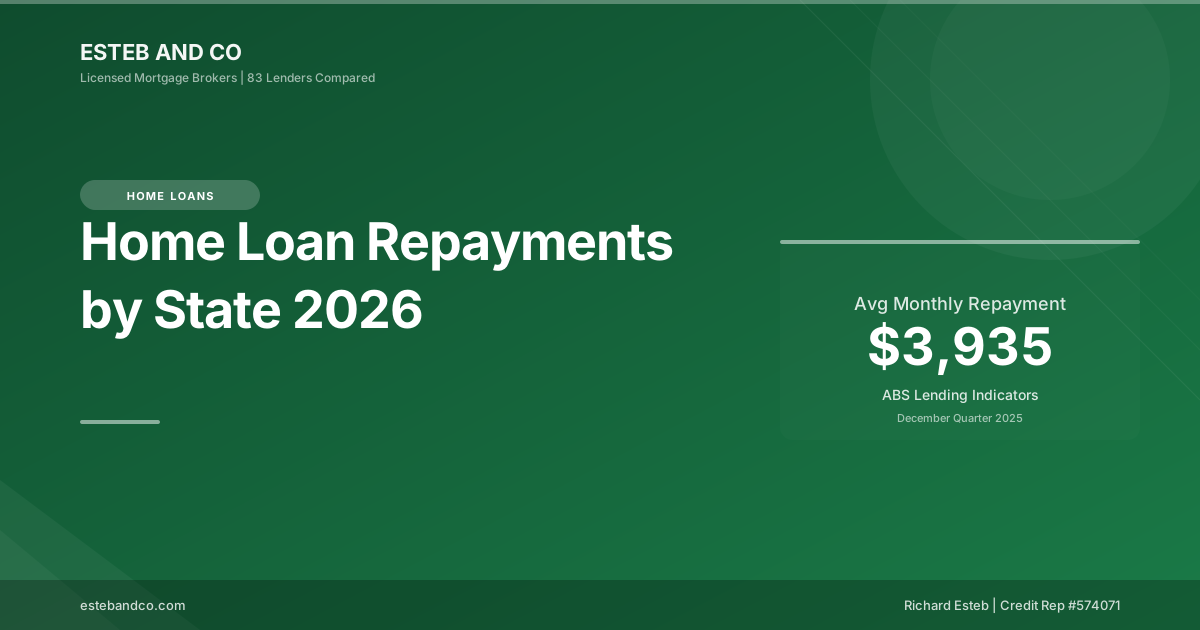
According to the latest ABS Lending Indicators (December Quarter 2025), the average Australian owner-occupier is paying $3,935 per month on their home loan. That’s $47,220 per year — or $908 per week — going straight to the bank.
This figure is based on:
- Average loan size: $693,801
- Average interest rate: 5.49%
- Loan term: 30 years, principal and interest
But the national average hides enormous variation between states. Where you live — or more precisely, where you buy — determines whether you’re paying closer to $2,700 or $4,700 per month. The difference between the cheapest and most expensive states is $1,967 per month. Over a year, that’s $23,604. Over 30 years, it adds up to hundreds of thousands of dollars.
State-by-State Breakdown
Here’s the full picture. Every state and territory, ranked from highest to lowest average repayment:
| Rank | State | Average Loan | Monthly Repayment | Annual Repayment | Weekly Equivalent |
|---|---|---|---|---|---|
| 1 | NSW | $828,065 | $4,696 | $56,352 | $1,084 |
| 2 | QLD | $687,161 | $3,897 | $46,764 | $899 |
| 3 | VIC | $646,577 | $3,667 | $44,004 | $846 |
| 4 | WA | $632,901 | $3,590 | $43,080 | $829 |
| 5 | ACT | $628,377 | $3,564 | $42,768 | $823 |
| 6 | SA | $616,428 | $3,496 | $41,952 | $807 |
| 7 | TAS | $483,920 | $2,745 | $32,940 | $634 |
| 8 | NT | $481,164 | $2,729 | $32,748 | $630 |
| National avg: $693,801 loan | $3,935/month | $47,220/year | $908/week | |||||
All repayments calculated at 5.49% over 30 years, P&I. Source: ABS Lending Indicators, December Quarter 2025.
The standout finding: NSW borrowers pay $1,967 more per month than NT borrowers. That’s $23,604 per year, purely because of the difference in average loan sizes between the two states.
Queensland has overtaken Victoria for the second-highest average loan — a shift driven by the post-pandemic migration to South East Queensland that has pushed property prices sharply higher in Brisbane, the Gold Coast, and the Sunshine Coast.
Why NSW Is So Expensive
NSW’s average loan of $828,065 is $134,264 above the national average. That gap translates directly into repayments — $761 more per month than the average Australian borrower.
It’s not just Sydney
While Sydney’s median house price (well above $1.2 million) drives much of this, it’s not solely a Sydney story. Regional NSW has also seen significant price growth — cities like Wollongong, Newcastle, and the Central Coast now have medians that would have been considered “Sydney prices” just five years ago.
The drivers
- Limited land supply — Geography constrains Sydney’s expansion (mountains to the west, ocean to the east, national parks to the north)
- Population concentration — NSW has Australia’s largest population and Sydney is the primary economic hub
- Income premium — Higher average incomes in Sydney support higher property prices (and larger loans)
- Infrastructure investment — Major transport projects (Metro, WestConnex) increase land values along corridors
For NSW borrowers, the key question is whether your rate is competitive. On an $828,065 loan, even a 0.3% rate difference saves $155 per month ($1,860 per year). If you haven’t compared rates recently, that’s money left on the table.
The Most Affordable States: Tasmania and NT
Tasmania: $2,745/month
Tasmania has the second-lowest average loan at $483,920 and monthly repayments of $2,745. That’s $1,190 less per month than the national average. Tasmania’s lower property prices reflect a smaller economy, lower population density, and historically less interstate migration (though this has been changing since 2020).
The trade-off: lower property prices often mean slower capital growth and a smaller rental market. But for owner-occupiers who want affordable homeownership, Tasmania remains one of the most accessible states in Australia.
Northern Territory: $2,729/month
The NT has the lowest average loan ($481,164) and the lowest average repayments ($2,729). Darwin’s property market has been one of the most subdued in Australia over the past decade, with prices only recently showing signs of recovery.
For borrowers in the NT, the affordability advantage is clear: monthly repayments are $1,206 below the national average. A dual-income household earning the median NT income can typically service this mortgage comfortably, with mortgage-to-income ratios well below the stress threshold.
How the RBA Rate Hike Affects Each State
The February 2026 RBA rate hike of 0.25% hits every state, but the dollar impact is proportional to loan size. States with higher average loans feel the pain more in absolute terms:
| State | Avg Loan | Extra per Month (0.25%) | Extra per Year |
|---|---|---|---|
| NSW | $828,065 | +$130 | +$1,560 |
| QLD | $687,161 | +$108 | +$1,296 |
| VIC | $646,577 | +$102 | +$1,224 |
| WA | $632,901 | +$99 | +$1,188 |
| ACT | $628,377 | +$99 | +$1,188 |
| SA | $616,428 | +$97 | +$1,164 |
| TAS | $483,920 | +$76 | +$912 |
| NT | $481,164 | +$76 | +$912 |
NSW borrowers are paying an extra $130 per month from the hike — nearly double what Tasmanian and NT borrowers face ($76). This is the compounding effect of higher loan sizes: every rate movement hurts more when you owe more.
This is exactly why I recommend every borrower builds a rate buffer into their budget. If you can afford repayments at your current rate plus 1%, you’ll handle any likely rate movement without breaking a sweat.
Ways to Reduce Your Mortgage Repayments
If your repayments feel heavy — regardless of which state you’re in — here are five proven strategies:
1. Refinance to a lower rate
This is the single biggest lever most borrowers have. The average rate is 5.49%, but the most competitive lenders on our panel are offering rates well below that. Even a 0.3% reduction on the national average loan saves $130 per month ($1,560/year). On NSW’s average loan of $828,065, the same 0.3% saving is worth $155 per month ($1,860/year).
Refinancing is free through a broker — we get paid by the new lender, not by you. Read our complete refinancing guide for the step-by-step process.
2. Use an offset account
Every dollar sitting in an offset account reduces the balance on which interest is calculated. $50,000 in an offset on a $700,000 loan at 5.49% saves approximately $229 per month in interest. Your salary, savings, and emergency fund should all be in your offset. If your current loan doesn’t have one, that alone could be reason enough to refinance.
3. Make extra repayments
Even small additional payments make a surprisingly large difference over time. An extra $200 per month on a $700,000 loan at 5.49% saves approximately $87,000 in total interest and cuts nearly 4 years off a 30-year loan term. Most variable loans allow unlimited extra repayments. Fixed loans typically cap extra payments at $10,000–$30,000 per year.
4. Negotiate with your current lender
Before you go through the hassle of refinancing, call your lender and ask for a rate review. Tell them you’re considering switching. Many lenders will offer a “retention rate” to keep your business — typically 0.10–0.30% below your current rate. It takes one phone call and there’s no cost. The savings may not be as large as refinancing to a new lender, but it’s instant and easy.
5. Review your loan structure
Some borrowers are on principal and interest when interest-only might make temporary sense (particularly investors). Others are on a 25-year term when extending to 30 years would reduce monthly repayments (though you’ll pay more total interest). A broker can model different structures to find the right balance between monthly cash flow and long-term cost.
Investment Property Repayments by State
Investor repayments are higher than owner-occupier repayments for two reasons: investor rates are higher (typically 5.74–5.99%) and average investor loans are larger ($717,000 nationally vs $693,801 for owner-occupiers).
| State | Avg Investor Loan | Monthly Repayment (5.89%) | Annual Repayment |
|---|---|---|---|
| NSW | $873,000 | $5,173 | $62,076 |
| WA | $644,000 | $3,816 | $45,792 |
| SA | $622,000 | $3,686 | $44,232 |
| NT | $460,000 | $2,726 | $32,712 |
| National investor avg: $717,000 | $4,248/month at 5.89% | |||
Investor rate estimated at owner-occupier average (5.49%) plus 0.40% investor premium. P&I over 30 years.
NSW investors are paying over $5,173 per month on average. That requires significant rental income (or personal income) to service. Even in a tight rental market, rental yields in Sydney rarely cover the full cost of holding a property at these loan sizes — which is why negative gearing remains an important part of the investor equation.
For the full analysis of investment lending, read our investment lending record high article.
How to Know If You’re Paying Too Much
Here’s a quick self-check:
Step 1: Check your current rate
Log into your lender’s app or portal and find your current interest rate. If you don’t know it off the top of your head, that’s already a sign you should be paying more attention.
Step 2: Compare to the average
The national average owner-occupier variable rate is 5.49%. If you’re above this, you’re paying more than average. If you’re more than 0.3% above this (so above 5.79%), you’re almost certainly paying too much. The best rates from competitive lenders currently start below 5.30% for well-qualified borrowers.
Step 3: Calculate your potential savings
Use a rough rule: every 0.25% reduction saves approximately $16 per month per $100,000 borrowed. On a $700,000 loan, a 0.5% rate reduction saves around $224 per month ($2,688/year).
Step 4: Talk to a broker
A 15-minute conversation with a broker can tell you exactly where you stand and what options are available. This costs nothing — we get paid by lenders, not by you. If there’s a better deal available, we’ll find it. If your current deal is competitive, we’ll tell you that too.
On average, borrowers who refinance through us save $3,000–$5,000 per year on their mortgage. Some save significantly more, particularly those who haven’t reviewed their loan in 2+ years.
Frequently Asked Questions
What is the average mortgage repayment in Australia in 2026?
$3,935 per month for owner-occupiers, based on the national average loan of $693,801 at 5.49% over 30 years. This equates to $47,220 per year. Repayments range from $2,729 in the NT to $4,696 in NSW.
Which state has the highest home loan repayments?
New South Wales, with average repayments of $4,696 per month on an average loan of $828,065. That’s $1,967 per month more than the NT, equating to a $23,604 annual gap.
How much does an average home loan cost in NSW?
The average NSW home loan is $828,065 with monthly repayments of $4,696 at 5.49%. That’s $56,352 per year, driven by Sydney’s property prices where medians well exceed $1 million.
What is the average home loan interest rate in Australia?
5.49% for owner-occupier variable loans as of December 2025. The RBA cash rate is 3.85%, meaning borrowers pay a 1.64% margin above the cash rate. Investor rates are typically 0.25–0.50% higher.
How can I reduce my monthly mortgage repayments?
Five strategies: (1) Refinance to a lower rate, (2) use an offset account, (3) make extra repayments, (4) negotiate with your current lender, (5) restructure your loan. A broker can assess which option saves you the most — the lender pays the broker on settlement and any file fee is quoted in writing first.
How are average repayments calculated?
Using the ABS average loan size for each state, at the national average variable rate of 5.49%, on a 30-year principal and interest basis. Actual repayments vary based on your specific rate, term, and repayment type. Source: ABS Lending Indicators, December Quarter 2025.
See where you stand
Compare your options across our panel of 50 lenders in about 2 minutes. Free, and it won’t affect your credit score.
Start complimentary assessment →No obligation · Richard Esteb, Credit Rep #574071
Richard Esteb
Ricky founded Esteb & Co to give everyday Australians access to the same loan comparison technology used by the big banks. He compares products from a panel of 50 lenders to find the right fit for each client’s situation.