Inflation Reaccelerates to 3.8%: What It Means for Home Loans in 2026

In this article
The Latest CPI Numbers: 3.8% Headline, 3.3% Trimmed Mean
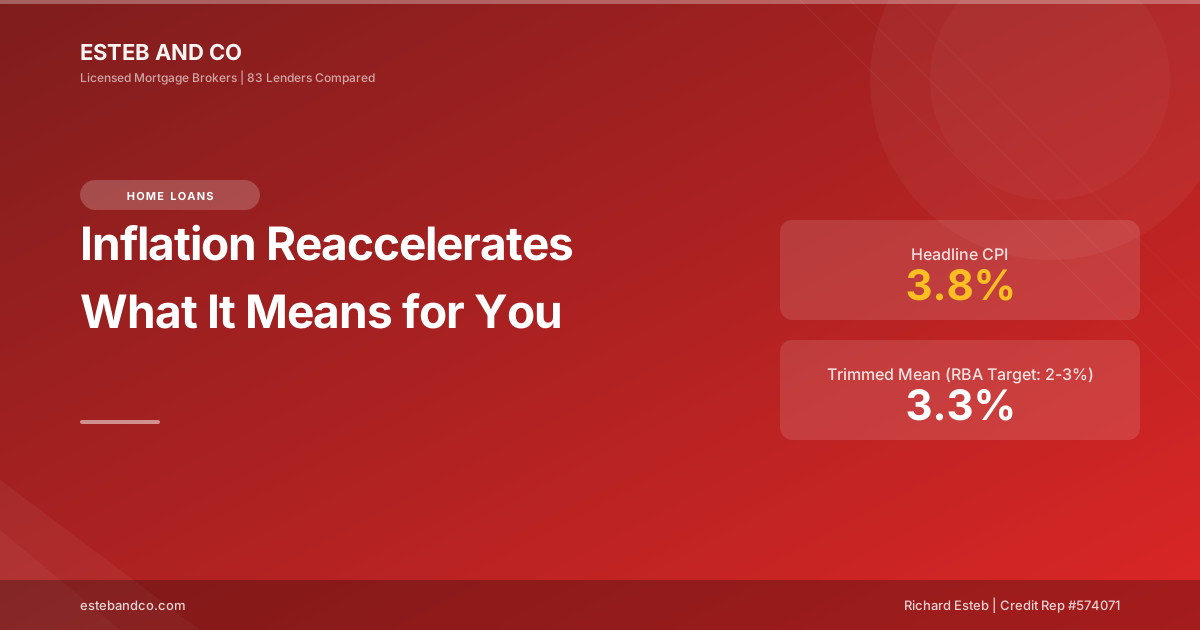
The ABS Consumer Price Index for the December quarter 2025 delivered a reality check for anyone hoping rate cuts were around the corner. Headline inflation came in at 3.8% annual — above expectations and heading in the wrong direction.
The key numbers:
- Headline CPI: 3.8% annual
- Trimmed mean CPI: 3.3% annual (the RBA’s preferred measure)
- RBA target band: 2-3%
- Gap from target: 0.3-0.8% above, depending on measure
This data was a key factor behind the RBA’s decision to hike rates in February 2026. And with the March quarter data still months away, borrowers need to plan for a world where inflation stays elevated and rate cuts remain distant.
Inflation at 3.8% isn’t a crisis — but it’s stubbornly above the level where the RBA would feel comfortable cutting rates. For borrowers, that means higher-for-longer is the base case.
Why Inflation Reaccelerated
After trending down through most of 2024 and into early 2025, inflation has turned back up. Five main factors are driving the reversal:
1. Government energy subsidies unwinding
The federal and state government electricity subsidies that suppressed CPI through 2024-25 are rolling off. The ABS estimates this alone added approximately 0.5 percentage points to headline CPI. This is a temporary, technical effect — but it hits household budgets regardless of whether economists call it “transitory.”
2. Persistent services inflation
Services inflation (as opposed to goods) remains stubbornly high. This includes:
- Insurance premiums: Up 13.2% annually, driven by natural disaster claims and reinsurance costs
- Rents: Up 6-8% in most capital cities, reflecting extremely low vacancy rates
- Healthcare: Rising costs for private health insurance, dental, and allied health
- Education: Childcare and school fees continuing to climb
Services inflation is driven largely by wages, and with the labour market still tight (4.1% unemployment), there’s limited relief in sight.
3. Housing costs
The ABS Housing group rose 4.8% annually. This captures rents (for renters), new dwelling purchase costs, and utility costs. With vacancy rates below 1% in many markets and building costs still elevated, housing inflation is unlikely to moderate quickly.
4. Food prices
Food and non-alcoholic beverages rose 3.7% annually, driven by weather events affecting agricultural production, transport costs, and supermarket pricing dynamics.
5. Global pressures
Supply chain disruptions from trade tensions and shipping route changes are adding to imported inflation. While the Australian dollar has been relatively stable, global commodity price movements flow through to local prices for fuel, manufactured goods, and industrial inputs.
Headline vs Trimmed Mean: Which Matters More?
Understanding the difference between these two measures is crucial for predicting what the RBA will do next.
| Measure | Current | What It Captures | RBA Weight |
|---|---|---|---|
| Headline CPI | 3.8% | All price changes, including volatile items | Secondary |
| Trimmed Mean | 3.3% | Strips out top/bottom 15% of price moves | Primary |
| Weighted Median | ~3.4% | Middle price change across the basket | Secondary |
The RBA focuses primarily on trimmed mean because it filters out temporary spikes (like energy subsidy changes or one-off weather events) and gives a clearer picture of where underlying inflation is trending.
The good news: trimmed mean at 3.3% is only 0.3% above the top of the target band (3%). It’s been trending down gradually from its 2023 peak of around 6%.
The bad news: the pace of decline has slowed dramatically. Trimmed mean has been stuck in the 3.2-3.5% range for several quarters. The “last mile” of disinflation is proving the hardest.
How Inflation Drives Interest Rates
The connection between inflation and your mortgage rate is direct and mechanical:
- CPI data is released quarterly by the ABS (January, April, July, October)
- The RBA assesses the data at its next monetary policy meeting
- If inflation is above target, the RBA keeps rates elevated or raises them
- Banks pass on rate changes to variable home loans within 1-2 weeks
- Your monthly repayment adjusts at the next billing cycle
At 3.8% headline and 3.3% trimmed mean, the RBA is nowhere near comfortable enough to cut rates. The February 2026 hike (from 3.60% to 3.85%) was a direct response to this data. And with CBA forecasting a potential further hike to 4.10% in May, the inflation trajectory over the next quarter is critical.
The timeline that matters
| Date | Event | Why It Matters |
|---|---|---|
| Late April 2026 | March quarter CPI release | The data point that determines the May RBA decision |
| May 2026 | RBA monetary policy meeting | CBA forecasts a hike to 4.10% if CPI stays sticky |
| Late July 2026 | June quarter CPI release | If trimmed mean drops below 3%, rate cut talk begins |
| Aug 2026 | RBA meeting | Earliest realistic date for a rate cut (if data permits) |
Rate Scenarios: What Could Happen Next
Based on the inflation data, here are the three most likely scenarios for 2026:
Scenario 1: Inflation stays sticky (40% probability)
If trimmed mean stays above 3.3% in the March quarter, the RBA is likely to hike again in May to 4.10%. Average variable rates would rise to approximately 5.74%, adding another $109/month to the average loan.
| Loan Size | Current (5.49%) | After May Hike (5.74%) | Extra/Month |
|---|---|---|---|
| $500,000 | $2,835 | $2,914 | +$79 |
| $693,801 (avg) | $3,935 | $4,044 | +$109 |
| $800,000 | $4,536 | $4,662 | +$126 |
| $1,000,000 | $5,670 | $5,828 | +$158 |
Scenario 2: Gradual improvement (45% probability)
If trimmed mean drops to 3.0-3.2% in the March quarter, the RBA will likely hold at 3.85% through mid-2026. Variable rates stay around 5.49%. Rate cuts become possible in late 2026 or early 2027 if the trend continues.
Scenario 3: Sharp improvement (15% probability)
If a combination of base effects and slowing demand pushes trimmed mean below 3%, the RBA could cut as early as August 2026. This would bring immediate relief to variable rate borrowers. However, this is the least likely scenario given current data.
Impact on Borrowing Power
Inflation doesn’t just affect your repayments — it also affects how much you can borrow in the first place.
Lenders assess your borrowing capacity using a 3% buffer above the current rate (mandated by APRA for banks). This means they test whether you can afford repayments at approximately 8.49% (current 5.49% + 3%).
Higher inflation expectations keep this test rate elevated, which reduces maximum borrowing capacity. Compared to the rate low in August 2025:
- At 3.60% cash rate (Aug 2025): Serviceability test at ~7.74% — higher borrowing power
- At 3.85% cash rate (now): Serviceability test at ~8.49% — reduced by approximately $15,000-$20,000
- At 4.10% cash rate (if May hike): Serviceability test at ~8.74% — reduced by a further $15,000-$20,000
For buyers at the margins of affordability, this matters. A $30,000-$40,000 reduction in borrowing power can mean the difference between qualifying for a property and falling short. Read our borrowing power guide for strategies to maximise your capacity.
What Borrowers Should Do Now
Inflation at 3.8% means higher-for-longer rates are the reality. Here’s how to protect yourself:
1. Refinance to the best available rate
You can’t control inflation, but you can control what rate you’re paying. The average gap between existing borrower rates and the best available rates is 0.5-1.0%. On the national average loan of $693,801, that’s $215-$425 per month in savings. That’s more impactful than any government subsidy.
Refinancing through a broker is complimentary — we get paid by lenders. Here’s how it works.
2. Build an inflation buffer into your budget
Don’t budget at your current rate. Budget at 1% above your current rate to prepare for potential further hikes. If you can comfortably manage repayments at 6.49%, you’ll handle whatever the RBA throws at you in 2026.
3. Consider partial fixing
Two-year fixed rates around 5.30-5.50% provide certainty on a portion of your loan while keeping the rest variable with offset access. If inflation stays sticky and rates go higher, the fixed portion protects you. Read our fixed vs variable rate comparison.
4. Maximise your offset
In a high-inflation environment, your offset account is your best friend. Every dollar in an offset reduces your effective interest rate. On a $700,000 loan at 5.49%, holding $50,000 in an offset saves approximately $230 per month in interest.
5. Resist the urge to fix everything
While the uncertainty is stressful, don’t lock in your entire loan at a fixed rate. Fixed rates already price in expected future movements, and you lose flexibility (offset access, extra repayments). A split approach (50-60% fixed, 40-50% variable) gives you the best of both worlds.
6. Watch the April CPI release
The March quarter CPI data (released late April) will determine the RBA’s May decision. If you’re considering making changes to your loan structure, the week after that data release is the time to act — you’ll have the clearest picture of where rates are heading.
Frequently Asked Questions
What is the current inflation rate in Australia?
ABS CPI shows headline inflation at 3.8% annually for the December quarter 2025. The trimmed mean — the RBA’s preferred measure — is at 3.3%. Both are above the RBA’s 2-3% target band. Key drivers include housing (+4.8%), insurance (+13.2%), and food (+3.7%).
Why has inflation reaccelerated?
Several factors: unwinding of government electricity subsidies (adding ~0.5% to headline CPI), persistent services inflation driven by wages and rents, rising insurance premiums after natural disasters, and global supply chain pressures from trade disruptions.
How does inflation affect my home loan rate?
The RBA uses the cash rate to control inflation. When inflation is above 2-3%, rates stay elevated or increase. At 3.8% CPI, the RBA has no room to cut. Each 0.25% increase adds approximately $109/month to the average $693,801 loan. See our February rate hike analysis.
When will interest rates come down?
Rate cuts require trimmed mean inflation to sustainably fall below 3%. Based on current trends, this may not happen until late 2026 at the earliest. The March quarter CPI data (due April) will be critical. If inflation stays sticky, cuts could be pushed into 2027.
What is the difference between headline CPI and trimmed mean?
Headline CPI measures all price changes. Trimmed mean strips out the most volatile items (top and bottom 15% of price movements) to show underlying trends. The RBA focuses on trimmed mean because it filters out temporary effects. Currently headline is 3.8% and trimmed mean is 3.3%.
See where you stand
Compare your options across our panel of 50 lenders in about 2 minutes. Free, and it won’t affect your credit score.
Start complimentary assessment →No obligation · Richard Esteb, Credit Rep #574071
Richard Esteb
Ricky founded Esteb & Co to give everyday Australians access to the same loan comparison technology used by the big banks. He compares products from a panel of 50 lenders to find the right fit for each client’s situation.