Interest-Only Home Loans 2026: When They Make Sense and Best Rates

In this article
How Interest-Only Home Loans Work
An interest-only (IO) home loan is exactly what the name suggests: for a set period, you only pay the interest on your loan. You don’t pay down the principal — the amount you actually borrowed — at all.
Here’s the lifecycle of a typical interest-only loan:
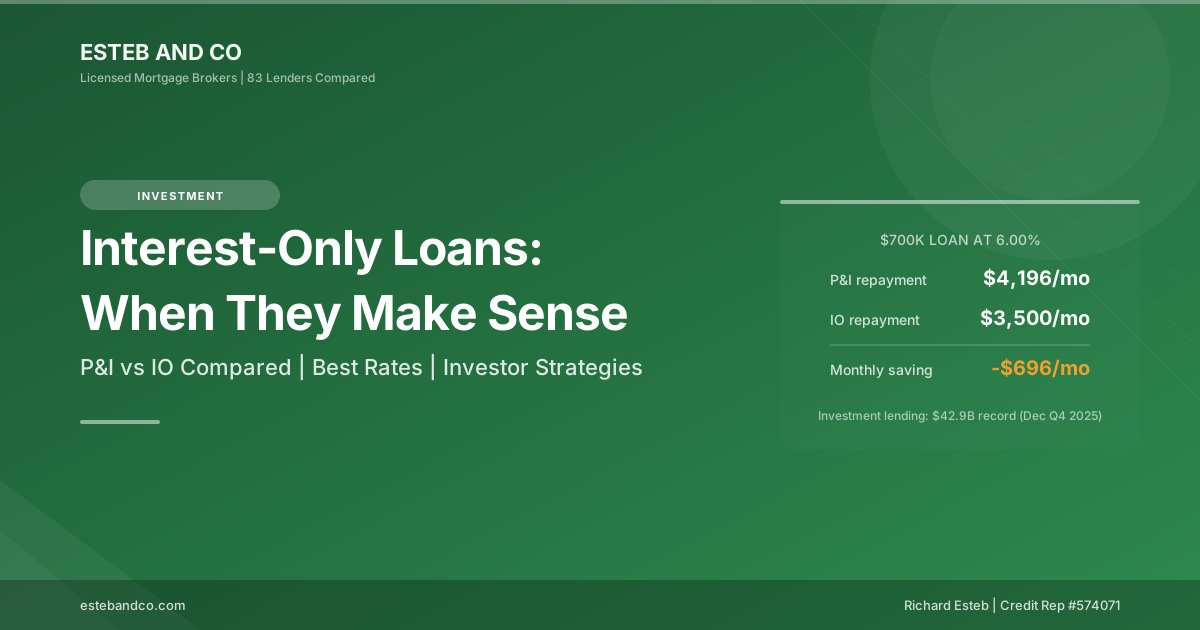
- IO period (1–5 years for owner-occupiers, up to 5–10 years for investors): You pay only the interest. On a $700,000 loan at 6.00%, that’s $3,500 per month. Your loan balance stays at $700,000 the entire time.
- Reversion to P&I: When the IO period ends, the loan automatically converts to principal and interest repayments. The catch? You now have to repay the full $700,000 over the remaining term. If you had a 30-year loan with 5 years IO, you’re now repaying $700,000 over 25 years — not 30.
- Higher post-IO repayments: Because the remaining term is shorter and you haven’t reduced the principal at all, your monthly repayments jump significantly. In our example, from $3,500 to approximately $4,508 per month — a 29% increase overnight.
The appeal is obvious: lower repayments during the IO period free up cash flow. But the trade-off is real — you pay substantially more in total interest over the life of the loan, and you face a payment shock when the IO period ends.
With the cash rate at 4.35% following three hikes in 2026, understanding exactly what IO costs you versus what it saves you has never been more important.
Interest-Only vs Principal and Interest: The Numbers
Let’s compare IO and P&I side by side on a $700,000 loan at 6.00% — close to the current average investor rate. These numbers tell the full story.
| Metric | Principal & Interest (30yr) | Interest-Only (5yr IO, then 25yr P&I) |
|---|---|---|
| Monthly repayment (IO period) | $4,196 | $3,500 |
| Monthly repayment (after IO reverts) | $4,196 | $4,508 |
| Monthly saving during IO period | — | $696 (16.6% less) |
| Total cash saved over 5yr IO period | — | $41,760 |
| Principal paid down after 5 years | ~$60,000 | $0 |
| Equity after 5yrs (excl. property growth) | ~$60,000 | $0 |
| Total interest paid over loan life | ~$611,000 | ~$749,000 |
| Extra interest cost of IO | — | ~$138,000 |
The monthly saving of $696 during the IO period is significant — that’s $8,352 per year in freed-up cash flow. But the total cost of that flexibility is approximately $138,000 in additional interest over the life of the loan.
Whether that trade-off makes sense depends entirely on what you do with the $696 per month you’re saving. If it sits in a savings account earning 4%, you’ll accumulate around $46,000 over five years — well short of the $138,000 extra cost. If you’re using it to fund a deposit on another investment property that generates capital growth and rental income, the maths can work in your favour.
The interest-only question is never “is it cheaper?” — it isn’t. The question is: “does what I do with the saved cash flow outweigh the extra cost?”
When Interest-Only Makes Sense
1. Property investors maximising cash flow and tax deductions
This is the most common and most defensible use of IO loans. For investors, interest on an investment loan is 100% tax-deductible. Paying IO keeps the deductible debt as high as possible for as long as possible. At a marginal tax rate of 37% or 45%, the after-tax cost of IO is substantially lower than the headline rate suggests.
Meanwhile, the $696/month saving can fund the deposit on the next investment property. With investment lending at a record $42.9 billion in December Quarter 2025 (up 31.8% year-on-year), many investors in our panel are using exactly this strategy to grow portfolios while minimising holding costs.
2. Developers and builders during construction
If you’re building or renovating, IO makes sense during the construction phase. You’re not living in the property (or renting it out), so cash flow is one-directional. IO keeps repayments low while you wait for the build to complete and the property to either sell or generate rental income.
3. Temporary income reduction
Taking parental leave? Starting a business? Transitioning careers? IO can bridge a period of reduced income without forcing you to sell or draw down savings. It’s a short-term cash flow tool — as long as you have a clear plan to revert to P&I when your income recovers.
4. Buying time before selling
If you’re holding a property short-term (say, while waiting for market conditions to improve or a development approval), IO reduces the cost of holding. You’re not planning to hold for 30 years, so the long-term interest cost is irrelevant — what matters is minimising the carrying cost during the holding period.
When Interest-Only Doesn’t Make Sense
1. Owner-occupiers with no investment strategy
If you’re living in the property and you don’t have a specific plan for the money you’re saving on repayments, IO is simply costing you $138,000 more over the life of the loan for no benefit. Your home loan interest isn’t tax-deductible, you’re not building equity, and you’re setting yourself up for payment shock when the IO period ends.
2. Borrowers who won’t invest the difference
IO only makes financial sense if you deploy the savings productively. If the $696/month saving gets absorbed into lifestyle spending, you’re worse off by six figures over the life of the loan. Be honest with yourself about this. Most people spend windfalls — if that’s you, P&I provides forced discipline.
3. Borrowers approaching retirement
If you’re within 15–20 years of retirement, you need to be aggressively paying down debt, not deferring it. Entering retirement with a large mortgage balance — especially one that hasn’t been reduced during IO periods — puts you under enormous financial pressure when your income drops.
4. Borrowers at maximum serviceability
Lenders assess IO loans at the P&I reversion rate plus a 3% buffer (for APRA-regulated banks). If you’re already at the limit of what lenders will approve, the IO reversion payment could leave you in genuine financial stress. Don’t rely on refinancing to extend the IO period — lending policies can change, property values can fall, and your income may not grow as expected.
Best Interest-Only Rates in 2026
Not all lenders offer interest-only, and those that do vary widely on rates, maximum IO periods, and LVR limits. Here are the top 15 lenders from our panel offering IO-capable variable loans, ranked by rate:
| Lender | Variable Rate (IO) | Notes |
|---|---|---|
| Ubank | 5.69% | Max 80% LVR, variable only |
| Firstmac | 5.69% | Non-bank, flexible IO terms |
| loans.com.au | 5.74% | Online lender |
| ING | 5.79% | Strong offset account |
| Great Southern | 5.79% | Regional bank |
| AMP | 5.84% | Up to 5yr IO period |
| Beyond Bank | 5.84% | Credit union |
| IMB | 5.84% | Mutual bank |
| Newcastle Permanent | 5.84% | Mutual bank |
| Macquarie | 5.85% | Strong for investors |
| BOQ | 5.89% | Regional bank |
| Bankwest | 5.89% | CBA subsidiary |
| Heritage | 5.89% | Credit union |
| Resimac | 5.89% | Non-bank, flexible policy |
| Suncorp | 5.89% | Up to 5yr IO period |
For context, the Big Four banks sit higher on the rate scale:
- CBA: 5.99%
- NAB: 5.99%
- Westpac: 5.99%
- ANZ: 6.04%
That’s a 0.30–0.35% gap between the cheapest IO lenders and the major banks. On a $700,000 loan, 0.30% saves approximately $131 per month or $1,572 per year. Over a 5-year IO period, that’s $7,860 in savings just from choosing the right lender.
If you have a more complex situation — bad credit history, SMSF lending, or non-standard income — specialist lenders like Liberty (6.29%) and Pepper (6.49%) offer IO options where mainstream lenders may decline.
Rates shown are indicative variable rates for IO investment loans at ≤80% LVR as of March 2026. Actual rates depend on LVR, loan amount, and individual assessment. Contact us for a personalised comparison.
Interest-Only for Property Investors: The Strategy
Investment lending hit a record $42.9 billion in December Quarter 2025, with 60,455 new investor loans and an average loan size of $717,000. A large proportion of those investors chose interest-only. Here’s why the strategy works — and how to execute it properly.
Maximise tax-deductible interest
Investment loan interest is fully tax-deductible. On a $700,000 IO loan at 6.00%, you’re claiming $42,000 per year in interest deductions. At a 37% marginal tax rate, that reduces your tax bill by $15,540. At 45%, it’s $18,900. If you were paying P&I, the deductible interest decreases each year as you pay down principal. IO keeps the deduction at its maximum for the entire IO period.
Free up cash for the next deposit
The $696/month saving on IO (versus P&I) gives you $8,352 per year in freed-up cash. Over a 5-year IO period, that’s $41,760 — potentially enough for a 10% deposit on a $400,000 property or a meaningful contribution toward a 20% deposit on your next investment. Portfolio investors use this cascading approach: each IO property’s cash flow savings fund the next acquisition.
APRA banks vs non-bank lenders: the buffer advantage
This is where broker advice adds real value. APRA-regulated banks must assess your IO loan at the P&I reversion rate plus a 3% buffer. On a $700,000 loan at 6.00%, the bank tests you as if repayments were P&I at 9.00% — approximately $5,878 per month.
Non-bank lenders (like Firstmac, Resimac, Liberty, and Pepper) aren’t bound by APRA’s 3% buffer. They typically use a 2%–2.75% buffer, which means they assess your repayments at a lower rate — making it easier to qualify and potentially allowing you to borrow more. This can be the difference between getting approved for one investment property and getting approved for two.
The lender you choose matters as much as the rate you pay. Different assessment criteria can change your borrowing power by $100,000+ — especially for investors with multiple properties.
Pair IO with an offset account
Some investors use a hybrid approach: IO loan with an offset account. Your redraw discipline determines whether this works. Park the $696/month saving in the offset, and you reduce the interest charged while keeping the cash accessible. After five years, you have a $41,760 buffer sitting in offset — reducing your effective interest rate while maintaining liquidity. The key is discipline: the money must stay in the offset, not fund holidays.
Risks of Interest-Only Loans
IO isn’t a free lunch. Here are the risks you must factor into your decision.
1. Payment shock at reversion
This is the biggest risk and the most predictable one. When a 5-year IO period ends on a $700,000 loan at 6.00%, your repayment jumps from $3,500 to approximately $4,508 per month — a 29% increase. If rates have risen during the IO period, the shock is even larger. At 7.00%, the post-IO P&I repayment would be approximately $4,942 — a 41% jump from your original IO payment.
Plan for this from day one. Know exactly when your IO period expires and what the P&I repayment will be. Start budgeting for the higher payment 6–12 months before reversion.
2. Zero equity build during IO
Five years of P&I repayments on a $700,000 loan at 6.00% would pay down approximately $60,000 in principal. Five years of IO pays down $0. If property values are flat or declining during that period, you have no equity buffer. This matters if you need to refinance, sell, or access equity for any reason.
3. Owing more if property values drop
With P&I, your loan balance decreases every month regardless of what happens to property values. With IO, your balance stays exactly where it started. If property values decline by 10%, a P&I borrower has their $60,000 in principal reduction as a cushion. An IO borrower is immediately in negative equity. In the current market, with the RBA cash rate at 4.10% and uncertainty about further hikes, this risk is worth considering — particularly in markets that have seen rapid price growth.
4. Refinancing risk
Many IO borrowers assume they’ll simply refinance into another IO period when the current one ends. This is not guaranteed. Lending policies change, your income may have changed, property values may have shifted, and APRA may have introduced new restrictions. In the 2017–2019 period, thousands of investors found they couldn’t refinance out of IO when their periods expired because APRA’s macroprudential measures had tightened lending criteria. Don’t build your strategy around an assumption that refinancing will always be available.
5. The $138,000 question
Over the full life of the loan, IO costs approximately $138,000 more in total interest compared to P&I from the start. That’s not a rounding error — it’s a house deposit in many regional markets. You must be confident that whatever you’re doing with the freed-up cash flow will generate returns exceeding $138,000. For investors with a clear portfolio strategy, this is achievable. For everyone else, it’s an expensive form of procrastination.
Frequently Asked Questions
What is an interest-only home loan?
An interest-only loan lets you pay only the interest portion for a set period (usually 1–5 years). You don’t pay down the principal during this time, so repayments are lower but you don’t build equity. At the end of the IO period, the loan reverts to principal and interest repayments over the remaining term, which increases your monthly payment significantly.
How much cheaper are interest-only repayments?
On a $700,000 loan at 6.00%, IO repayments are approximately $3,500/month compared to $4,196/month for P&I — a saving of $696/month or 16.6%. However, you pay approximately $138,000 more in total interest over the life of the loan because you’re not reducing the principal during the IO period and your post-IO repayments are higher over a shorter remaining term.
Can I get an interest-only loan as an owner-occupier?
Yes, but options are more limited. Most lenders restrict owner-occupier IO periods to 1–5 years, and you’ll face stricter serviceability assessment. Investment IO loans typically have longer IO periods (up to 5–10 years depending on the lender) and more lender options. For owner-occupiers, you’ll need a clear reason — such as a temporary income reduction or a bridging strategy — to make IO worthwhile, since the interest isn’t tax-deductible.
What happens when the interest-only period ends?
Your loan automatically reverts to principal and interest repayments over the remaining term. This causes a significant jump in monthly payments — often 29–40% higher depending on rates. On a $700,000 loan at 6.00%, the jump is from $3,500 to approximately $4,508 per month. You can apply to extend the IO period (subject to lender approval and current policies), refinance to a new IO loan with a different lender, or continue with P&I repayments.
Are interest-only loans good for property investors?
For many investors, yes. IO reduces holding costs, maximises tax-deductible interest (the full $42,000/year on a $700,000 loan at 6.00%), and frees up cash flow for additional investments. However, you need a clear strategy. IO only makes sense if you’re using the savings productively — funding deposits for additional properties, investing the difference in other assets, or holding the savings in an offset account. If the money disappears into lifestyle spending, IO is simply costing you $138,000 more over the loan’s life.
See where you stand
Compare your options across our panel of 50 lenders in about 2 minutes. Free, and it won’t affect your credit score.
Start complimentary assessment →No obligation · Richard Esteb, Credit Rep #574071
Richard Esteb
Ricky founded Esteb & Co to give everyday Australians access to the same loan comparison technology used by the big banks. He compares products from a panel of 50 lenders to find the right fit for each client’s situation.