RBA Hikes Cash Rate to 4.10% — Back-to-Back Rises Hit Borrowers. Here’s What to Do

In this article
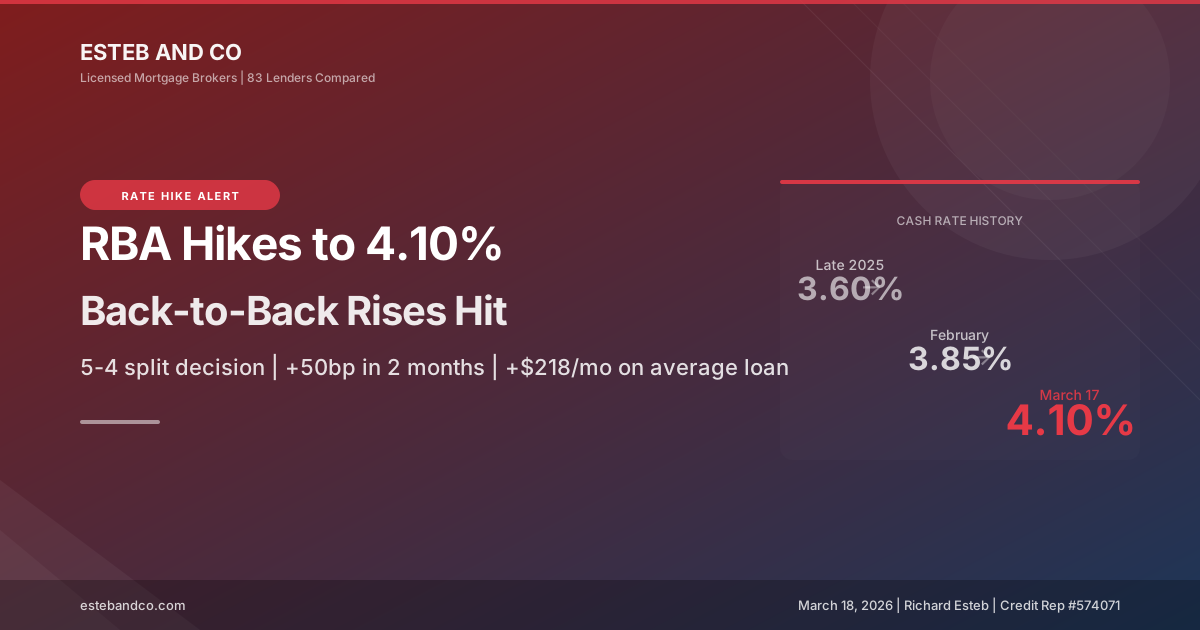
It happened. The RBA hiked the cash rate to 4.10% yesterday, March 17, delivering the second consecutive increase in as many months. The February hike from 3.60% to 3.85% was supposed to be a “one and done” recalibration. Instead, the Board pushed through again — this time in a razor-thin 5-4 split.
The numbers hit hard. Two hikes in two months have added 50 basis points to the cash rate, wiping out two thirds of the easing the RBA delivered through 2025. For the average Australian borrower with a $693,801 home loan, that translates to roughly $218 more per month — or $2,616 per year — compared to where repayments sat at the end of 2025.
CBA has already confirmed it will pass on the full 25 basis points from March 27. The other big banks are expected to follow within days. That creates a narrow window — roughly one to two weeks — where borrowers can still act before the repricing hits.
This article breaks down what happened, what it costs you, and exactly what you should do about it.
The Decision: RBA Hikes to 4.10% in a Tight 5-4 Split
The Reserve Bank Board voted 5-4 to increase the cash rate target by 25 basis points from 3.85% to 4.10%, effective March 18, 2026. This is the highest the cash rate has been since August 2025, effectively taking rates back to where they were seven months ago.
The split was the tightest possible margin for a nine-member board. Five members voted to hike. Four voted to hold. Governor Michele Bullock noted in the post-decision press conference that the disagreement was not about direction but about timing:
“All members agreed that a further adjustment to policy was likely needed. The disagreement was about whether to move now or to wait for additional data. The majority judged that the cost of waiting and being behind the curve outweighed the cost of acting a month early.” — RBA Governor Michele Bullock, March 17, 2026
That framing is important. Even the four who voted to hold were not arguing against a hike — they wanted to wait, likely for the March quarter CPI data due in late April. The fact that all nine members saw the need for further tightening tells us the RBA’s tolerance for above-target inflation has genuinely run out.
This is now the second consecutive hike after the Board raised the cash rate from 3.60% to 3.85% in February. Combined, the two moves have added 50 basis points in just seven weeks — the most aggressive tightening sequence since mid-2023.
Why the RBA Hiked Again — and Why Four Members Disagreed
The Board’s statement pointed to three factors that forced its hand:
Inflation picked up in the second half of 2025
After trending down through early 2025, inflation reversed course. Headline CPI is running at 3.8% and the trimmed mean — the RBA’s preferred measure of underlying inflation — sits at 3.3%. Both remain firmly above the 2-3% target band. The Board made clear that the progress on disinflation had stalled and, in some areas, reversed.
Capacity pressures remain elevated
The economy is still running above its sustainable capacity. Unemployment is historically low, wages are growing faster than productivity, and consumer spending has held up better than the RBA expected. Services inflation in particular has proven sticky, driven by insurance, rents and healthcare costs. From the Board’s perspective, aggregate demand is not slowing fast enough.
Middle East conflict is pushing fuel prices higher
Escalating geopolitical tensions in the Middle East have driven oil and fuel prices higher, adding direct pressure to both headline CPI and household cost-of-living measures. The Board cited this as a supply-side risk that monetary policy cannot control directly, but that nevertheless affects inflation expectations and second-round effects on prices.
Why four members disagreed
The four dissenters did not dispute the inflation picture. Their argument, as summarised by Bullock, was about timing and risk management. The March quarter CPI — the most important piece of data for the inflation outlook — is not published until late April. Moving ahead of that data carries a risk of overtightening, especially when the full impact of the February hike has not yet flowed through to the economy.
There is also the question of cumulative impact. Two hikes in two months land on households simultaneously once lenders reprice. Some board members were concerned about the speed of transmission and the lagged effects on consumer confidence and spending. In an economy where housing accounts for a disproportionate share of household wealth and debt, the margin for error is thin.
The split vote matters because it tells us the bar for a third consecutive hike is high. Four of nine members already think the Board has moved fast enough. If any of the five majority members waver at the May meeting, the outcome flips.
What Back-to-Back Hikes Cost You
The cumulative impact of the February and March hikes is substantial. On the average Australian home loan of $693,801 (ABS December quarter 2025 data), here is what the last two months have done to repayments:
| Loan Size | At 3.60% (Jan) | At 3.85% (Feb) | At 4.10% (Now) | Monthly Increase (Cumulative) | Annual Increase |
|---|---|---|---|---|---|
| $400,000 | $2,205 | $2,268 | $2,331 | +$126 | +$1,512 |
| $500,000 | $2,756 | $2,835 | $2,914 | +$158 | +$1,896 |
| $607,624 (avg FHB) | $3,351 | $3,447 | $3,543 | +$192 | +$2,304 |
| $693,801 (avg all) | $3,826 | $3,935 | $4,044 | +$218 | +$2,616 |
| $800,000 | $4,410 | $4,536 | $4,662 | +$252 | +$3,024 |
| $1,000,000 | $5,513 | $5,670 | $5,828 | +$315 | +$3,780 |
For context, the national median home value sits at $912,465, and total housing loan commitments were up 5.1% in number and 9.5% in value over the December quarter 2025. Borrowers took on record levels of debt right before this hiking cycle restarted. First home buyer loans averaged $607,624 (up 6.8%), while investor lending hit a record $42.9 billion for the quarter, up 31.8% year-on-year.
The repayment increases are painful enough. But borrowing power takes a hit too. Each 25bp hike reduces borrowing capacity by approximately $12,000. The combined 50bp since January has wiped roughly $24,000 off what a typical borrower can qualify for. If you were approved for $700,000 in January, the same income and expenses would now get you approximately $676,000.
When Will Your Lender Reprice? The Window Is Closing
Lenders do not raise rates instantly after an RBA decision. There is a lag — typically 10 to 14 days — between the RBA announcement and when the new rate hits your mortgage. That lag creates a window of opportunity.
Here is what we know so far about the major lenders:
| Lender | Current Variable Rate | Expected New Rate | Effective Date |
|---|---|---|---|
| CBA | 5.99% | ~6.24% | March 27 (confirmed) |
| Westpac | 5.99% | ~6.24% | Expected late March |
| NAB | 5.99% | ~6.24% | Expected late March |
| ANZ | 6.04% | ~6.29% | Expected late March |
| Macquarie | 5.85% | ~6.10% | Expected late March |
| Bank Australia | ~5.38% | ~5.63% | TBC |
| Columbus Capital | ~5.84% | ~6.09% | TBC |
| Liberty | ~6.24% | ~6.49% | TBC |
| Pepper | ~6.39% | ~6.64% | TBC |
Note: The rates above are pre-hike rates. Lenders are actively repricing over the coming days. The “expected new rate” column assumes a full pass-through of 25bp, which is standard practice — all four major banks passed on the full February hike.
The critical point: if you are thinking about refinancing, the clock is ticking. Once your current lender reprices (your rate goes up) and your target lender also reprices, the savings from switching narrow. The optimal move is to lock in a refinance application this week, before the new rates take effect across the board.
For borrowers with pre-approvals: your existing pre-approval assessment was done at the old rate plus buffer. It remains valid for its full 90-day term. But if you need to reapply or extend, the new assessment will use the higher rate — reducing your borrowing power by approximately $12,000.
What You Should Do Right Now
There are three concrete actions borrowers should take in the next one to two weeks. Not next month. Now. The repricing window is narrow and every day you wait costs you options.
1. Refinance before your lender reprices
If you are on a variable rate above 6.00%, you are almost certainly paying more than you need to. Even before this hike, the spread between the best and worst variable rates was 0.5% to 1.5%. On the average loan of $693,801, a 0.50% saving is worth $218 per month ($2,616/year). A 1.00% saving is $436 per month ($5,232/year).
The key is timing. Lenders reprice at different speeds. If you can get a refinance application lodged and conditionally approved before your target lender reprices, you lock in the lower rate. CBA reprices March 27. Others will follow. That gives you roughly seven to ten days to act.
Even if you miss the pre-repricing window, refinancing still makes sense. The rate differential between lenders persists after repricing — if you are on a 6.24% SVR and a competitor is at 5.63%, the gap is still worth switching for. But acting now maximises your saving.
2. Lock in pre-approvals at current assessment rates
If you are a buyer in the market, a pre-approval obtained before your lender updates its assessment rate protects your borrowing capacity. Most pre-approvals are valid for 90 days. That means a pre-approval locked in this week stays at the 3.85% assessment base until mid-June, even though the cash rate is now 4.10%.
This matters because each 25bp hike reduces what you can borrow by approximately $12,000. The 50bp cumulative increase since January has already cut typical borrowing capacity by $24,000. If another hike comes in May, you could lose a further $12,000. Getting pre-approved now draws a line under the damage.
Speed matters. Macquarie is still turning around approvals in 2 days. Bank of Sydney does it in 3 days. The big four take 7-8 days. There is no reason to wait.
3. Consider non-bank lenders for borrowing power
APRA-regulated banks (the big four, Macquarie, regional banks) must assess you at your actual rate plus a 3.00% buffer. At the new 4.10% cash rate, that means banks are testing whether you can service a loan at roughly 8.63% to 9.24% depending on the product rate.
Non-bank lenders like Columbus Capital, Liberty and Pepper use lower buffers of 2.00% to 2.75%. The practical difference is significant. A borrower who maxes out at $680,000 with a major bank might qualify for $700,000 to $730,000 with a non-bank lender.
Non-bank lenders are not for everyone — they may lack offset accounts, branch access, and the brand familiarity of a major bank. But if you are on the borderline of affording the property you want, or if a bank has knocked you back, they are a genuine option worth exploring. This is exactly where a broker who accesses the full market adds real value.
Is Another Hike Coming?
The next RBA meeting is May 20, 2026. The question on every borrower’s mind: will there be a third consecutive hike?
Here is what we know:
- The March quarter CPI is the key data point. It will be published in late April, roughly three weeks before the May decision. If headline CPI stays above 3.5% and trimmed mean stays above 3.0%, the hawks on the Board will have their justification. If inflation shows meaningful progress back toward the 2-3% target, the case for pausing strengthens considerably.
- The 5-4 split makes another hike harder, not easier. Four of nine members already voted against the March hike. For a May hike to proceed, all five majority members need to hold firm — and the inflation data needs to warrant it. If even one member flips, the Board holds.
- Global conditions are uncertain. Middle East conflict continues to push energy prices higher, but the broader global economy is showing signs of slowing. If trading partners weaken, Australian export demand softens, and the RBA may find its domestic inflation problem partly self-correcting through lower commodity prices.
- The labour market is the wildcard. If unemployment ticks up in the March and April data releases, the Board will be more cautious about adding further pressure. If jobs remain resilient, the hawks keep their ammunition.
Our view: a May hike is possible but not probable. The 5-4 split tells us the consensus for tightening is fragile. The March CPI data will be decisive. Borrowers should plan for the possibility of 4.35% but not assume it as a certainty.
Regardless of what happens in May, the actions above — refinancing, locking in pre-approvals, and exploring non-bank options — are sensible moves that pay off whether rates go up, hold, or eventually come back down.
Frequently Asked Questions
What is the RBA cash rate after the March 2026 decision?
The cash rate is 4.10% following the March 17 hike from 3.85%. This was the second consecutive increase — the RBA also hiked in February from 3.60% to 3.85%. Combined, the two hikes have added 50 basis points in seven weeks, taking rates back to where they were seven months ago and wiping out two thirds of the easing delivered in 2025.
How much do the back-to-back hikes add to my mortgage repayments?
The cumulative 50bp of hikes add approximately $218 per month ($2,616/year) to the average Australian home loan of $693,801. Each 25bp hike adds roughly $109 per month. On a $1,000,000 loan, the combined increase is approximately $315 per month ($3,780/year). First home buyers with the average loan of $607,624 are looking at about $192 per month more than they were paying at the start of the year.
When will my lender raise its variable rate?
CBA has confirmed it will pass on the full 0.25% from March 27. Westpac, NAB and ANZ are expected to follow within days, likely by the end of March or early April. This creates a narrow window of roughly one to two weeks where you can still lodge a refinance application before rates update across the board.
Will the RBA hike again in May 2026?
The next meeting is May 20. The March quarter CPI data, published in late April, will be the deciding factor. If inflation remains elevated, a third consecutive hike to 4.35% is possible. However, the tight 5-4 split in March suggests the bar for another hike is high — four of nine board members already thought moving in March was premature. Our view is a May hike is possible but not probable.
Should I refinance now or wait for rates to come back down?
Refinancing now is advisable if you are on a rate above 6.00%. Waiting for cuts is a gamble — if the May CPI data is hot, rates could go higher still. Even if rates eventually fall, the savings you capture by refinancing today compound from day one. The spread between the best and worst variable rates is currently 0.5% to 1.5%, which on the average loan is $218 to $658 per month. Acting now locks in those savings regardless of where the RBA moves next. Read our refinance guide for a step-by-step walkthrough.
See where you stand
Compare your options across our panel of 50 lenders in about 2 minutes. Free, and it won’t affect your credit score.
Start complimentary assessment →No obligation · Richard Esteb, Credit Rep #574071
Richard Esteb
Ricky founded Esteb & Co to give everyday Australians access to the same loan comparison technology used by the big banks. He compares products from a panel of 50 lenders to find the right fit for each client’s situation.