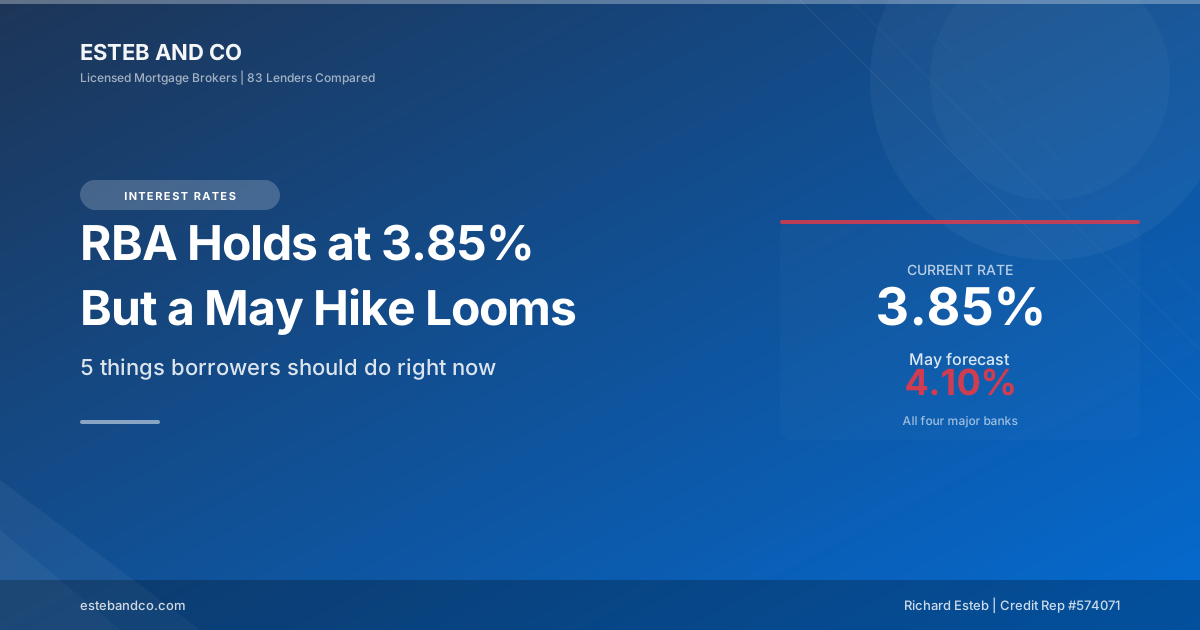
RBA Holds at 3.85% in March — But a May Hike Looms. Here’s What to Do Now

In this article
- March 17 decision: a hold, but what comes next?
- Why all four major banks are tipping a May hike
- What another 0.25% hike actually costs you
- Lowest rates available right now (March 2026)
- Action 1: Get pre-approved now to lock in today’s assessment rate
- Action 2: Refinance off your high SVR — real savings of 0.5-1.5%
- Action 3: Check your buffer — non-bank lenders may approve you where banks won’t
- Frequently asked questions
The RBA meets on Monday, March 17, and the consensus is clear: rates will hold at 3.85%. After the February hike from 3.60% to 3.85% caught many borrowers off guard, the Board is expected to pause and assess the fallout.
But here is the part that matters more. ANZ, CBA, NAB and Westpac — all four major banks — are now predicting a further 25 basis point hike to 4.10% in May. RBA Governor Michele Bullock has reminded markets that “every meeting is live,” and with headline CPI stuck at 3.8% and trimmed mean at 3.3%, the Board has the ammunition to move again.
We are not writing this to alarm you. We are writing it because the window between now and May is a window of opportunity. If you act in the next six to eight weeks, you can lock in pre-approvals at current assessment rates, refinance to a lower rate before lenders reprice, and potentially save tens of thousands over the life of your loan.
Here is exactly what we think you should do.
March 17 Decision: a Hold, but What Comes Next?
The February hike was the first upward move since November 2023 and it broke a cautious easing cycle that had delivered three cuts through 2025. The RBA took the cash rate from 3.60% back up to 3.85%, signalling that the inflation fight is not over.
For March, the Board has limited new data to act on. The most critical input — the March quarter CPI — will not be published until late April. Without fresh inflation numbers, the Board is expected to hold and continue monitoring.
“Every meeting is live. The Board will do what is necessary to return inflation to the target range.” — RBA Governor Michele Bullock, February 2026
What makes this hold different from a typical pause is the forward guidance. The Board has explicitly left the door open for further tightening. The statement language has shifted from “not ruling anything in or out” to “remains prepared to act.” That is a meaningful escalation.
The key date to mark in your calendar is late April, when the ABS publishes the March quarter CPI. If trimmed mean inflation stays above 3.3%, a May hike to 4.10% becomes the base case. If it drops towards 3.0%, the RBA will likely hold through mid-year.
Why All Four Major Banks Are Tipping a May Hike
This is not one rogue forecast. ANZ, CBA, NAB and Westpac have all flagged a 25bp hike to 4.10% in May as their central or risk scenario. Their reasoning comes down to three factors:
Inflation remains stubbornly above target
Headline CPI is running at 3.8% and trimmed mean at 3.3% — both above the RBA’s 2-3% target band. Services inflation in particular has proven sticky, driven by insurance, rents and healthcare costs. The unwinding of government energy subsidies has pushed headline CPI higher, but even stripping that out, underlying price pressures are not easing fast enough.
Housing credit growth is accelerating
ABS lending data shows total dwelling loans are up 9.5% in value over the year, with first home buyer loans surging 15.5% in value. Strong credit growth fuels demand, pushes property prices higher, and gives the RBA a financial stability reason to keep policy tight. The Board has flagged this explicitly in recent minutes.
The labour market is still too tight
Unemployment remains historically low, wages are growing faster than productivity, and consumer spending has held up better than expected. From the RBA’s perspective, aggregate demand is not slowing enough to bring inflation down on its own. Monetary policy needs to do more of the work.
The market is not fully priced for a May hike — interest rate futures suggest roughly a 50-50 split. But the fact that all four majors agree on the direction tells us something. These are the institutions that set mortgage rates for millions of Australians. When they prepare for a hike, it is worth paying attention.
What Another 0.25% Hike Actually Costs You
On the average Australian home loan of $693,801 (ABS data), each 0.25% increase adds approximately $109 per month to repayments. If the RBA hikes to 4.10% in May, the cumulative impact from the 3.60% low in late 2025 would be:
| Loan Size | At 3.85% (Now) | At 4.10% (May?) | Monthly Increase | Annual Increase |
|---|---|---|---|---|
| $400,000 | $2,268 | $2,331 | +$63 | +$756 |
| $500,000 | $2,835 | $2,914 | +$79 | +$948 |
| $693,801 (avg) | $3,935 | $4,044 | +$109 | +$1,308 |
| $800,000 | $4,536 | $4,662 | +$126 | +$1,512 |
| $1,000,000 | $5,670 | $5,828 | +$158 | +$1,896 |
But higher repayments are only half the story. Each 0.25% hike also reduces your borrowing capacity by approximately $12,000. If you are in the middle of a property search or waiting to apply for pre-approval, a May hike means you qualify for less — potentially losing out on properties you could have afforded a month earlier.
That is why timing matters right now.
Lowest Rates Available Right Now (March 2026)
Before we get into the action plan, here is the current landscape. These are the lowest owner-occupied variable rates from our panel as of March 14, 2026:
| Lender | Variable Rate | Turnaround Time | Notes |
|---|---|---|---|
| Bank Australia | 5.13% | - | Lowest rate available |
| Bank of Sydney | 5.14% | 3 days | Fast approval |
| Bank of China | 5.18% | - | Competitive for larger loans |
| Queensland Country Bank | 5.19% | - | Regional specialist |
| Macquarie Bank | 5.34% | 2 days | Fastest turnaround in market |
| Bank SA / Bank of Melbourne | 5.39% | 8 days | Westpac subsidiary |
| Westpac | 5.42% | 8 days | Major bank |
| ANZ | 5.51% | - | Major bank |
| CBA | 5.74% | 8 days | Major bank |
| NAB | 5.74% | 7 days | Major bank |
The spread between the lowest rate (Bank Australia at 5.13%) and the big four (5.42% to 5.74%) is 0.29% to 0.61%. On a $693,801 loan, that gap is worth $126 to $264 per month. Many borrowers are paying even more than the big four standard rates because they have never refinanced off their lender’s standard variable rate.
If you are paying above 5.60%, you are almost certainly paying too much.
Action 1: Get Pre-Approved Now to Lock in Today’s Assessment Rate
This is the single most important thing buyers can do right now. When a lender assesses your borrowing capacity, they use the current interest rate plus a buffer (typically 3% for APRA-regulated banks). If the cash rate rises to 4.10% in May, the assessment rate rises with it — and your maximum borrowing amount drops.
A pre-approval obtained in March or early April locks in the current assessment rate for 90 days with most lenders. That means even if the RBA hikes in May, your approved borrowing amount stays the same until the pre-approval expires.
Speed matters here. These lenders have the fastest turnaround times for getting your approval processed:
| Lender | Approval Turnaround | Variable Rate |
|---|---|---|
| Macquarie Bank | 2 days | 5.34% |
| Bank of Sydney | 3 days | 5.14% |
| Suncorp | 4 days | - |
| UBank / Great Southern | 5 days | - |
| Bankwest | 6 days | - |
| St George / ME Bank | 7 days | - |
| NAB | 7 days | 5.74% |
| CBA / Westpac / Bank SA | 8 days | 5.74% / 5.42% / 5.39% |
If you are buying in the next three to six months, getting your pre-approval lodged now gives you a buffer against the May decision. Even if rates do not move, you lose nothing by having a pre-approval in hand. It puts you in a stronger negotiating position when you find the right property.
Action 2: Refinance Off Your High SVR — Real Savings of 0.5-1.5%
If you are an existing borrower sitting on your lender’s standard variable rate (SVR), March is the time to move. SVRs at the major banks are sitting between 5.74% and 6.00%+ depending on when you took out your loan and whether you have ever renegotiated.
Refinancing to a competitive rate of 5.13% to 5.39% could save you 0.35% to 0.87% or more. On the average loan of $693,801, that translates to:
- 0.35% saving: $152/month ($1,824/year)
- 0.50% saving: $218/month ($2,616/year)
- 0.87% saving: $381/month ($4,572/year)
- 1.50% saving: $658/month ($7,896/year)
The prospect of a May hike adds urgency. If the cash rate goes to 4.10%, lenders will reprice their variable products upward. Refinancing before that happens means you start from a lower base. You still absorb the hike, but the dollar amount hurts less when your starting rate is 5.13% instead of 5.74%.
A common concern we hear: “What if I fix instead?” Fixing a portion of your loan can make sense if you want payment certainty. Consider a split approach — fix 50-60% to protect against hikes and keep 40-50% variable with an offset account for flexibility. Read our fixed vs variable guide for a deeper look at the trade-offs.
Action 3: Check Your Buffer — Non-Bank Lenders May Approve You Where Banks Won’t
This is a point most borrowers are not aware of. APRA-regulated banks (the big four, Macquarie, regional banks) are required to use a 3.00% serviceability buffer. That means they assess whether you can afford repayments at your actual rate plus 3% — so at today’s rates, they are testing you at roughly 8.13% to 8.74%.
Non-bank lenders are not bound by APRA’s buffer mandate. They use lower buffers of 2.00% to 2.75%, which means they assess you at a lower hypothetical rate. The practical result: more borrowing power.
| Lender | Type | Variable Rate | Buffer Rate | Assessment Rate |
|---|---|---|---|---|
| Columbus Capital | Non-bank | 5.59% | 2.75% | 8.34% |
| Liberty Financial | Non-bank | 5.99% | 2.75% | 8.74% |
| Pepper Money | Non-bank | 6.14% | 2.50% | 8.64% |
| Bluestone | Specialist | 7.49% | 2.00% | 9.49% |
| CBA | Bank (APRA) | 5.74% | 3.00% | 8.74% |
| ANZ | Bank (APRA) | 5.51% | 3.00% | 8.51% |
| Bank Australia | Bank (APRA) | 5.13% | 3.00% | 8.13% |
Notice that Columbus Capital at 5.59% with a 2.75% buffer gives you an assessment rate of 8.34% — lower than CBA at 8.74% despite CBA having a marginally higher actual rate. For a borrower on the edge of their borrowing capacity, this difference can mean qualifying for $20,000 to $50,000 more in loan amount.
Non-bank lenders are not for everyone. They typically do not offer offset accounts, branch access, or the brand familiarity of a big four bank. But if you have been knocked back by a bank or need to maximise your borrowing power before a potential May hike, they are worth considering. This is exactly the kind of scenario where working with a broker who has access to the full market makes a real difference.
Two more things to consider before May
4. Consider fixing a portion of your loan
If your risk tolerance is low and budget certainty matters more than flexibility, locking in a fixed rate on part of your loan shields you from May and beyond. Fixed rates already price in some expectation of future moves, so they are not a guaranteed bargain — but they do remove uncertainty. Talk to us about the split loan approach that works for your situation.
5. Do not panic — rates are still historically moderate
Context matters. Even at 4.10%, the cash rate would be well below the 2008 peak of 7.25% and comparable to the long-run average. Variable mortgage rates around 5.50% are uncomfortable but manageable for most borrowers. The economy is still growing, unemployment is low, and wages are rising. This is not a crisis — it is a correction. The borrowers who come out ahead are the ones who take action calmly and early, not the ones who freeze.
Frequently Asked Questions
What is the RBA cash rate in March 2026?
The cash rate is 3.85% following the February 2026 hike from 3.60%. The RBA is widely expected to hold at 3.85% at the March 17 meeting. The next potential move is a hike to 4.10% in May, with all four major banks flagging this as their base or risk scenario.
Will the RBA raise rates again in May 2026?
ANZ, CBA, NAB and Westpac are all predicting a 25bp hike to 4.10% in May. The deciding factor is the March quarter CPI data, due in late April. If trimmed mean inflation stays above 3.3%, a hike is likely. Governor Bullock has said “every meeting is live.”
How much would a May rate hike cost me per month?
Each 0.25% increase adds approximately $109 per month on the average home loan of $693,801. A hike to 4.10% would bring the cumulative increase from the 3.60% low to about $218 per month or $2,616 per year. It also reduces borrowing capacity by roughly $12,000 per 0.25% increment.
Should I get pre-approved now before rates go up?
Yes. Pre-approvals are assessed at today’s rates plus a buffer. Locking in now preserves your borrowing capacity for 90 days, even if the RBA hikes in May. Some lenders like Macquarie can process approvals in as little as 2 days. There is no downside to having a pre-approval ready.
What are the lowest home loan rates available right now?
The lowest owner-occupied variable rates from our panel include Bank Australia at 5.13%, Bank of Sydney at 5.14%, and Bank of China at 5.18%. Among the majors, Westpac offers 5.42%, ANZ 5.51%, and CBA and NAB both sit at 5.74%. See our full lender comparison for the latest rates.
See where you stand
Compare your options across our panel of 50 lenders in about 2 minutes. Free, and it won’t affect your credit score.
Start complimentary assessment →No obligation · Richard Esteb, Credit Rep #574071
Richard Esteb
Ricky founded Esteb & Co to give everyday Australians access to the same loan comparison technology used by the big banks. He compares products from a panel of 50 lenders to find the right fit for each client’s situation.