Record Lending Meets Rising Rates: What ABS Data and Back-to-Back Hikes Mean for Borrowers

In this article
- Australia’s lending boom by the numbers
- First home buyers are surging — but the maths just changed
- Investor lending hits record $42.9 billion — can it last?
- State-by-state: what your home loan actually costs now
- The affordability squeeze: median home value $912,465 vs shrinking borrowing power
- What smart borrowers are doing right now
- Frequently asked questions
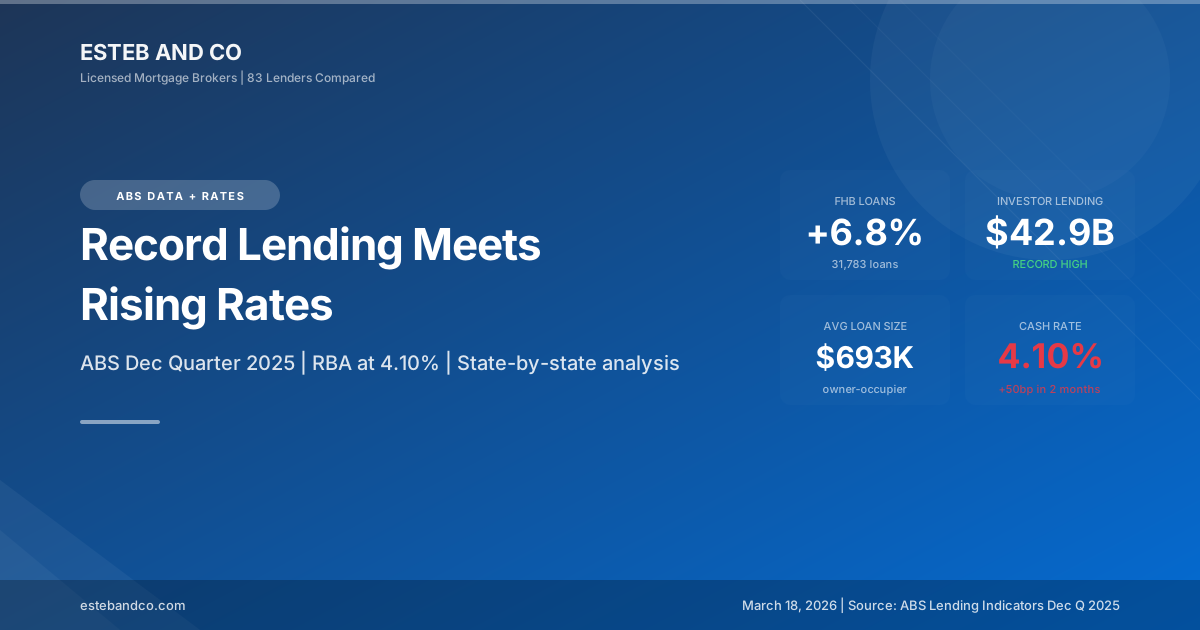
The latest ABS Lending Indicators paint a picture of a market running hot. Total new housing loan commitments rose 5.1% in number and 9.5% in value over the December Quarter 2025. First home buyers surged 6.8%. Investor lending smashed through records at $42.9 billion. The average owner-occupier loan hit $693,801.
And then the RBA hiked. Twice.
In February, the cash rate went from 3.60% to 3.85%. Yesterday — March 17 — it went to 4.10%. That is 50 basis points in two months. Every one of those ABS lending figures was calculated in a world where the cash rate was 3.60%. That world no longer exists.
This article breaks down what the ABS data actually shows, what it means now that rates have jumped, and what you should do about it. We are not going to sugarcoat it: borrowing power has shrunk, repayments have gone up, and the maths has changed for every buyer in every state. But there are still clear steps you can take to put yourself in the strongest position possible.
Australia’s Lending Boom by the Numbers
The ABS December Quarter 2025 Lending Indicators data, released on 23 February 2026, showed lending activity accelerating across the board. Here are the headline figures:
| Metric | December Quarter 2025 | Change |
|---|---|---|
| Total new loan commitments (number) | — | +5.1% quarterly |
| Total new loan commitments (value) | — | +9.5% quarterly |
| Owner-occupier loans (number) | — | +4.8% quarterly |
| Owner-occupier loans (value) | — | +10.6% quarterly |
| Average owner-occupier loan | $693,801 | — |
| Investor loans (number) | 60,455 loans | +5.5% quarterly |
| Investor loans (value) | $42.9 billion (record) | +31.8% YoY |
| First home buyer loans (number) | 31,783 loans | +6.8% quarterly |
| First home buyer loans (value) | $19.3 billion | +15.5% quarterly |
| Average FHB loan size | $607,624 | +8.5% quarterly |
The December Quarter 2025 ABS Lending Indicators represent the most recent complete picture of Australia’s housing credit market — and they were compiled entirely under a 3.60% cash rate. With the RBA now at 4.10% after back-to-back hikes, this data is simultaneously the best guide we have and already out of date. The numbers tell us where demand was heading. The rate hikes tell us where affordability is heading. They are moving in opposite directions.
The value growth outpacing volume growth tells us something important: Australians are not just borrowing more often, they are borrowing larger amounts. The average owner-occupier loan of $693,801 reflects property prices that have continued to climb even as rates bounced off their lows. Average monthly repayments at the time of the data sat at $3,935 based on a 5.49% average rate.
But that 5.49% figure is already stale. With the cash rate now at 4.10%, variable rates are moving toward 5.74% and higher. That changes the repayment maths for every borrower in the data set — and for every borrower reading this right now.
First Home Buyers Are Surging — But the Maths Just Changed
First home buyers were the standout in the December quarter. 31,783 loans were written, up 6.8% in number and a striking 15.5% in value. The average FHB loan size jumped 8.5% in just one quarter to reach $607,624. This was the largest rise in FHB lending since the December Quarter 2023.
Two government schemes drove much of this activity. The expanded 5% Deposit Guarantee allowed more first home buyers to enter the market with a smaller deposit without paying lenders mortgage insurance. The new Help to Buy shared equity scheme reduced the amount buyers need to borrow by having the government take an equity stake in the property.
These schemes got more buyers into the market. But the back-to-back RBA hikes have rewritten the cost equation for every one of them — and for anyone who has not yet locked in a loan.
Here is what repayments look like on the average FHB loan of $607,624 at each stage of the rate cycle, assuming a 30-year principal and interest loan:
| Cash Rate | Approx. Variable Rate | Monthly Repayment | vs 3.60% Cash Rate | Annual Difference |
|---|---|---|---|---|
| 3.60% (late 2025) | 5.49% | $3,448 | — | — |
| 3.85% (Feb 2026) | 5.74% | $3,543 | +$95/mo | +$1,140/yr |
| 4.10% (Mar 2026) | 5.99% | $3,641 | +$193/mo | +$2,316/yr |
A first home buyer who locked in at 5.49% before the hikes is paying $193 less per month than someone taking out the same loan today. Over a year, that is $2,316. Over the first five years, it adds up to more than $11,500 in additional repayments.
And it gets harder from there. Each 25bp hike does not just increase repayments — it also reduces how much you can borrow. At the APRA-mandated 3% serviceability buffer, banks now assess FHB applicants at roughly 8.99% (5.99% + 3.00%). That is a meaningfully higher bar than the 8.49% assessment rate just two months ago.
The practical result: a borrower who could have qualified for $607,624 at a 3.60% cash rate may now only qualify for roughly $583,000 — approximately $24,000 less.
What this means for first home buyers
If you are a first home buyer who has not yet applied for a loan, the window of opportunity is narrowing but it is not closed. Government schemes still have places available. Pre-approvals obtained now lock in the current assessment rate for 90 days. And non-bank lenders with lower buffers (2% to 2.75%) may be able to approve you where a bank cannot.
The worst thing you can do is wait and hope rates come back down. The ABS data shows clearly that demand is strong and getting stronger. Waiting means competing with more buyers while being able to borrow less.
Investor Lending Hits Record $42.9 Billion — Can It Last?
Investor lending was the record-breaker in the December quarter. 60,455 loans worth a combined $42.9 billion were written — the highest quarterly figure ever recorded by the ABS. Year-on-year growth hit 31.8%, with the average investor loan size climbing $43,000 to $717,000 nationally.
NSW dominated the investor market, with the average investor loan size reaching $873,000 — the only state above the national benchmark. Western Australia ($644,000), South Australia ($622,000), and the Northern Territory ($460,000) rounded out the states with available data.
The investment surge was fuelled by a combination of factors: strong rental yields, expectations of capital growth, and a wave of SMSF investors entering the property market. But with the cash rate now at 4.10%, the equation is shifting.
The rental yield vs mortgage cost squeeze
Investor mortgage rates are typically 0.20% to 0.50% higher than owner-occupier rates. With the cash rate at 4.10%, investor variable rates are pushing toward 6.20% to 6.50% depending on the lender and LVR. On the average investor loan of $717,000, the numbers look like this:
| Scenario | Rate | Monthly Repayment (P&I) | Monthly Repayment (IO) |
|---|---|---|---|
| Pre-hike (late 2025) | 5.89% | $4,248 | $3,520 |
| Post-hike (Mar 2026) | 6.39% | $4,480 | $3,818 |
| Monthly increase | — | +$232 | +$298 |
| Annual increase | — | +$2,784 | +$3,576 |
For an interest-only investor loan — the structure most property investors use — the monthly cost has jumped nearly $300 since the 3.60% cash rate. That is $3,576 per year in additional holding costs that need to be offset by rental income or capital growth.
The question every investor needs to ask: does the rental yield on your property still cover the mortgage cost at 6.39%? For many investors in Sydney, where median rents have not kept pace with property price growth, the answer is increasingly no. Negatively geared properties are getting more expensive to hold, and the gap between rental income and mortgage repayments is widening with every rate hike.
Can investor lending stay at record levels? The December quarter data suggests enormous appetite, but that appetite was built on a 3.60% cash rate. At 4.10%, the maths is harder. We expect investor lending volumes to moderate over the March and June quarters as the higher rates flow through to serviceability assessments and holding costs.
State-by-State: What Your Home Loan Actually Costs Now
The ABS data provides average owner-occupier loan sizes and monthly repayments for each state and territory, calculated at the pre-hike average rate of approximately 5.49%. But with the cash rate now at 4.10% and variable rates moving toward 5.74%, those repayment figures need updating.
The table below shows the ABS-reported figures alongside our estimated repayments at the post-hike rate environment. We have used 5.74% as the post-hike variable rate — a conservative estimate based on where the big four banks are repricing.
| State | Average Loan | Old Repayment (5.49%) | New Repayment (5.74%) | Monthly Increase | Annual Increase |
|---|---|---|---|---|---|
| NSW | $828,065 | $4,696 | $4,830 | +$134 | +$1,608 |
| QLD | $687,161 | $3,897 | $4,008 | +$111 | +$1,332 |
| VIC | $646,577 | $3,667 | $3,773 | +$106 | +$1,272 |
| WA | $632,901 | $3,590 | $3,693 | +$103 | +$1,236 |
| ACT | $628,377 | $3,564 | $3,666 | +$102 | +$1,224 |
| SA | $616,428 | $3,496 | $3,597 | +$101 | +$1,212 |
| TAS | $483,920 | $2,745 | $2,824 | +$79 | +$948 |
| NT | $481,164 | $2,729 | $2,808 | +$79 | +$948 |
NSW borrowers are hit hardest in absolute terms, paying an estimated $134 more per month after the back-to-back hikes — that is $1,608 per year on the average loan of $828,065. Even in Tasmania and the Northern Territory, where average loans are lower, borrowers are looking at an extra $79 per month.
And these figures only reflect the move from 5.49% to 5.74%. If your lender passes on the full 50bp of hikes — pushing variable rates toward 5.99% — the increases are roughly double what is shown here. On the average NSW loan, that would be closer to $268 per month or $3,216 per year.
The full-pass-through scenario
Not all lenders have fully passed through both hikes yet. Some passed the February hike in full but are staggering the March hike. Others have used the opportunity to trim margins slightly and pass on less than the full 25bp. It is worth checking exactly what your lender has done — and whether a competitor is offering a better deal.
If you are paying above 5.80% on an owner-occupier variable rate right now, there is almost certainly a better option available. A rate difference of even 0.30% on a $700,000 loan saves you roughly $131 per month or $1,572 per year.
The Affordability Squeeze: Median Home Value $912,465 vs Shrinking Borrowing Power
Here is the core tension in the Australian housing market right now. The national median home value sits at $912,465 as of January 2026. Meanwhile, the amount the average borrower can qualify for is shrinking with every rate hike.
At a 3.60% cash rate, a household earning $150,000 with minimal debts and a 20% deposit could typically borrow around $780,000 from a major bank. At 4.10%, that same household can borrow approximately $756,000 — a drop of roughly $24,000.
That gap between the median home price ($912,465) and what a typical borrower can actually qualify for ($756,000 with 20% deposit = targeting a $945,000 purchase) means the margin for error is razor-thin for many buyers. And for single-income households or those with existing debts, the median-priced home is increasingly out of reach through traditional bank lending.
Non-bank lenders: a path to more borrowing power
This is where the distinction between APRA-regulated banks and non-bank lenders becomes critical. APRA requires banks to assess borrowers using a 3.00% serviceability buffer. At a 5.99% variable rate, that means banks test whether you can afford repayments at 8.99%.
Non-bank lenders are not bound by APRA’s buffer. They typically use buffers of 2.00% to 2.75%, which translates to assessment rates of 7.99% to 8.74%. The lower the assessment rate, the more you can borrow.
| Lender Type | Variable Rate | Buffer | Assessment Rate | Approx. Max Loan ($150K Income) |
|---|---|---|---|---|
| Major bank (APRA) | 5.74% | 3.00% | 8.74% | $756,000 |
| Non-bank (2.75% buffer) | 5.59% | 2.75% | 8.34% | $790,000 |
| Non-bank (2.50% buffer) | 6.14% | 2.50% | 8.64% | $765,000 |
| Non-bank (2.00% buffer) | 6.49% | 2.00% | 8.49% | $775,000 |
The difference can be significant. A non-bank lender with a 2.75% buffer and a competitive rate like Columbus Capital at 5.59% can offer an assessment rate of 8.34% — 40 basis points lower than CBA at 8.74%, despite CBA having a marginally lower actual rate. That translates to roughly $34,000 more borrowing power.
Non-bank lenders are not right for everyone. They may not offer offset accounts, branch networks, or the brand recognition of a big four bank. But for borrowers who are being squeezed by the APRA buffer — particularly first home buyers and investors at the edge of their capacity — they are a legitimate option that is often overlooked.
This is one of the key reasons to work with a finance broker rather than going direct to a bank. A bank will only tell you what they can offer. A broker with access to 50 lenders can show you where the buffers are lower and the borrowing power is higher.
What Smart Borrowers Are Doing Right Now
The ABS data tells us lending demand is strong. The back-to-back RBA hikes tell us the cost of that lending is rising fast. If you are a borrower — whether buying your first home, investing, or looking to refinance — here are the four moves that make the most sense right now.
1. Getting pre-approved before any further hikes
A pre-approval locks in the current assessment rate for 90 days with most lenders. If the RBA holds at 4.10% through the next meeting or hikes again, your approved borrowing amount stays the same until the pre-approval expires.
Consider the maths. Each 25bp hike reduces your borrowing capacity by approximately $12,000. The 50bp of hikes since late 2025 have already cost borrowers roughly $24,000 in capacity. If there is a further hike in May — which some economists are not ruling out — getting pre-approved now protects you against that loss.
Some lenders can process pre-approvals in as little as 2 days (Macquarie Bank) or 3 days (Bank of Sydney). There is no downside to having a pre-approval in hand. If rates drop, you can reapply at the lower rate. If they rise, you are protected.
2. Refinancing off standard variable rates
If you took out your loan more than two years ago and have not refinanced or renegotiated, there is a strong chance you are paying a standard variable rate (SVR) that is 0.50% to 1.50% higher than the best available rates. On the average loan of $693,801:
- 0.50% saving: $218/month ($2,616/year)
- 1.00% saving: $436/month ($5,232/year)
- 1.50% saving: $658/month ($7,896/year)
The back-to-back hikes make this even more urgent. Every rate hike gets passed on to your SVR in full. Refinancing to a competitive rate means you start from a lower base — you still absorb the hike, but the dollar impact is less when your starting rate is 5.13% instead of 5.74% or 6.00%+.
3. Considering non-bank lenders for more borrowing power
As we covered in section 5, non-bank lenders with lower serviceability buffers can approve loans that APRA-regulated banks cannot. If you have been knocked back by a bank, or if the APRA buffer is pushing your borrowing capacity below what you need, a non-bank lender is worth exploring.
This is not about taking on risky debt. Non-bank lenders like Columbus Capital, Liberty Financial, and Pepper Money are established, regulated entities. They simply use different serviceability criteria. A broker can help you assess whether a non-bank option is appropriate for your situation.
4. Using government schemes while they are available
The 5% Deposit Guarantee and Help to Buy scheme both have limited places. The ABS data shows first home buyer demand surging partly because of these schemes. If you are eligible, applying now secures your place before allocations run out.
The 5% Deposit Guarantee lets you buy with just a 5% deposit without paying LMI — saving $10,000 to $30,000+ depending on your loan size. Help to Buy reduces the amount you need to borrow by having the government take an equity stake. Both schemes can be combined with competitive rates from participating lenders.
These schemes will not be available forever. Political cycles, budget constraints, and allocation limits mean the window could close. If you are a first home buyer who qualifies, this is a case where acting sooner is clearly better than waiting.
Frequently Asked Questions
What did the latest ABS lending data show for December Quarter 2025?
The ABS December Quarter 2025 Lending Indicators showed total new loan commitments rose 5.1% in number and 9.5% in value. First home buyer loans surged 6.8% in number and 15.5% in value to 31,783 loans worth $19.3 billion. Investor lending hit a record $42.9 billion, up 31.8% year-on-year. The average owner-occupier loan reached $693,801. This data was collected under a 3.60% cash rate, which has since risen to 4.10%.
How much has borrowing power dropped after the back-to-back RBA hikes?
The RBA hiked from 3.60% to 3.85% in February 2026 and then to 4.10% in March 2026 — a total of 50 basis points in two months. Each 25bp hike reduces borrowing power by approximately $12,000 for the average borrower. Combined, borrowers can now qualify for roughly $24,000 less than they could at the 3.60% cash rate in late 2025. On the average loan of $693,801, repayments have increased by approximately $218 per month or $2,616 per year.
What is the average home loan repayment in each state after the rate hikes?
After the March 2026 hike to 4.10%, estimated monthly repayments on average owner-occupier loans by state are: NSW $4,830 (loan $828,065), QLD $4,008 (loan $687,161), VIC $3,773 (loan $646,577), WA $3,693 (loan $632,901), ACT $3,666 (loan $628,377), SA $3,597 (loan $616,428), TAS $2,824 (loan $483,920), NT $2,808 (loan $481,164). These figures are estimates based on approximately 5.74% variable rates post-hike.
Can non-bank lenders help me borrow more than a big four bank?
Yes. APRA-regulated banks must use a 3% serviceability buffer, assessing your repayments at around 8.74% or higher. Non-bank lenders use lower buffers of 2% to 2.75%, which means they test you at a lower hypothetical rate. This can result in $20,000 to $50,000 more borrowing power depending on your income and circumstances. Non-bank lenders like Columbus Capital and Liberty Financial are established, regulated entities — they simply use different assessment criteria. A finance broker can help you compare options across both bank and non-bank lenders.
Should first home buyers wait for rates to come down before buying?
Timing the market is extremely difficult. ABS data shows first home buyer loans surged 6.8% in the December quarter, meaning competition is increasing. Government schemes like the 5% Deposit Guarantee and Help to Buy have limited places and may not be available indefinitely. Getting pre-approved now locks in your borrowing capacity for 90 days with most lenders. If rates do drop, you can reapply at the lower rate. If they rise further, you are protected. The bigger risk for most first home buyers is being priced out of the market by rising property prices and shrinking borrowing power, rather than paying a marginally higher rate.
See where you stand
Compare your options across our panel of 50 lenders in about 2 minutes. Free, and it won’t affect your credit score.
Start complimentary assessment →No obligation · Richard Esteb, Credit Rep #574071
Richard Esteb
Ricky founded Esteb & Co to give everyday Australians access to the same loan comparison technology used by the big banks. He compares products from a panel of 50 lenders to find the right fit for each client’s situation.