Offset Accounts Explained: How They Work and Best Lenders for 2026

What Is an Offset Account and How Does It Work?
An offset account is one of the most powerful features available on an Australian home loan — yet most borrowers either don’t have one or aren’t using theirs properly. I see this every week in my office.
Here’s the simple version: an offset account is a regular transaction account — you can deposit your salary, pay bills from it, use a linked debit card — but it’s linked to your mortgage. Whatever balance sits in that account is subtracted from your loan balance when the bank calculates your daily interest.
So if you owe $693,801 on your mortgage (the current average Australian home loan according to the latest ABS data) and you have $50,000 sitting in your offset account, the bank only charges you interest on $643,801. You still owe the full amount, but you’re paying interest on a lower figure every single day.
Think of it this way: every dollar in your offset is earning you your mortgage rate, tax-free. At 5.99%, that’s a guaranteed, tax-free return you won’t find in any savings account.
Most offset accounts are “100% offset” — meaning every dollar counts. Some older products offered partial offset (say 50%), but these are rare now and we don’t generally recommend them. The key requirement is that the offset account must be linked to a variable rate loan, or the variable portion of a split loan. Fixed rate loans almost never come with offset.
A quick example
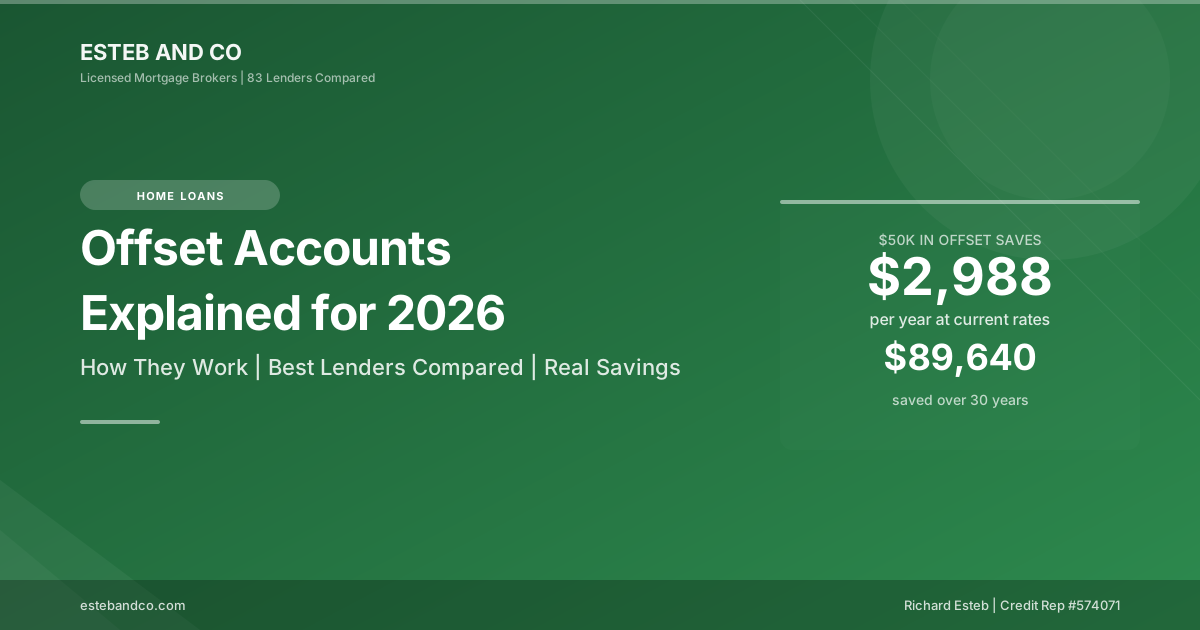
Let’s say you have a $693,801 loan at 5.99%. Without an offset, your monthly interest is approximately $3,463. Now park $50,000 in your offset. Your interest is now calculated on $643,801, bringing monthly interest down to roughly $3,214. That’s a saving of $249 every month — or $2,988 per year — just by having your savings sit in the right account.
You’re not locking the money away. You can spend it, transfer it, withdraw it at an ATM. The offset benefit simply adjusts daily based on whatever balance is in there. Money in on Monday, interest benefit starts Monday. Money out on Friday, benefit stops Friday. It’s completely liquid.
How Much Can an Offset Account Save You?
I ran the numbers this week using the current average loan size of $693,801 and a rate of 5.99% (around where the major banks sit right now with the RBA cash rate at 4.10%). Here’s what different offset balances save you:
| Offset Balance | Monthly Interest Saved | Annual Saving | 30-Year Total Saving | Loan Shortened By |
|---|---|---|---|---|
| $20,000 | $100 | $1,198 | $35,940 | ~1.5 years |
| $50,000 | $249 | $2,988 | $89,640 | ~3.5 years |
| $100,000 | $499 | $5,988 | $179,280 | ~7 years |
| $150,000 | $749 | $8,988 | $269,640 | ~10 years |
Based on $693,801 loan at 5.99% variable, P&I repayments, 30-year term. Assumes offset balance is maintained for full term. Actual savings will vary as rates change.
Look at those 30-year numbers. Keeping $100,000 in your offset — money you can access anytime — saves you nearly $180,000 in interest and cuts about 7 years off your loan. That’s not a rounding error. That’s a life-changing amount of money.
And here’s the part most people miss: unlike a savings account, the “return” from your offset is tax-free. A savings account paying 5.00% actually earns you around 3.25-3.75% after tax (depending on your marginal rate). Your offset gives you the full mortgage rate — currently 5.99% at the majors — with zero tax. For high-income earners paying the 45% marginal rate, you’d need a savings account paying over 10.89% to match a 5.99% offset. That account doesn’t exist.
Offset vs Redraw: What’s the Difference?
I get asked this question constantly, and the distinction matters more than most people realise — especially for property investors.
Both offset and redraw reduce the interest you pay. But they work differently, and the ATO treats them very differently.
| Feature | Offset Account | Redraw Facility |
|---|---|---|
| How it works | Separate transaction account linked to loan | Extra repayments sit inside the loan itself |
| Access to funds | Instant — debit card, BPAY, transfer | Usually via app/online, may take 1-2 days |
| Daily interest benefit | Yes | Yes |
| Tax treatment (investors) | Loan deductibility preserved | May reduce deductibility if redrawn for personal use |
| Lender can restrict access | No — it’s your bank account | Yes — some lenders can freeze redraw |
| Fees | Some loans charge a monthly or annual fee | Usually free |
| Available on fixed loans | Rarely | Sometimes (with limits) |
The investor trap
This is the big one. If you have an investment property loan and you make extra repayments into the loan (building up a redraw balance), then later redraw that money to buy a car or go on holiday, the ATO considers that redrawn amount a new borrowing for personal purposes. You lose the tax deduction on that portion of the interest.
With an offset account, this problem doesn’t exist. Your savings sit in a separate account. The loan balance never changes. So when you withdraw money from the offset for personal use, your investment loan deductibility stays intact.
If you own an investment property, use an offset account — not redraw. This is one of the most common and costly mistakes I see investors make, and their accountants are usually the ones who catch it at tax time.
For owner-occupiers with no investment angle, the difference is less critical. Redraw works fine and most lenders offer it for free. But I still prefer offset for the flexibility and the fact that your lender cannot restrict access to it — during COVID, several lenders temporarily froze redraw access on some loan products. Your offset balance is always yours.
Best Offset Account Home Loans in 2026
Not all offset accounts are equal. Some lenders charge monthly fees for the privilege, some restrict you to one offset account, and some bury the offset option in their premium “packaged” loan products. I went through our panel this week and pulled the best options.
These are owner-occupier, principal and interest variable rates as of March 2026:
| Lender | Variable Rate | Comparison Rate | Offset Type | Notes |
|---|---|---|---|---|
| Ubank | 5.69% | 5.72% | 100% | Max 80% LVR; low fees |
| loans.com.au | 5.74% | 5.76% | 100% | Online only; very low fees |
| ING | 5.79% | 5.82% | 100% | No monthly fees; salary deposit required |
| Great Southern | 5.79% | 5.85% | 100% | Regional lender; personal service |
| AMP | 5.84% | 5.96% | 100% | Package rate; annual fee applies |
| Newcastle Perm | 5.84% | 5.90% | 100% | Credit union; competitive fees |
| Beyond Bank | 5.84% | 5.90% | 100% | Mutual bank; no annual fee |
| IMB | 5.84% | 5.90% | 100% | Mutual bank; Illawarra-based |
| Macquarie | 5.85% | 5.92% | 100% | Sharp rates; strong digital platform |
| Bankwest | 5.89% | 5.96% | 100% | CBA-backed; no annual fee on basic |
| Heritage | 5.89% | 5.95% | 100% | QLD mutual; no ongoing fees |
| Resimac | 5.89% | 6.05% | 100% | Non-bank; flexible lending criteria |
| Suncorp | 5.89% | 6.05% | 100% | Package product; branch network |
| BOQ | 5.89% | 6.05% | 100% | Regional bank; package discounts |
| St George | 5.94% | 6.10% | 100% | Westpac group; strong in NSW |
| Bendigo | 5.94% | 6.10% | 100% | Community bank; branch access |
| CBA | 5.99% | 6.15% | 100% | Largest branch network; cashback deals |
| NAB | 5.99% | 6.12% | 100% | Rate negotiation possible; package rates |
| Westpac | 5.99% | 6.20% | 100% | Package discounts for multi-product |
| ANZ | 6.04% | 6.18% | 100% | Investment bundle discounts |
| Liberty | 6.29% | 6.55% | 100% | Flexible policy; suits non-standard borrowers |
Rates are indicative only and subject to change. Your actual rate depends on your LVR, loan amount, and circumstances. Information current as of March 2026.
Notable lenders WITHOUT offset
Some competitive lenders on our panel don’t offer offset accounts at all:
- Athena — 5.69% variable. Lowest rate on our panel, but no offset. Uses redraw only.
- Firstmac — 5.69% variable. Online lender, no offset. Redraw available.
- Pepper Money — 6.49% variable. Specialist lender for non-standard borrowers.
- La Trobe — 6.59% variable. Specialist/non-conforming lender.
- Bluestone — 6.79% variable. Bad credit specialist.
So the question becomes: is a 5.69% rate without offset better than, say, ING at 5.79% with offset? That depends entirely on your savings balance — and I’ll show you the maths in the next section.
Find the Best Offset Loan for Your Situation
We'll compare offset account loans across 50 lenders and show you exactly how much you could save.
Get Matched Now →Complimentary assessment — we compare 50 lenders and get paid by them, not you.
When an Offset Account Is (and Isn’t) Worth It
An offset account isn’t always the right move. I’ve talked clients out of paying extra for one when the numbers didn’t add up. Here’s how I assess it.
An offset is worth it when:
- You can maintain a balance above $20,000-$30,000. At 5.99%, a $30,000 offset balance saves you $1,797 per year. If the offset loan costs you an extra 0.10-0.15% in rate or $300-$400 in annual fees, you’re well ahead.
- You’re a property investor. The tax deductibility advantage of offset over redraw is clear-cut. If you have any investment debt, offset should be non-negotiable.
- You have irregular income. Self-employed borrowers, commission earners, or anyone whose income fluctuates benefit from having a large buffer sitting in offset rather than locked into extra loan repayments.
- You’re saving for something specific. Instead of putting your house deposit savings, renovation fund, or emergency fund into a savings account earning a taxable 4-5%, park it in offset and earn your mortgage rate tax-free.
- You want to pay off your mortgage faster without committing. Extra repayments into the loan are hard to get back (redraw restrictions, lender policies). Money in offset is always accessible.
An offset probably isn’t worth it when:
- Your savings balance is consistently below $10,000. The interest saving on $10,000 at 5.99% is about $599 per year. If the offset product costs $250-$400 more in annual fees or a rate loading, the net benefit is marginal.
- The rate premium is too high. Some lenders charge 0.30-0.40% more for their offset product. On a $693,801 loan, that’s $2,081-$2,775 per year extra. You’d need to maintain an offset balance above $35,000-$46,000 just to break even.
- You’re on a tight budget and every dollar goes to bills. If your account balance is essentially zero by payday each fortnight, offset adds complexity without meaningful benefit.
- You’re on a fixed rate. Most fixed rate loans don’t offer offset. If you’ve fixed your entire loan, offset isn’t an option. Consider splitting part to variable if you want offset access.
The break-even calculation
Here’s the simple formula I use with clients. Compare the no-offset loan (lower rate, no fees) against the offset loan (slightly higher rate or fees). The offset loan is worth it when:
Interest saved on your offset balance > extra cost of the offset product (rate premium + fees)
Example: Athena at 5.69% (no offset) versus ING at 5.79% (with offset). The 0.10% rate premium on $693,801 costs you $694 per year. At 5.79%, a $12,000 offset balance saves you $694 — so anything above $12,000 in the account and ING wins. If you typically keep $30,000-$50,000 in savings, the offset loan saves you significantly more despite the higher headline rate.
How to Maximise Your Offset
Having an offset account is step one. Using it properly is where the real savings come from. Here are the strategies I walk my clients through.
1. Credit your salary directly into the offset
This is the single most impactful thing you can do. Every dollar of your salary starts reducing your mortgage interest from the moment it hits the account. Even though you’ll spend most of it during the month on bills and living expenses, the money is earning you a return for every day it sits there.
On a household income of $150,000 with expenses of $8,000 per month, your offset balance fluctuates between roughly $4,500 (just before payday) and $17,000 (just after payday). The average daily balance might be around $10,000-$12,000 — saving you $600-$720 per year in interest that you’d otherwise miss if your salary went into a regular transaction account.
2. Consolidate all savings into one offset
I see clients with $15,000 in a savings account, $8,000 in a term deposit, and $5,000 in another transaction account — while their offset sits at $3,000. Move it all into the offset. That $28,000 combined balance saves you $1,677 per year at 5.99%. The savings account is probably earning you 4.5% before tax — which after tax at the 37% marginal rate is 2.84%. The offset gives you 5.99%, tax-free. It’s not even close.
3. Avoid multiple offset accounts unless you need them
Some lenders let you open 2, 5, or even 10 offset accounts. That can be useful for budgeting (one for bills, one for savings, one for holidays). But if your lender charges a monthly fee per offset account — and some charge $10-$15 per account — the costs add up. Keep it simple unless you have a specific reason to separate funds.
4. Use a credit card for daily spending (and pay it off in full)
This is an advanced strategy but it works brilliantly. Put your everyday spending on a credit card with up to 55 days interest-free. Your cash stays in the offset for an extra 30-55 days compared to paying directly from the offset. On $4,000 monthly spending, that extra float in offset saves roughly $100-$150 per year. It only works if you pay the card in full every month — credit card interest at 20%+ will obliterate any offset benefit.
5. Park lumps sums temporarily
Received a tax refund, bonus, inheritance, or sold an asset? Even if you plan to spend the money in 3-6 months, park it in offset in the meantime. A $20,000 lump sum sitting in offset for just 6 months saves you $599 in interest. That’s free money for doing nothing except choosing the right account.
6. Review regularly
As your offset balance grows and your loan shrinks, there comes a point where the offset is covering a significant portion of your loan. If your offset balance reaches 30-40% of your remaining loan, you’re in an incredibly strong position. At that point, I’d review whether you’re better off making a lump sum payment to reduce the principal outright — especially if you’re not an investor and tax deductibility isn’t a factor.
Frequently Asked Questions
What is a mortgage offset account?
A mortgage offset account is a transaction account linked to your home loan that reduces the interest you pay. The balance in the offset is subtracted from your loan principal when calculating daily interest. You can use it as your everyday transaction account — deposit salary, pay bills, withdraw cash — and every dollar in the account saves you interest at your home loan rate.
How much can an offset account save me?
On the average Australian loan of $693,801 at 5.99%, keeping $50,000 in your offset saves approximately $2,988 per year in interest. Over 30 years, that same $50,000 balance saves around $89,640 in total interest and shortens your loan by roughly 3.5 years. The more you keep in offset, the more you save.
Is an offset account better than a redraw facility?
For investors, yes — offset is generally superior because the ATO treats them differently for tax deduction purposes. With offset, your loan balance stays the same and deductibility is preserved. With redraw, if you withdraw funds for personal use, the ATO may consider it a new borrowing and reduce your interest deductions. For owner-occupiers with no investment considerations, the practical difference is smaller, but offset still offers better liquidity and access.
Do all lenders offer offset accounts?
No. Of our 83-lender panel, around 50 offer offset accounts. Notable lenders without offset include Pepper Money, La Trobe, Bluestone, Athena, and Firstmac. Some of these lenders offer very competitive rates, so it’s worth calculating whether the lower rate or the offset feature saves you more based on your typical savings balance.
Is it worth paying a higher rate for an offset account?
Generally yes, if you can maintain a balance above $20,000-$30,000. The interest saved on a $30,000 balance at 5.99% is $1,797 per year. If the rate premium for an offset product is 0.10-0.20%, the extra cost on a $693,801 loan is $694-$1,388 per year — so you come out ahead with a balance above roughly $12,000-$23,000 depending on the premium.
Your Next Step
If you’re sitting on savings in a transaction account or a savings account earning a taxable 4-5%, you’re leaving money on the table. An offset account linked to your mortgage gives you a guaranteed, tax-free return at your mortgage rate — currently 5.79-5.99% with the best lenders on our panel.
The right offset loan depends on your savings balance, your loan size, whether you’re an investor, and whether the rate and fee structure of the offset product makes sense for your numbers. That’s exactly what we help clients figure out every day.
You can start a free comparison and we’ll match you with the best offset loans from our 83-lender panel. No cost to start, no obligation — we get paid by the lender, not you.
See where you stand
Compare your options across our panel of 50 lenders in about 2 minutes. Free, and it won’t affect your credit score.
Start complimentary assessment →No obligation · Richard Esteb, Credit Rep #574071
Richard Esteb
Ricky founded Esteb & Co to give everyday Australians access to the same loan comparison technology used by the big banks. He compares products from a panel of 50 lenders to find the right fit for each client’s situation.