Wage Growth vs Mortgage Costs 2026: Are Australians Falling Behind?

In this article
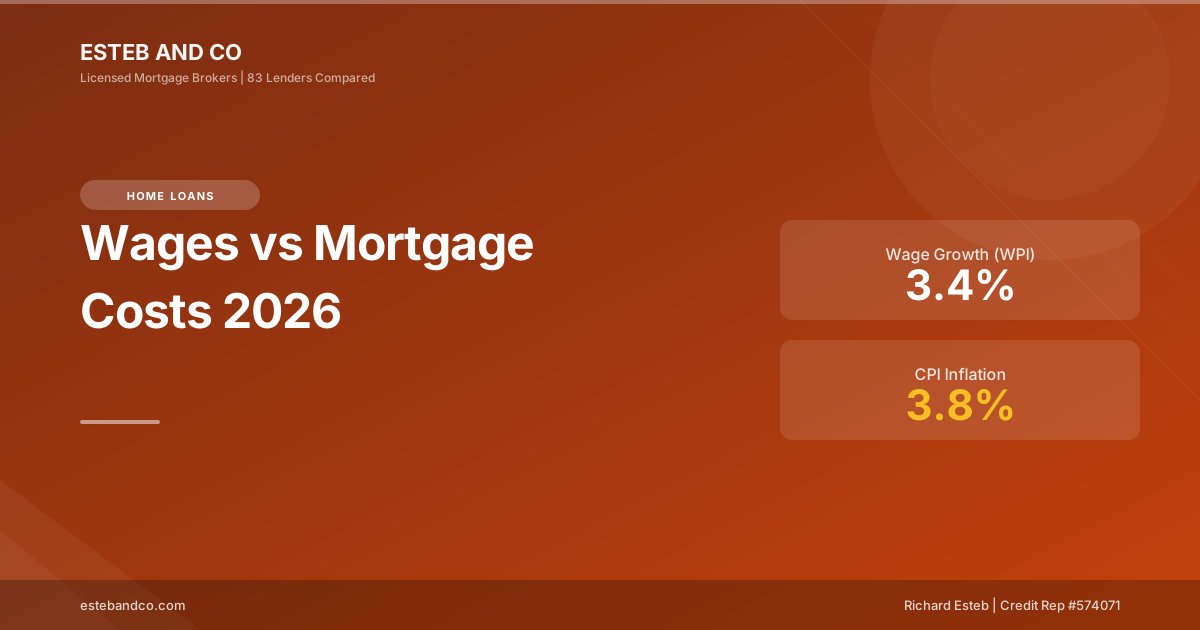
The Wage-Inflation Squeeze: Wages 3.4% vs CPI 3.8%
Here’s a number that should concern every Australian borrower: wages are growing at 3.4% per year, while the cost of living is rising at 3.8%. That gap of 0.4% might sound small, but it means real wages — what your pay actually buys — are going backwards.
The latest ABS Wage Price Index (WPI) for the December quarter 2025 shows:
- Annual wage growth: 3.4%
- Quarterly wage growth: 0.8%
- Private sector: 3.3% annual
- Public sector: 3.6% annual
Meanwhile, the ABS Consumer Price Index (CPI) for the same quarter came in at 3.8% annual headline, with trimmed mean at 3.3%. Your pay rise isn’t even covering the grocery bill, let alone the mortgage increase.
For every dollar of pay rise you received in 2025, inflation ate $1.12 of it. You’re not imagining it — you really are worse off.
How Mortgage Costs Have Outpaced Wage Growth
While wages have grown moderately, mortgage costs have gone through the roof. Here’s the mismatch since the RBA started hiking in May 2022:
| Metric | May 2022 | March 2026 | Change |
|---|---|---|---|
| Cash rate | 0.10% | 3.85% | +3,750% |
| Avg variable rate | ~2.50% | 5.49% | +120% |
| Monthly repayment ($693k) | ~$2,440 | $3,935 | +$1,495 (+61%) |
| Annual wages (WPI) | Base | +~13% | +13% |
| Consumer prices (CPI) | Base | +~18% | +18% |
The numbers are stark. Mortgage repayments on an average loan have risen 61% since early 2022, while wages have risen only about 13%. That’s a gap of nearly 50 percentage points. No amount of budgeting covers that kind of divergence without either increasing income, reducing the mortgage cost, or cutting spending elsewhere.
The monthly impact on household budgets
For a household on the median income of approximately $72,000 (roughly $4,670/month after tax), the mortgage on an average $693,801 loan now consumes 84% of one full-time income. In early 2022, it was closer to 52%. That’s a massive shift in affordability.
For dual-income households, the picture is less dire but still challenging. Two median earners bring home roughly $9,340 after tax. Mortgage repayments of $3,935 represent 42% of combined income — above the 30% threshold that financial advisers consider comfortable.
Wage Growth by Sector — Who’s Doing Better?
Not all workers are feeling the squeeze equally. ABS data shows significant variation in wage growth across industries:
| Sector | Annual Wage Growth | vs CPI (3.8%) |
|---|---|---|
| Healthcare & Social Assistance | 4.2% | +0.4% (ahead) |
| Education & Training | 4.0% | +0.2% (ahead) |
| Public Administration | 3.8% | Even |
| Construction | 3.6% | -0.2% (behind) |
| Professional Services | 3.3% | -0.5% (behind) |
| Retail Trade | 3.1% | -0.7% (behind) |
| Accommodation & Food | 2.9% | -0.9% (behind) |
Workers in healthcare and education are just about keeping pace with inflation, thanks largely to enterprise bargaining agreements and government-funded pay increases. But if you work in retail, hospitality, or professional services, your real wages are declining meaningfully.
For mortgage borrowers in lower-growth sectors, the squeeze is particularly acute. A retail worker whose wages grew 3.1% while their mortgage costs jumped $109/month from the February rate hike faces genuinely difficult budgeting decisions.
The RBA’s Dilemma: Wages, Inflation, and Rates
Here’s the cruel irony of the current situation: the RBA is raising rates partly because of wage growth, even though that wage growth isn’t keeping up with inflation.
From the RBA’s perspective, wages growing at 3.4% with productivity growth near zero means unit labour costs are rising. This feeds into services inflation — businesses pass higher wage costs through as higher prices. The RBA sees this as a risk that inflation becomes entrenched above the 2-3% target.
But from a borrower’s perspective, 3.4% wage growth feels inadequate. After inflation takes its cut, there’s nothing left to absorb higher mortgage costs. It’s a classic squeeze from both sides: the RBA tightens because wages are “too high” for the inflation target, while borrowers feel wages are too low for the cost of living.
What needs to happen for relief
For borrowers, the best scenario is one where:
- Inflation drops towards 2.5-3.0% (allowing the RBA to cut rates)
- Wage growth holds steady at 3.0-3.5% (so real wages finally turn positive)
- Productivity improves (allowing both outcomes simultaneously)
The March quarter CPI data (due late April) will be the next major signal. If trimmed mean inflation drops materially below 3.3%, the case for rate cuts later in 2026 strengthens considerably.
Mortgage Stress Indicators
When wages don’t keep up with mortgage costs, mortgage stress follows. Here are the key indicators we’re watching:
- Mortgage repayments above 30% of income: Roughly 1 in 3 Australian mortgage holders now spend more than 30% of gross income on repayments, up from about 1 in 5 pre-pandemic
- Refinancing volumes: ABS data shows lending for refinancing remains elevated as borrowers actively seek lower rates — a sign that people are feeling the pinch
- Hardship applications: Banks report a gradual increase in hardship arrangements, though levels remain below the pandemic peak
- Savings buffers declining: The average mortgage offset/savings buffer has been drawn down over the past 12 months as households use reserves to absorb higher costs
The good news: Australia hasn’t seen a material spike in mortgage defaults. Strong employment (4.1% unemployment) is the main buffer — as long as people have jobs, most find a way to manage. The risk emerges if unemployment rises at the same time as rates stay high.
What Borrowers Can Do to Close the Gap
You can’t control inflation or the RBA, but there are practical steps to reduce the gap between your income and your mortgage costs:
1. Refinance — the single biggest lever
If you haven’t reviewed your home loan in the past 12 months, you’re almost certainly paying more than you need to. The average spread between what existing borrowers pay and the best available rates is 0.5-1.0%.
On the national average loan of $693,801:
- 0.5% saving: $215/month ($2,580/year)
- 0.75% saving: $320/month ($3,840/year)
- 1.0% saving: $425/month ($5,100/year)
That $215-$425 per month in savings is worth more than most pay rises. And refinancing through a broker is complimentary — we get paid by lenders. Read our step-by-step refinancing guide.
2. Maximise your offset account
Every dollar in an offset account reduces the interest you pay. On a $700,000 loan at 5.49%, keeping $40,000 in an offset saves about $183 per month in interest. Consolidate all savings, transaction funds, and any other cash into your offset.
3. Consolidate expensive debt
If you’re carrying credit card debt (18-22% interest), personal loans (8-15%), or car loans (7-10%) alongside your mortgage, consolidating into your home loan rate (5.49%) can free up hundreds per month. Just be aware that stretching short-term debt over 30 years costs more in total interest — plan to pay the consolidated amount down faster.
4. Review your loan structure
Some borrowers are on interest-only loans that have reverted to principal and interest, causing a sudden repayment jump. Others are paying for features they don’t use (like a package fee for an unused credit card). A quick loan review can identify structural savings.
5. Consider a split fixed/variable arrangement
Fixing a portion of your loan locks in certainty for 1-3 years. With two-year fixed rates around 5.30-5.50%, you can protect against further hikes on part of your loan while keeping the rest variable with offset access. Read our fixed vs variable guide.
Frequently Asked Questions
Are wages keeping up with mortgage costs in 2026?
No. Wages are growing at 3.4% annually while CPI is at 3.8%, meaning real wages are declining. Mortgage costs have risen roughly 61% since the rate hiking cycle began in 2022, while wages have risen only about 13%. The gap between income growth and housing costs continues to widen.
What is the current wage growth rate in Australia?
The ABS Wage Price Index shows annual growth of 3.4% as of the December quarter 2025 (0.8% quarterly). Private sector wages grew 3.3% while public sector grew 3.6%. Healthcare and education are leading at 4.0-4.2%; retail and hospitality lag at 2.9-3.1%.
How much have mortgage repayments increased since 2022?
Monthly repayments on a $693,801 loan have increased from approximately $2,440 at the 2022 low to $3,935 at the current rate — an increase of $1,495/month or 61%. This far outstrips the ~13% wage growth over the same period.
What can borrowers do if wages aren’t keeping up?
The biggest lever is refinancing. Most borrowers who haven’t reviewed their loan in 12+ months are paying 0.5-1.0% more than necessary. On a $693,801 loan, a 0.5% rate reduction saves $215/month — equivalent to a 3.5% pay rise after tax. Refinancing through a broker is complimentary.
See where you stand
Compare your options across our panel of 50 lenders in about 2 minutes. Free, and it won’t affect your credit score.
Start complimentary assessment →No obligation · Richard Esteb, Credit Rep #574071
Richard Esteb
Ricky founded Esteb & Co to give everyday Australians access to the same loan comparison technology used by the big banks. He compares products from a panel of 50 lenders to find the right fit for each client’s situation.