Finance Broker vs Bank: Why It Matters in 2026

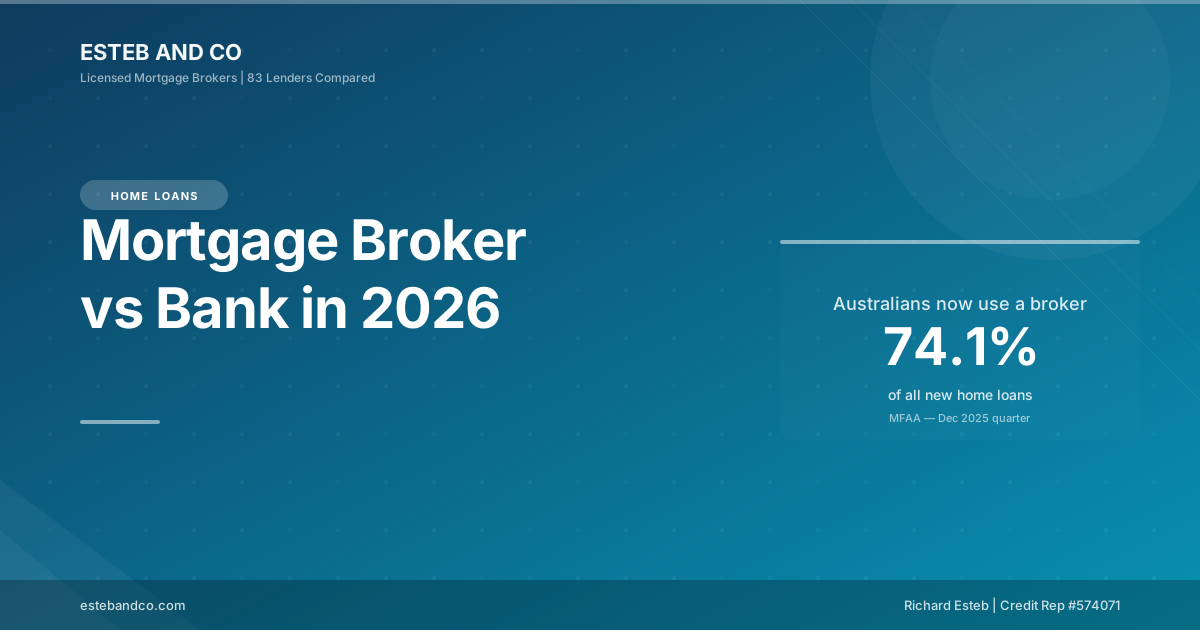
74.1% of Australians Now Use a Broker
I'm going to be upfront: I'm a finance broker, so you'd expect me to advocate for using one. But I'm also going to give you the honest picture of when going direct to a bank makes more sense. That said, the numbers speak for themselves.
The MFAA's latest Industry Intelligence Service report (December 2025) shows that 74.1% of all new residential home loans in Australia were written through finance brokers. That's the highest figure ever recorded, up from 71.6% in December 2024 and 69.8% in December 2023.
Three quarters of Australians are choosing a broker over going direct to a bank. That's not a coincidence - it's because the broker model offers genuine advantages for most borrowers. But let me explain exactly how it works so you can decide for yourself.
How Finance Brokers Work vs Banks
The fundamental difference is simple: a bank sells its own products. A broker compares products from many lenders and recommends the best fit for you.
Going to a bank
When you walk into a CBA branch and ask about a home loan, the person you speak to can only offer CBA products. They can't tell you that NAB has a better rate for your situation, or that Macquarie's servicing calculator would approve you for $80,000 more. They're not being dishonest - they literally can't access other lenders' products. It's like asking a Toyota dealer which car brand is best.
Using a finance broker
A broker has access to a panel of lenders - typically 30 to 80+. We submit your application to the lender whose product, rate, and policies best suit your situation. We handle the paperwork, chase the lender for updates, negotiate on your behalf, and manage the process through to settlement.
At Esteb and Co, our panel includes 50 lenders: all four major banks, regional banks like Bankwest and Bank of Queensland, online lenders like ING and Athena, and specialist lenders like Pepper Money and Liberty for borrowers with non-standard situations.
The Cost Comparison: Broker vs Direct
This is the question everyone asks, and the answer surprises most people: using a broker is complimentary. The rate you get through a broker is the same as - or often better than - going direct.
| Factor | Finance Broker | Going Direct to Bank |
|---|---|---|
| Cost to you | $0 (paid by lender) | $0 |
| Interest rate | Same or better (brokers negotiate) | Standard advertised rate (may negotiate) |
| Number of lenders compared | 30-83+ (depends on panel) | 1 (their own products only) |
| Product range | Hundreds of products across panel | 8-15 products from one lender |
| Legal obligation to you | Best Interests Duty (legally must act in your interest) | No equivalent obligation |
| Application support | Full paperwork assistance, chasing lender | Varies by branch/banker |
| After-settlement support | Ongoing rate monitoring, refinance advice | Typically limited unless you ask |
| Specialist situations | Access to non-conforming lenders | Limited to bank's own credit policy |
The reason brokers can offer the same or better rates is that lenders want broker business - brokers send them high volumes of quality applications. Many lenders offer broker-exclusive rates or cashback offers that aren't available in-branch.
How Finance Brokers Get Paid
Full transparency - this is how I earn my living, and I think every borrower should understand it:
Upfront commission
When your loan settles, the lender pays the broker an upfront commission. This is typically 0.50% to 0.70% of the loan amount (excluding any offset balance). On a $600,000 loan, that's $3,000-$4,200. This commission is paid once, at settlement.
Trail commission
The lender also pays a smaller ongoing "trail" commission - typically 0.15% to 0.20% per year of the remaining loan balance, paid monthly. On a $600,000 loan, that's roughly $75-$100 per month. This commission continues for the life of the loan (or until you refinance elsewhere).
Why trail commission exists
Trail commission aligns the broker's incentive with yours. Because I receive trail for as long as you stay with that lender, I'm motivated to put you with a lender you'll be happy with long-term - not just one that pays the highest upfront commission. If I put you in a bad product and you leave in 6 months, I earn almost no trail.
It also means I have a financial incentive to check in on you periodically, make sure your rate is still competitive, and alert you when it's time to refinance. A bank employee has no such incentive - once you've signed, their job is done.
Does the commission affect the rate?
No. The commission comes from the lender's margin - it doesn't get added to your interest rate. ASIC has investigated this extensively and confirmed that broker rates are comparable to or better than direct rates. Under the Best Interests Duty, I can't recommend a lender purely because they pay a higher commission.
The Best Interests Duty: Your Legal Protection
Since January 2021, Australian finance brokers have operated under a legal Best Interests Duty (BID). This means:
- I must prioritise your interests ahead of my own commercial interests
- I must consider a range of products from my panel that could suit your needs
- I must recommend a product that is "not unsuitable" for your circumstances
- I must document why I recommended a particular lender and product
- If two lenders are equally suitable but one pays me more, I must disclose this
This duty does not apply to bank staff. A CBA lender has no legal obligation to tell you that NAB has a better product for your situation. They can only offer CBA products, and they're assessed on how many CBA products they sell. There's no equivalent consumer protection when you go direct.
When a Broker Is Better
A broker adds the most value in these situations:
You're a first home buyer. You don't know what you don't know. A broker guides you through the entire process, explains the jargon, and makes sure you access every grant and scheme available.
You're self-employed. Different lenders have wildly different policies on self-employed income. Some want 2 years of tax returns, others accept 1 year, and some will use BAS statements or accountant letters. A broker knows which lender's policy fits your income structure.
You have credit issues. Your bank will likely say no. A broker has access to specialist non-conforming lenders who exist specifically for credit-impaired borrowers.
You want the best rate. Comparing rates across 50 lenders beats comparing rates across 1 lender. We also know which lenders are offering cashback deals, fee waivers, and broker-exclusive pricing that isn't advertised.
You're refinancing. Your current bank's "retention offer" is often not the best available. A broker can show you exactly what the market offers and whether switching saves you money (after accounting for exit fees and cashback).
You're buying an investment property. Investment lending has tighter rules and wider rate variations between lenders. A broker ensures you're not paying an unnecessary premium.
Your situation is complex. Multiple income sources, unusual employment, guarantor loans, construction loans, SMSF purchases - these all require matching your situation to the right lender's policy. A broker does this matching daily.
When Going Direct Makes Sense
I'll be honest about when a broker might not add value:
You have a private banker. If you have a genuine private banking relationship with $500K+ in deposits or investments, your banker can often negotiate pricing that brokers can't access. This is genuine relationship pricing, not just a retention offer.
Your employer has a corporate deal. Some large employers negotiate special rates with specific banks (police, nurses, teachers, public servants). These deals can be excellent and aren't available through brokers.
You want a specific credit union or mutual. Some smaller credit unions and building societies don't work with brokers. If your local credit union offers the best rate, go direct.
You're refinancing with a strong retention offer. If your current lender offers a rate cut to keep you, and that rate genuinely matches the market, staying put avoids the hassle of switching. But verify it against what a broker can offer first - retention teams often have room to move further.
Broker vs Bank: Side-by-Side Comparison
Let me give you a concrete scenario. A couple earning $150,000 combined, 20% deposit, buying a $700,000 home (so $560,000 loan), clean credit, PAYG employed:
| Scenario | Going Direct to Their Bank (CBA) | Using a Broker |
|---|---|---|
| Rate offered | 6.14% (standard) | 5.79% (Macquarie via broker channel) |
| Monthly repayment | $3,411 | $3,284 |
| Monthly saving | - | $127/month |
| Annual saving | - | $1,524/year |
| Saving over 5 years | - | $7,620 |
| Saving over 30 years | - | $45,720 |
| Cost of broker | N/A | $0 (paid by Macquarie) |
| Borrowing power | $620,000 | $700,000 (Macquarie's calculator) |
Rates are indicative only. Actual rates depend on your individual circumstances. Information current as of February 2026.
In this real-world scenario, the broker saved the client $127/month, increased their borrowing power by $80,000, and it cost them nothing. The bank would never have told them about Macquarie's rate - because the bank can't access it.
How to Choose a Good Broker
Not all brokers are equal. Here's what to look for:
Panel size. A broker with 20 lenders on their panel has fewer options than one with 80+. Ask how many lenders they compare.
Specialisation. Some brokers focus on first home buyers, others on investors, others on complex situations. Choose a broker whose expertise matches your needs.
ASIC registration. Every legitimate broker must be an ASIC-registered credit representative. You can verify registration on the ASIC Connect register.
Communication. Your broker should explain things in plain language, respond promptly, and proactively update you through the process. If they can't explain why they're recommending a particular lender, find a different broker.
Reviews and referrals. Ask for testimonials or check Google Reviews. A good broker's best marketing is their existing clients.
Technology. Modern brokers use digital tools to streamline the application process, compare rates in real-time, and keep you updated. If your broker is still faxing documents, it might be time to upgrade.
Frequently Asked Questions
Do finance brokers charge a fee?
No. In Australia, finance brokers are paid by the lender, not by you. The broker receives an upfront commission (typically 0.5-0.7% of the loan amount) and an ongoing trail commission (typically 0.15-0.20% per year). This means using a broker costs you nothing - the rate you get through a broker is the same or often better than going direct to the bank.
How many lenders does a finance broker compare?
This varies by broker. Large aggregator-backed brokers typically have panels of 30-50 lenders. At Esteb and Co, we compare 50 lenders including all four major banks, regional banks, online lenders, and specialist non-conforming lenders. A bank, by comparison, only offers its own products.
Is the rate better through a broker or going direct?
Brokers typically get the same or better rates than walking into a branch. Many lenders offer broker-exclusive pricing. Under the Best Interests Duty, brokers are legally required to recommend a loan that's in your best interest, not just the one that pays them the highest commission.
What is the Best Interests Duty for finance brokers?
Since January 2021, Australian finance brokers have been legally required to act in their client's best interests. The broker must prioritise your needs over their own commercial interests. This duty doesn't apply to bank staff - they have no obligation to tell you about a better deal at a competitor.
When should I go direct to a bank instead of using a broker?
Going direct makes sense if you have a private banker offering genuine relationship pricing, your employer has a corporate deal with a specific bank, or you want a product from a lender not on any broker's panel. For most borrowers, a broker gives you more options, better comparison, and expert guidance at no cost.
How do finance brokers get paid?
Brokers receive an upfront commission (typically 0.5-0.7% of the loan amount, paid at settlement) and a trail commission (typically 0.15-0.20% per year, paid monthly for the loan's life). On a $600,000 loan, the upfront is roughly $3,000-$4,200 and the trail is roughly $900-$1,200 per year. These commissions come from the lender - you don't pay anything.
Your Next Step
Whether you use a broker or go direct, the most important thing is to compare. Accepting the first rate you're offered - from anyone - is leaving money on the table.
If you want to see what a broker can do for you, get in touch. We'll compare your situation across 50 lenders, show you exactly what you qualify for, and explain why we're recommending each option. No obligation, no pressure, and it costs you nothing.
See where you stand
Compare your options across our panel of 50 lenders in about 2 minutes. Free, and it won’t affect your credit score.
Start complimentary assessment →No obligation · Richard Esteb, Credit Rep #574071
Richard Esteb
Ricky founded Esteb & Co to give everyday Australians access to the same loan comparison technology used by the big banks. He compares products from a panel of 50 lenders to find the right fit for each client’s situation.